Plants and Photosynthesis
Basic Parts
Stem – used for transport and support, they have lots of xylem and phloem.
Flower – essential for pollination and reproduction, they are brightly coloured and scented
to attract bees.
Leaf – they absorb light for photosynthesis, having a large surface area which is packed with
chlorophyll.
Root – they absorb water and minerals, made up of lots of root hair cells and have a large
surface area.
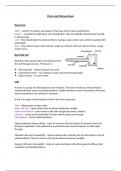
Root Hair Cell
Root hair cells absorb water and minerals from
the soil through osmosis. They have a:
Thin Cell Wall – shorter distance to travel
Large Surface Area – for maximum water and nutrient absorption
Large Vacuole – to store water
Leaf
A tissue is a group of cells doing the same function. The leaf is made up of these tissues:
Mesophyll tissue carries out photosynthesis. Epidermal tissue covers and protects the plant.
Xylem and phloem are involved in transport.
A leaf is an organ which produces food in the form of glucose.
Thin – allows gases to pass easily.
Wide and Flat – large surface area to absorb maximum sunlight.
Xylem and Phloem – carry water to the cells and glucose away, support.
Stomata – pores on the underside of leaves which gases pass through
Chloroplasts – lots for photosynthesis
Upper Epidermis (waxy cuticle) – layer of wax over the leaf surface to prevent water loss
through evaporation. The epidermis is a protective layer but transparent to allow light
through.
Palisade Cell Layer (mesophyll) – closely packed cells, meaning lots of chlorophyll so lots of
photosynthesis. They are close to the top to absorb maximum sunlight.
Spongy Cell Layer (mesophyll) – large air spaces between cells allow gases to diffuse from
respiration and photosynthesis.
, Xylem of Vascular Bundle (vein) – these are transport vessels for water and minerals; from
roots to leaves. The cell walls are made of lignin which gives the tube its structure.
Phloem of Vascular Bundle (vein) – transport vessel for sugar from leaves to root.
Stomata (lower epidermis) – mainly on underside of leaf, they are tiny holes that gases pass
through. However, some water still escapes. If the stomata were on the top of the leaf,
there would be more sun exposure, so a faster rate of evaporation.
Guard Cells – these surround each stomata and can open and close it.
Lower Epidermis (cuticle) – this layer is transparent and has lots of stomata.
Xylem
The xylem and phloem are arranged in the centre of the root, to strengthen the root against
being pulled out of the ground.
Xylem vessels are involved in the movement of water through a plant, from roots to stem to
leaves. Water is absorbed from the soil through root hair cells by osmosis until it reaches
the xylem. It evaporates from the leaves – transpiration. The xylem tubes are made from
dead xylem cells, which have, without their cell walls, formed tubes through which the
water and dissolved minerals can flow. The rest of the xylem cell has a thick reinforced cell
wall which provides strength.
Phloem
Basic Parts
Stem – used for transport and support, they have lots of xylem and phloem.
Flower – essential for pollination and reproduction, they are brightly coloured and scented
to attract bees.
Leaf – they absorb light for photosynthesis, having a large surface area which is packed with
chlorophyll.
Root – they absorb water and minerals, made up of lots of root hair cells and have a large
surface area.
Root Hair Cell
Root hair cells absorb water and minerals from
the soil through osmosis. They have a:
Thin Cell Wall – shorter distance to travel
Large Surface Area – for maximum water and nutrient absorption
Large Vacuole – to store water
Leaf
A tissue is a group of cells doing the same function. The leaf is made up of these tissues:
Mesophyll tissue carries out photosynthesis. Epidermal tissue covers and protects the plant.
Xylem and phloem are involved in transport.
A leaf is an organ which produces food in the form of glucose.
Thin – allows gases to pass easily.
Wide and Flat – large surface area to absorb maximum sunlight.
Xylem and Phloem – carry water to the cells and glucose away, support.
Stomata – pores on the underside of leaves which gases pass through
Chloroplasts – lots for photosynthesis
Upper Epidermis (waxy cuticle) – layer of wax over the leaf surface to prevent water loss
through evaporation. The epidermis is a protective layer but transparent to allow light
through.
Palisade Cell Layer (mesophyll) – closely packed cells, meaning lots of chlorophyll so lots of
photosynthesis. They are close to the top to absorb maximum sunlight.
Spongy Cell Layer (mesophyll) – large air spaces between cells allow gases to diffuse from
respiration and photosynthesis.
, Xylem of Vascular Bundle (vein) – these are transport vessels for water and minerals; from
roots to leaves. The cell walls are made of lignin which gives the tube its structure.
Phloem of Vascular Bundle (vein) – transport vessel for sugar from leaves to root.
Stomata (lower epidermis) – mainly on underside of leaf, they are tiny holes that gases pass
through. However, some water still escapes. If the stomata were on the top of the leaf,
there would be more sun exposure, so a faster rate of evaporation.
Guard Cells – these surround each stomata and can open and close it.
Lower Epidermis (cuticle) – this layer is transparent and has lots of stomata.
Xylem
The xylem and phloem are arranged in the centre of the root, to strengthen the root against
being pulled out of the ground.
Xylem vessels are involved in the movement of water through a plant, from roots to stem to
leaves. Water is absorbed from the soil through root hair cells by osmosis until it reaches
the xylem. It evaporates from the leaves – transpiration. The xylem tubes are made from
dead xylem cells, which have, without their cell walls, formed tubes through which the
water and dissolved minerals can flow. The rest of the xylem cell has a thick reinforced cell
wall which provides strength.
Phloem