Oxidative Phosphorylation
Stages of Oxidative Phosporylation
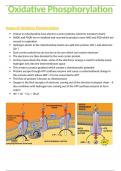
Cristae in mitochondria have electron carrier proteins (electron transport chain)
NADH and FADH are re-oxidised and recycled to produce more NAD and FAD which are
reused in respiration
Hydrogen atoms in the mitochondrial matrix are split into protons (2H⁺) and electrons
(2e⁻)
Each carrier protein has an iron ion at its core which can receive electrons
The electrons are then donated to the next carrier protein
As they move down the chain, some of the electrons’ energy is used to actively pump
hydrogen ions into the intermembrane space
This creates a proton gradient which creates a chemiosmotic potential
Protons escape through ATP synthase enzyme and cause a conformational change in
the enzyme which allows ADP + P to be converted to ATP
This flow of protons is known as chemiosmosis
Oxygen is the final receptor of electrons coming out of the electron transport chain – it
also combines with hydrogen ions coming out of the ATP synthase enzyme to form
water:
4H⁺ + 4e⁻ + O₂ -> 2H₂O
Stages of Oxidative Phosporylation
Cristae in mitochondria have electron carrier proteins (electron transport chain)
NADH and FADH are re-oxidised and recycled to produce more NAD and FAD which are
reused in respiration
Hydrogen atoms in the mitochondrial matrix are split into protons (2H⁺) and electrons
(2e⁻)
Each carrier protein has an iron ion at its core which can receive electrons
The electrons are then donated to the next carrier protein
As they move down the chain, some of the electrons’ energy is used to actively pump
hydrogen ions into the intermembrane space
This creates a proton gradient which creates a chemiosmotic potential
Protons escape through ATP synthase enzyme and cause a conformational change in
the enzyme which allows ADP + P to be converted to ATP
This flow of protons is known as chemiosmosis
Oxygen is the final receptor of electrons coming out of the electron transport chain – it
also combines with hydrogen ions coming out of the ATP synthase enzyme to form
water:
4H⁺ + 4e⁻ + O₂ -> 2H₂O