Animal Tissues
Epithelial Tissue
Covers and lines free surfaces in the body (e.g. skin, blood vessels, walls of organs)
Cells packed very close to each other and bound by lateral contacts to form continuous
sheets
No blood vessels in tissue – get nutrients by diffusion from tissue fluid
Short life cycles – divide regularly to replace worn or damaged cells
Some cells have cilia or microvilli
Functions: protection, absorption, filtration, excretion and secretion
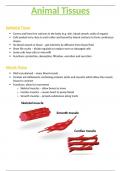
Muscle Tissue
Well vascularised – many blood vessels
Contain microfilaments containing proteins (actin and myosin) which allow the muscle
tissue to contract
Functions: allow for movement
o Skeletal muscles – allow bones to move
o Cardiac muscles – causes heart to pump blood
o Smooth muscles – propels substances along tracts
Epithelial Tissue
Covers and lines free surfaces in the body (e.g. skin, blood vessels, walls of organs)
Cells packed very close to each other and bound by lateral contacts to form continuous
sheets
No blood vessels in tissue – get nutrients by diffusion from tissue fluid
Short life cycles – divide regularly to replace worn or damaged cells
Some cells have cilia or microvilli
Functions: protection, absorption, filtration, excretion and secretion
Muscle Tissue
Well vascularised – many blood vessels
Contain microfilaments containing proteins (actin and myosin) which allow the muscle
tissue to contract
Functions: allow for movement
o Skeletal muscles – allow bones to move
o Cardiac muscles – causes heart to pump blood
o Smooth muscles – propels substances along tracts