Cell Organelles
Nucleus
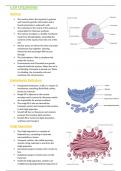
The nucleus stores the organism’s genome
and transmits genetic information and is
found exclusively in eukaryotic cells
The nucleolus in the centre of the nucleus is
responsible for ribosome synthesis
The nuclear envelope is a double membrane
made from phospholipids, separating the
contents of the nucleus from the rest of the
cell
Nuclear pores are where the inner and outer
membranes fuse together, allowing
ribosomes and messenger RNA to pass
through
The nucleoplasm is like a cytoplasm but
inside the nucleus
Chromosomes and Chromatin are genetic
material inside the nucleus. When the cell is
not dividing, chromatin is spread out. When
it is dividing, the chromatin coils and
condense into chromosomes
Endoplasmic Reticulum
Endoplasmic Reticulum, or ER, is a system of
membranes containing fluid-filled cavities
known as cisternae
Rough ER is adjacent to the nuclear
envelope and is covered in ribosomes which
are responsible for protein synthesis
The rough ER is also an intercellular
transport system and transports the proteins
to the Golgi apparatus
Smooth ER has no ribosomes and contains
enzymes that catalyse lipid reactions
Smooth ER is involved in lipid absorption,
synthesis and transport
Golgi Apparatus
The Golgi Apparatus is a complex of
flattened sacs, consisting of cisternae
surrounded by a lumen
Transport vesicles, also called secretory
vesicles, bring materials to and from the
Golgi apparatus
Incoming transport vesicles enter via the cis
face
Outgoing transport vesicles leave via the
trans face
Inside the Golgi apparatus, proteins are
modified and packaged before being sent of
Nucleus
The nucleus stores the organism’s genome
and transmits genetic information and is
found exclusively in eukaryotic cells
The nucleolus in the centre of the nucleus is
responsible for ribosome synthesis
The nuclear envelope is a double membrane
made from phospholipids, separating the
contents of the nucleus from the rest of the
cell
Nuclear pores are where the inner and outer
membranes fuse together, allowing
ribosomes and messenger RNA to pass
through
The nucleoplasm is like a cytoplasm but
inside the nucleus
Chromosomes and Chromatin are genetic
material inside the nucleus. When the cell is
not dividing, chromatin is spread out. When
it is dividing, the chromatin coils and
condense into chromosomes
Endoplasmic Reticulum
Endoplasmic Reticulum, or ER, is a system of
membranes containing fluid-filled cavities
known as cisternae
Rough ER is adjacent to the nuclear
envelope and is covered in ribosomes which
are responsible for protein synthesis
The rough ER is also an intercellular
transport system and transports the proteins
to the Golgi apparatus
Smooth ER has no ribosomes and contains
enzymes that catalyse lipid reactions
Smooth ER is involved in lipid absorption,
synthesis and transport
Golgi Apparatus
The Golgi Apparatus is a complex of
flattened sacs, consisting of cisternae
surrounded by a lumen
Transport vesicles, also called secretory
vesicles, bring materials to and from the
Golgi apparatus
Incoming transport vesicles enter via the cis
face
Outgoing transport vesicles leave via the
trans face
Inside the Golgi apparatus, proteins are
modified and packaged before being sent of