WGU D236 PATHOPHYSIOLOGY FINAL
EXAM ALL 180 QUESTIONS AND
VERIFIED ANSWERS WITH RATIONALES
LATEST 2022-2023/ WGU D236
PATHOPHYSIOLOGY FINAL EXAM ALL
LESSONS
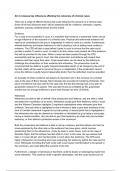
,1. What is Starling's Law of Capillary forces? How does this explain why a
nutritionally deficient child would have edema?
Starling’s Law describes how fluids move across the capillary membrane. There are two
major opposing forces that act to balance each other, hydrostatic pressure (pushing water out of
the capillaries) and osmotic pressure (including oncontic pressure, which pushes fluid into the
capillaries). Both electrolytes and proteins (oncontic pressure) in the blood affect osmotic
pressure, high electrolyte and protein concentrations in the blood would cause water to leave the
cells and interstitial space and enter the blood stream to dilute the high concentrations. On, the
other hand, low electrolyte and protein concentrations (as seen in a nutritionally deficient child)
would cause water to leave the capillaries and enter the cells and interstitial fluid which can lead
to edema.
2. How does the RAAS (Renin-Angiotensin-Aldosterone System) result in
increased blood volume and increased blood pressure?
A drop in blood pressure is sensed by the kidneys by low perfusion, which in turn begins to
secrete renin. Renin then triggers the liver to produce angiotensinogen, which is converted to
Angiotensin I in the lungs and then angiotensin II by the enzyme Angiotensin-converting enzyme
(ACE). Angiotensin II stimulates peripheral arterial vasoconstriction which raises BP. Angiotensin II
is also stimulating the adrenal gland to release aldosterone, which acts to increase sodium and
water reabsorption increasing blood volume, while also increased potassium secretion in urine.
3. How can hyperkalemia lead to cardiac arrest?
Normal levels of potassium are between 3.5 and 5.2 mEq/dL. Hyperkalemia refers to
potassium levels higher that 5.2 mEq/dL. A major function of potassium is to conduct nerve
impulses in muscles. Too low and muscle weakness occurs and too much can cause muscle spasms.
This is especially dangerous in the heart muscle and an irregular heartbeat can cause a heart attack.
4. The body uses the Protein Buffering System, Phosphate Buffering System, and
Carbonic Acid-Bicarbonate System to regulate and maintain homeostatic pH,
what is the consequence of a pH imbalance?
Proteins contain many acidic and basic group that can be affected by pH changes. Any
increase or decrease in blood pH can alter the structure of the protein (denature), thereby
affecting its function as well.
5. Describe the laboratory findings associated with metabolic
Want to earn $103 per month?
acidosis, metabolic alkalosis, respiratory acidosis and respiratory alkalosis. (ie
relative pH and CO2 levels).
, Want to earn $103 per month?
EXAM ALL 180 QUESTIONS AND
VERIFIED ANSWERS WITH RATIONALES
LATEST 2022-2023/ WGU D236
PATHOPHYSIOLOGY FINAL EXAM ALL
LESSONS
,1. What is Starling's Law of Capillary forces? How does this explain why a
nutritionally deficient child would have edema?
Starling’s Law describes how fluids move across the capillary membrane. There are two
major opposing forces that act to balance each other, hydrostatic pressure (pushing water out of
the capillaries) and osmotic pressure (including oncontic pressure, which pushes fluid into the
capillaries). Both electrolytes and proteins (oncontic pressure) in the blood affect osmotic
pressure, high electrolyte and protein concentrations in the blood would cause water to leave the
cells and interstitial space and enter the blood stream to dilute the high concentrations. On, the
other hand, low electrolyte and protein concentrations (as seen in a nutritionally deficient child)
would cause water to leave the capillaries and enter the cells and interstitial fluid which can lead
to edema.
2. How does the RAAS (Renin-Angiotensin-Aldosterone System) result in
increased blood volume and increased blood pressure?
A drop in blood pressure is sensed by the kidneys by low perfusion, which in turn begins to
secrete renin. Renin then triggers the liver to produce angiotensinogen, which is converted to
Angiotensin I in the lungs and then angiotensin II by the enzyme Angiotensin-converting enzyme
(ACE). Angiotensin II stimulates peripheral arterial vasoconstriction which raises BP. Angiotensin II
is also stimulating the adrenal gland to release aldosterone, which acts to increase sodium and
water reabsorption increasing blood volume, while also increased potassium secretion in urine.
3. How can hyperkalemia lead to cardiac arrest?
Normal levels of potassium are between 3.5 and 5.2 mEq/dL. Hyperkalemia refers to
potassium levels higher that 5.2 mEq/dL. A major function of potassium is to conduct nerve
impulses in muscles. Too low and muscle weakness occurs and too much can cause muscle spasms.
This is especially dangerous in the heart muscle and an irregular heartbeat can cause a heart attack.
4. The body uses the Protein Buffering System, Phosphate Buffering System, and
Carbonic Acid-Bicarbonate System to regulate and maintain homeostatic pH,
what is the consequence of a pH imbalance?
Proteins contain many acidic and basic group that can be affected by pH changes. Any
increase or decrease in blood pH can alter the structure of the protein (denature), thereby
affecting its function as well.
5. Describe the laboratory findings associated with metabolic
Want to earn $103 per month?
acidosis, metabolic alkalosis, respiratory acidosis and respiratory alkalosis. (ie
relative pH and CO2 levels).
, Want to earn $103 per month?