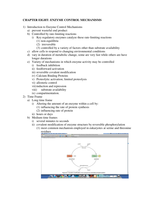
CHAPTER EIGHT: ENZYME CONTROL MECHANISMS
1) Introduction to Enzyme Control Mechanisms
a) prevent wasteful end product
b) Controlled by rate-limiting reactions
i) Key regulatory enzymes catalyze these rate-limiting reactions
(1) non-equilibriu
(2) irreversible
(3) controlled by a variety of factors other than substrate availability
c) allow cells to respond to changing environmental conditions
d) vary in duration of metabolic change, some are very fast while others are have
longer durations
e) Variety of mechanisms in which enzyme activity may be controlled
i) feedback inhibition
ii) feedforward activation
iii) reversible covalent modification
iv) Calcium Binding Proteins
v) Proteolytic activation; limited proteolysis
vi) allosteric control
vii) induction and repression
viii) substrate availability
ix) compartmentation.
2) Time Frame
a) Long time frame
i) Altering the amount of an enzyme within a cell by:
(1) influencing the rate of protein synthesis
(2) influencing rate of protein
ii) hours or days
b) Medium time frames
i) several minutes to seconds
ii) covalent modification of enzyme structure by reversible phosphorylation
(1) most common mechanism employed in eukaryotes at serine and threonine
residues
1) Introduction to Enzyme Control Mechanisms
a) prevent wasteful end product
b) Controlled by rate-limiting reactions
i) Key regulatory enzymes catalyze these rate-limiting reactions
(1) non-equilibriu
(2) irreversible
(3) controlled by a variety of factors other than substrate availability
c) allow cells to respond to changing environmental conditions
d) vary in duration of metabolic change, some are very fast while others are have
longer durations
e) Variety of mechanisms in which enzyme activity may be controlled
i) feedback inhibition
ii) feedforward activation
iii) reversible covalent modification
iv) Calcium Binding Proteins
v) Proteolytic activation; limited proteolysis
vi) allosteric control
vii) induction and repression
viii) substrate availability
ix) compartmentation.
2) Time Frame
a) Long time frame
i) Altering the amount of an enzyme within a cell by:
(1) influencing the rate of protein synthesis
(2) influencing rate of protein
ii) hours or days
b) Medium time frames
i) several minutes to seconds
ii) covalent modification of enzyme structure by reversible phosphorylation
(1) most common mechanism employed in eukaryotes at serine and threonine
residues