
6.1.3 Manipulating Genomes
Outline the steps involved in sequencing the genome of an organism;
Genome: all the genes possessed by an individual organism or the whole sequence of bases in all of the DNA in an
organism.
DNA sequencing: process of determining the order of nucleotide bases (A, T, G and C) in a molecule of DNA
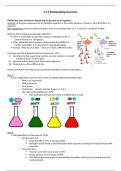
Relies on PCR and dideoxynucleotides (ddNTPs)
Same as nucleotides except they contains a hydrogen on the 3’
carbon instead of a –OH group.
When integrated into a sequence they prevent the addition of
further nucleotides as it cannot form a phosphate bridge
Contain a fluorescent marker – each one will be a different colour
A genome must be fragmented before sequencing – why?
i) Genotype too big; sequencing reaction can only operate on a length
of DNA of about 750 base pairs
ii) Accuracy better/fewer errors (with small fragments)
iii) Divide job over time/different labs
Similar to PCR BUT only ONE primer and deoxynucleotides instead of nucleotides.
Step 1:
Into 4 eppendorfs (one for each variant of labelled dideoxynucleotides) add:
o DNA to be sequenced
o DNA polymerase
o Your primer
o Nucleotides – contains the four bases A, C, G & T
o One dideoxynucleotides (A/C/G/T)
DNA replication will halt every time a modified base is used
Step 2:
Add eppendorfs to thermocycler (PCR)
o Denaturation step
Heated briefly to 95oC to denature DNA
Hydrogen bonds break so the DNA double helix separates creating two single stranded DNA
molecules
o Annealing step
Thermal cycler then cools down to 50 oC
Primer attaches to one strand of DNA
Tells DNA polymerase where to start adding nucleotides (will copy one strand but not the
reverse strand)
, o Extension step
Thermal cycler changes the temperature to 72 oC
DNA polymerase locates primer and attaches
Nucleotides are added on to the grown chain by DNA polymerase
Whenever a dideoxynucleotides is used instead of normal deoxynucleotide, DNA replication
stops – “Chain-terminating event”
If looking at one tube, e.g “G” tube – find a mixture of products ending with G dideoxynucleotide
Each strand terminates at a different point depending on where the modified nucleotide was added
Bands of all different lengths produced
Step 3:
Electrophoresis
Contents of each of the four tubes are run in separate lanes on a electrophoresis gel in order to separate the
different sized bands from one another
o Smaller fragments are produced when the ddNTP is added closer to the primer
o Chains are smaller and therefore migrate faster across the gel
o After the contents have been run across the gel, the gel is then exposed to either UV light or X-Ray
depending on the method used for labelling the DNA.
The complementary base sequence can be read from the gel - the smallest nucleotide is at the bottom of the gel.
Automated sequencing: more DNA can be sequenced in a shorter period of time.
Reactions are performed in a single tube containing all four ddNTPs each labelled with a different colour dye
DNA separated on a gel by electrophoresis
o All run on the same lane
o Shortest lengths move fastest and the longer ones move slowly
Since the four dyes fluoresce at different wavelengths, a laser then reads the gel to determine the identity of
each band according to the wavelengths at which it fluoresces.
Results are shown on a chromatogram (diagram of colored peaks that correspond to the nucleotide in that
location in the sequence)
Outline the steps involved in sequencing the genome of an organism;
Genome: all the genes possessed by an individual organism or the whole sequence of bases in all of the DNA in an
organism.
DNA sequencing: process of determining the order of nucleotide bases (A, T, G and C) in a molecule of DNA
Relies on PCR and dideoxynucleotides (ddNTPs)
Same as nucleotides except they contains a hydrogen on the 3’
carbon instead of a –OH group.
When integrated into a sequence they prevent the addition of
further nucleotides as it cannot form a phosphate bridge
Contain a fluorescent marker – each one will be a different colour
A genome must be fragmented before sequencing – why?
i) Genotype too big; sequencing reaction can only operate on a length
of DNA of about 750 base pairs
ii) Accuracy better/fewer errors (with small fragments)
iii) Divide job over time/different labs
Similar to PCR BUT only ONE primer and deoxynucleotides instead of nucleotides.
Step 1:
Into 4 eppendorfs (one for each variant of labelled dideoxynucleotides) add:
o DNA to be sequenced
o DNA polymerase
o Your primer
o Nucleotides – contains the four bases A, C, G & T
o One dideoxynucleotides (A/C/G/T)
DNA replication will halt every time a modified base is used
Step 2:
Add eppendorfs to thermocycler (PCR)
o Denaturation step
Heated briefly to 95oC to denature DNA
Hydrogen bonds break so the DNA double helix separates creating two single stranded DNA
molecules
o Annealing step
Thermal cycler then cools down to 50 oC
Primer attaches to one strand of DNA
Tells DNA polymerase where to start adding nucleotides (will copy one strand but not the
reverse strand)
, o Extension step
Thermal cycler changes the temperature to 72 oC
DNA polymerase locates primer and attaches
Nucleotides are added on to the grown chain by DNA polymerase
Whenever a dideoxynucleotides is used instead of normal deoxynucleotide, DNA replication
stops – “Chain-terminating event”
If looking at one tube, e.g “G” tube – find a mixture of products ending with G dideoxynucleotide
Each strand terminates at a different point depending on where the modified nucleotide was added
Bands of all different lengths produced
Step 3:
Electrophoresis
Contents of each of the four tubes are run in separate lanes on a electrophoresis gel in order to separate the
different sized bands from one another
o Smaller fragments are produced when the ddNTP is added closer to the primer
o Chains are smaller and therefore migrate faster across the gel
o After the contents have been run across the gel, the gel is then exposed to either UV light or X-Ray
depending on the method used for labelling the DNA.
The complementary base sequence can be read from the gel - the smallest nucleotide is at the bottom of the gel.
Automated sequencing: more DNA can be sequenced in a shorter period of time.
Reactions are performed in a single tube containing all four ddNTPs each labelled with a different colour dye
DNA separated on a gel by electrophoresis
o All run on the same lane
o Shortest lengths move fastest and the longer ones move slowly
Since the four dyes fluoresce at different wavelengths, a laser then reads the gel to determine the identity of
each band according to the wavelengths at which it fluoresces.
Results are shown on a chromatogram (diagram of colored peaks that correspond to the nucleotide in that
location in the sequence)


