

Unit 9 Assignment 1
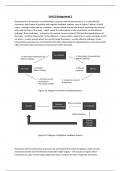
Homeostasis is the process of maintaining a constant internal environment. It is controlled by
hormones, which work in positive and negative feedback systems, seen in Figure 1 below. In both
cases, a change is detected by a receptor – tissues which receive information regarding the internal
and external state of the body – which sends the information to the coordinator via the afferent
pathway. The coordinator - in humans, the central nervous system (CNS) and the hypothalamus of
the brain - send the information to the effectors – tissues which respond as to return variables to the
set point – a value around which the normal range fluctuates – via the efferent pathway. These
homeostatic processes are controlled by hormones released by the hypothalamus in the brain which
often stimulate other hormones and processes within the body,
Figure 1b. Diagram of Positive Feedback System.
Figure 1b. Diagram of Negative Feedback System.
Hormones which control these processes are secreted by the endocrine glands, which secrete
hormones directly into the blood to reach their target organs – the tissues or organs which
hormones act upon. These target organs also have receptors for their respective hormones.
, Endocrine glands, however, secrete substances onto epithelial surfaces, through ducts.
Here are some examples of exocrine (ex) and endocrine (end) glands:
Gland Hormone/ Action Target Organ
Secretion
Adrenal Adrenaline Increase heart rate and blood pressure, Heart, muscles,
glands (Ex) vasodilation towards muscles, increase blood brain
glucose levels
Pancreas Insulin Regulate blood glucose concentration by Liver
(Ex) allowing glucose uptake by cells
Sweat Sweat Thermoregulation, cooling the skin as sweat Skin (dermis
glands (End) evaporates layer)
Salivary Saliva Early digestive processes Mouth
glands (End)
One example of a homeostatic process is osmoregulation, the process of maintaining optimum
water content within the body, which involves the nephron structures adjusting levels of sodium
pumped into kidney tissues. If this system fails, dehydration, a condition of insufficient water
content in the body, can occur. A similar process is thermoregulation, during which arrector pili
muscles, sweat glands and vasoconstriction/dilation are used to maintain a constant core
temperature; if unsuccessful, the body can become dangerously hot (hyperthermia) or dangerously
cold (hypothermia). Another example is the use of insulin and glucagon to regulate the glucose
concentration of the blood, the conditions type 1 and 2 diabetes occur when the body is unable to
do this effectively. Diabetes can often cause hyperglycemia, an excess of glucose in the blood.
Osmoregulation is the homeostatic control of osmotic pressure within the body. The processes take
place within the renal system – comprised of the kidneys, bladder, ureters and urethra. The major
blood vessels within this system are the descending aorta and inferior vena cava which branch off
into the renal vein and renal artery for each kidney, see diagram below.
Homeostasis is the process of maintaining a constant internal environment. It is controlled by
hormones, which work in positive and negative feedback systems, seen in Figure 1 below. In both
cases, a change is detected by a receptor – tissues which receive information regarding the internal
and external state of the body – which sends the information to the coordinator via the afferent
pathway. The coordinator - in humans, the central nervous system (CNS) and the hypothalamus of
the brain - send the information to the effectors – tissues which respond as to return variables to the
set point – a value around which the normal range fluctuates – via the efferent pathway. These
homeostatic processes are controlled by hormones released by the hypothalamus in the brain which
often stimulate other hormones and processes within the body,
Figure 1b. Diagram of Positive Feedback System.
Figure 1b. Diagram of Negative Feedback System.
Hormones which control these processes are secreted by the endocrine glands, which secrete
hormones directly into the blood to reach their target organs – the tissues or organs which
hormones act upon. These target organs also have receptors for their respective hormones.
, Endocrine glands, however, secrete substances onto epithelial surfaces, through ducts.
Here are some examples of exocrine (ex) and endocrine (end) glands:
Gland Hormone/ Action Target Organ
Secretion
Adrenal Adrenaline Increase heart rate and blood pressure, Heart, muscles,
glands (Ex) vasodilation towards muscles, increase blood brain
glucose levels
Pancreas Insulin Regulate blood glucose concentration by Liver
(Ex) allowing glucose uptake by cells
Sweat Sweat Thermoregulation, cooling the skin as sweat Skin (dermis
glands (End) evaporates layer)
Salivary Saliva Early digestive processes Mouth
glands (End)
One example of a homeostatic process is osmoregulation, the process of maintaining optimum
water content within the body, which involves the nephron structures adjusting levels of sodium
pumped into kidney tissues. If this system fails, dehydration, a condition of insufficient water
content in the body, can occur. A similar process is thermoregulation, during which arrector pili
muscles, sweat glands and vasoconstriction/dilation are used to maintain a constant core
temperature; if unsuccessful, the body can become dangerously hot (hyperthermia) or dangerously
cold (hypothermia). Another example is the use of insulin and glucagon to regulate the glucose
concentration of the blood, the conditions type 1 and 2 diabetes occur when the body is unable to
do this effectively. Diabetes can often cause hyperglycemia, an excess of glucose in the blood.
Osmoregulation is the homeostatic control of osmotic pressure within the body. The processes take
place within the renal system – comprised of the kidneys, bladder, ureters and urethra. The major
blood vessels within this system are the descending aorta and inferior vena cava which branch off
into the renal vein and renal artery for each kidney, see diagram below.



