

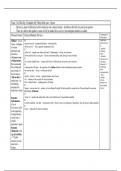
Topic: On This Day I Complete My Thirty-Sixth year – Byron
- Byron is a man of reflection, but he wishes he was a man of action – he believes the life of a poet is too passive
- There is a shift in the speaker’s sense of self; he marks life as a lover, but anticipates death as a soldier.
Themes/Context Literary/Dramatic Devices Techniques of
whole poem
Hellenist – love of S1 Ballad form
‘unmoved/ moved’ – juxtaposed half rhyme – subverted prefix (Byron lyricises
Greece - birthplace
‘Still let me love!’ – tries to generate/ compensate for loss it)
of western - quatrains,
S2
philosophy and alternating
‘yellow leaf’ – singular noun, illusion to Sonnet 73 (Shakespeare) – old age, loss of passion rhyme
democracy ‘flowers and fruits of Love are gone’ – fricatives and monosyllabic, mask rhyme give sense of finality - tetrameter,
Greece in war S3 with last line of
of independence, ‘fire/ volcanic/ kindled/ blaze’ – semantic field of fire still has desire, but no-one to love him back each stanza
Byron sponsored S4 ditrametre
fleet of ships and ‘exalted portion of the pain’ – the experience of the Sublime in Burke is that of simultaneous pleasure and pain diminishing,
‘but wear the chain’ – slavery = not being loved back shows
arms (statues of anticipated death
him in Greece) S5
- Poem
Byron died 3 ‘not thus’, ‘not here’, ‘nor now’ – temporal markers, state of being oscillates
‘sh’ s – sibilance is like an exhale relieved of burden between
months later – he
‘bier,/ or binds his brow’ – plodding plosives burden different view
forebodingly S6 points (mental
anticipates his ‘Spartan… was not more free’ – paradox, isn’t one liberated by death? He also forcefully re-scripts his fate inserts himself in an ancient, process)
death (but in battle) Marshall glory (Hellenism)
S7
Romantic ‘Awake’ x3 – repetition has jolting effect with a lyrical self-direction a parenthetical qualifier
Individualism – S8
‘Unworthy manhood – unto thee’ – deconstructive prefix = desire to force a new definition of masculinity. Also, the caesura is almost unnatural
(French S9
Revolution), belief ‘Is here’ – preposition enforces immediacy
in the opportunity
to shape liberties,
yet the burn of
solitude
(individual’s perils)
Romantic
Melancholy in the
Age of Sensibility
– 1770s/80s
increase in novels
about men’s
feelings
- Byron is a man of reflection, but he wishes he was a man of action – he believes the life of a poet is too passive
- There is a shift in the speaker’s sense of self; he marks life as a lover, but anticipates death as a soldier.
Themes/Context Literary/Dramatic Devices Techniques of
whole poem
Hellenist – love of S1 Ballad form
‘unmoved/ moved’ – juxtaposed half rhyme – subverted prefix (Byron lyricises
Greece - birthplace
‘Still let me love!’ – tries to generate/ compensate for loss it)
of western - quatrains,
S2
philosophy and alternating
‘yellow leaf’ – singular noun, illusion to Sonnet 73 (Shakespeare) – old age, loss of passion rhyme
democracy ‘flowers and fruits of Love are gone’ – fricatives and monosyllabic, mask rhyme give sense of finality - tetrameter,
Greece in war S3 with last line of
of independence, ‘fire/ volcanic/ kindled/ blaze’ – semantic field of fire still has desire, but no-one to love him back each stanza
Byron sponsored S4 ditrametre
fleet of ships and ‘exalted portion of the pain’ – the experience of the Sublime in Burke is that of simultaneous pleasure and pain diminishing,
‘but wear the chain’ – slavery = not being loved back shows
arms (statues of anticipated death
him in Greece) S5
- Poem
Byron died 3 ‘not thus’, ‘not here’, ‘nor now’ – temporal markers, state of being oscillates
‘sh’ s – sibilance is like an exhale relieved of burden between
months later – he
‘bier,/ or binds his brow’ – plodding plosives burden different view
forebodingly S6 points (mental
anticipates his ‘Spartan… was not more free’ – paradox, isn’t one liberated by death? He also forcefully re-scripts his fate inserts himself in an ancient, process)
death (but in battle) Marshall glory (Hellenism)
S7
Romantic ‘Awake’ x3 – repetition has jolting effect with a lyrical self-direction a parenthetical qualifier
Individualism – S8
‘Unworthy manhood – unto thee’ – deconstructive prefix = desire to force a new definition of masculinity. Also, the caesura is almost unnatural
(French S9
Revolution), belief ‘Is here’ – preposition enforces immediacy
in the opportunity
to shape liberties,
yet the burn of
solitude
(individual’s perils)
Romantic
Melancholy in the
Age of Sensibility
– 1770s/80s
increase in novels
about men’s
feelings


