Topic 8: Planetary Motion and
Gravity
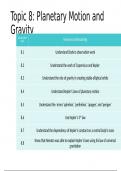
Specification
Point Necessary Understanding
8.1 Understand Brahe’s observation work
8.2 Understand the work of Copernicus and Kepler
8.3 Understand the role of gravity in creating stable elliptical orbits
8.4 Understand Kepler’s laws of planetary motion
8.5 Understand the terms ‘aphelion’, ‘perihelion’, ‘apogee’, and ‘perigee’
8.6 Use Kepler’s 3rd law
8.7 Understand the dependency of Kepler’s constant on a central body’s mass
Know that Newton was able to explain Kepler’s laws using his law of universal
8.8
gravitation
,8.1 Brahe’s observation work
Tycho Brahe’s contributions to astronomy was focused on re-evaluating
existence data from a different perspective than to Copernicus.
Main Revision: The Earth
Doesn’t Move
[1]
Jupiter and Saturn’s Interpretation of New Stars Brahe’s Model of
Conjunction and Comets Cosmos
In Brahe’s model, al
In 1537, Brahe observed a new star in the
In 1536 (aged 16), Brahe planets orbited the S
constellation of Cassiopeia in the so-called
observed the conjunction of Sun and the Moon orb
‘unmoving fixed region of stars’.
Saturn and Jupiter being off Earth.
from official records by a However, Brahe observed its movement! Regressive
month, thus demonstrating
that better data could help Brahe, also through observing a comet in However, Brahe res
create more robust 1577, challenged the consensus that the some problems of Cop
astronomical models. celestial sphere is not fixed, permanent, model: stellar par
nor perfect.
, 8.2 Understand the work of Copernicus and Kepler
Copernicus – the lone astronomer – contributed significantly to how science conceived the movement of
heavenly bodies.
Copernicus’ Quest for Deeper Harmony and
Order
In his seminal 1543 work “On Revolutions of the
Heavenly Spheres”, Copernicus placed the Sun at
the centre of the universe and the Earth in motion
across the heavens as one of the planets.
Copernicus worked explained what the Greek
models of Plato and Eudoxus could not: the
Copernican revolution could explain why the orbit
of Mercury and Venus appeared so closely tied to
the position of the Sun.
Earth orbited the Sun once a year, turns once
daily on its axis, and accommodates precession of
the equinoxes, with orbits circular
[1]
Heliocentric System
Gravity
Specification
Point Necessary Understanding
8.1 Understand Brahe’s observation work
8.2 Understand the work of Copernicus and Kepler
8.3 Understand the role of gravity in creating stable elliptical orbits
8.4 Understand Kepler’s laws of planetary motion
8.5 Understand the terms ‘aphelion’, ‘perihelion’, ‘apogee’, and ‘perigee’
8.6 Use Kepler’s 3rd law
8.7 Understand the dependency of Kepler’s constant on a central body’s mass
Know that Newton was able to explain Kepler’s laws using his law of universal
8.8
gravitation
,8.1 Brahe’s observation work
Tycho Brahe’s contributions to astronomy was focused on re-evaluating
existence data from a different perspective than to Copernicus.
Main Revision: The Earth
Doesn’t Move
[1]
Jupiter and Saturn’s Interpretation of New Stars Brahe’s Model of
Conjunction and Comets Cosmos
In Brahe’s model, al
In 1537, Brahe observed a new star in the
In 1536 (aged 16), Brahe planets orbited the S
constellation of Cassiopeia in the so-called
observed the conjunction of Sun and the Moon orb
‘unmoving fixed region of stars’.
Saturn and Jupiter being off Earth.
from official records by a However, Brahe observed its movement! Regressive
month, thus demonstrating
that better data could help Brahe, also through observing a comet in However, Brahe res
create more robust 1577, challenged the consensus that the some problems of Cop
astronomical models. celestial sphere is not fixed, permanent, model: stellar par
nor perfect.
, 8.2 Understand the work of Copernicus and Kepler
Copernicus – the lone astronomer – contributed significantly to how science conceived the movement of
heavenly bodies.
Copernicus’ Quest for Deeper Harmony and
Order
In his seminal 1543 work “On Revolutions of the
Heavenly Spheres”, Copernicus placed the Sun at
the centre of the universe and the Earth in motion
across the heavens as one of the planets.
Copernicus worked explained what the Greek
models of Plato and Eudoxus could not: the
Copernican revolution could explain why the orbit
of Mercury and Venus appeared so closely tied to
the position of the Sun.
Earth orbited the Sun once a year, turns once
daily on its axis, and accommodates precession of
the equinoxes, with orbits circular
[1]
Heliocentric System