UNIT 13: Applications of Organic and Inorganic Chemistry
LEARNING AIM A: Investigate acid-base equilibria in order to understand buffer action
to optimize acid-base titration procedures.
Introduction
This assignment will demonstrate how to evaluate the accuracy of acid-based titrations
using an indicator, an auto titrator and a pH meter. This will also demonstrate how to
perform complex calculations, rearrange equations and assess the action of buffer
solutions. This report will also justify the selection of indicators, accurately read the Ka in
a weak acid and finally demonstrate the accuracy when using a pH meter in order to
select suitable indicators.
Index
• Introduction
• Titration
• Results
• Graphs
• References
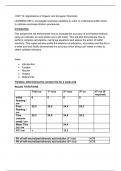
Titration; determining the constant Ka for a weak acid
Results TITRATIONS
Trial run 1st runs 2nd runs 3rd un 4th run (if
required)
Initial 0 0 0 0
Reading /
cm
Final 25.5 24.5 24.4 24.2
Reading /
cm
Titre 25.5 24.5 24.4 24.2
(volume
used) / cm
Mean Titre 24.4
(v) / cm
V/2 / cm v 12.2
PH of half-neutralized ethanoic acid solution (1st run) 4.78
PH of half-neutralized ethanoic acid solution (2nd run) 4.72
, PH of half-neutralized ethanoic acid solution (3rd run if 4.53
required)
Average pH value 4.75
My Calculations
Ka of ethanoic acid = 1.74 x 10^-5
Henderson Hesselbach equation
Ka = log10- 4.75 = 1.77827941 x 10^-5
Theoretical pH: 4.76
Actual pH: 4.54
Suitable indicators
Weak Alkali Strong Acid Titration (ammonia solution and hydrochloric acid)
Methyl orange would be the best indicator for this because it will change sharply at the equivalent point
as seen in 25.
LEARNING AIM A: Investigate acid-base equilibria in order to understand buffer action
to optimize acid-base titration procedures.
Introduction
This assignment will demonstrate how to evaluate the accuracy of acid-based titrations
using an indicator, an auto titrator and a pH meter. This will also demonstrate how to
perform complex calculations, rearrange equations and assess the action of buffer
solutions. This report will also justify the selection of indicators, accurately read the Ka in
a weak acid and finally demonstrate the accuracy when using a pH meter in order to
select suitable indicators.
Index
• Introduction
• Titration
• Results
• Graphs
• References
Titration; determining the constant Ka for a weak acid
Results TITRATIONS
Trial run 1st runs 2nd runs 3rd un 4th run (if
required)
Initial 0 0 0 0
Reading /
cm
Final 25.5 24.5 24.4 24.2
Reading /
cm
Titre 25.5 24.5 24.4 24.2
(volume
used) / cm
Mean Titre 24.4
(v) / cm
V/2 / cm v 12.2
PH of half-neutralized ethanoic acid solution (1st run) 4.78
PH of half-neutralized ethanoic acid solution (2nd run) 4.72
, PH of half-neutralized ethanoic acid solution (3rd run if 4.53
required)
Average pH value 4.75
My Calculations
Ka of ethanoic acid = 1.74 x 10^-5
Henderson Hesselbach equation
Ka = log10- 4.75 = 1.77827941 x 10^-5
Theoretical pH: 4.76
Actual pH: 4.54
Suitable indicators
Weak Alkali Strong Acid Titration (ammonia solution and hydrochloric acid)
Methyl orange would be the best indicator for this because it will change sharply at the equivalent point
as seen in 25.