
26
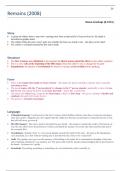
Remains (2008)
Simon Armitage (b.1963)
Story
• A group of soldiers shoot a man who’s running away from a bank raid he’s been involved in. His death is
described in graphic detail.
• The soldier telling the story wasn’t quite sure whether the man was armed or not – this plays on his mind.
• The soldier is constantly haunted by this man’s death.
Structure
• The first 4 stanzas are a flashback to the incident; the final 4 stanzas detail the effects on the soldier (speaker).
• The is a clear volta at the beginning of the fifth stanza where the soldier’s tone is changed by his guilt.
• Enjambment: the speaker is overwhelmed by what he is saying and has to think before speaking.
Form
• There is no regular line length or rhyme scheme – this makes the poem sound like someone who is naturally
narrating a story.
• The poem begins with the 1st person plural but changes to the 1st person singular, potentially to show the loss
due to war and making the poem sound more personal – almost like a confession.
• All stanzas are 4 lines long, except for the final stanza, which is 2 lines long – this gives a feeling of finality and
emphasis; the guilt will remain forever.
• The poem is a dramatic monologue.
Language
• Colloquial language: Used heavily in the first 4 stanzas which further reinforces the idea of someone narrating a
story and creates a flippant tone; this suggest that the soldier has become accustomed to seeing the horrors of war,
but will still never get over it.
• Horrific Imagery: The man’s death is described in gory detail – the imagery reminds the reader of the horrors of
war, but also shows how desensitised to violence and death the speaker was at the time (they had become part if
his everyday life).
• Nonchalance: Initially, there’s a very casual attitude towards the death of the man – the tone at the beginning is
very anecdotal; he’s shot without warning and is just thrown into a lorry to be “carted off”.
• Guilt: The speaker can’t get over the memory of the killing in his mind. He is tormented by thoughts of the man,
and wondering whether he was armed or not. The poem ends with the speaker acknowledging that he has blood on
his hands – he knows he’s guilty.
• Synedoche: Describing something as something else (not technically what it actually is).
Remains (2008)
Simon Armitage (b.1963)
Story
• A group of soldiers shoot a man who’s running away from a bank raid he’s been involved in. His death is
described in graphic detail.
• The soldier telling the story wasn’t quite sure whether the man was armed or not – this plays on his mind.
• The soldier is constantly haunted by this man’s death.
Structure
• The first 4 stanzas are a flashback to the incident; the final 4 stanzas detail the effects on the soldier (speaker).
• The is a clear volta at the beginning of the fifth stanza where the soldier’s tone is changed by his guilt.
• Enjambment: the speaker is overwhelmed by what he is saying and has to think before speaking.
Form
• There is no regular line length or rhyme scheme – this makes the poem sound like someone who is naturally
narrating a story.
• The poem begins with the 1st person plural but changes to the 1st person singular, potentially to show the loss
due to war and making the poem sound more personal – almost like a confession.
• All stanzas are 4 lines long, except for the final stanza, which is 2 lines long – this gives a feeling of finality and
emphasis; the guilt will remain forever.
• The poem is a dramatic monologue.
Language
• Colloquial language: Used heavily in the first 4 stanzas which further reinforces the idea of someone narrating a
story and creates a flippant tone; this suggest that the soldier has become accustomed to seeing the horrors of war,
but will still never get over it.
• Horrific Imagery: The man’s death is described in gory detail – the imagery reminds the reader of the horrors of
war, but also shows how desensitised to violence and death the speaker was at the time (they had become part if
his everyday life).
• Nonchalance: Initially, there’s a very casual attitude towards the death of the man – the tone at the beginning is
very anecdotal; he’s shot without warning and is just thrown into a lorry to be “carted off”.
• Guilt: The speaker can’t get over the memory of the killing in his mind. He is tormented by thoughts of the man,
and wondering whether he was armed or not. The poem ends with the speaker acknowledging that he has blood on
his hands – he knows he’s guilty.
• Synedoche: Describing something as something else (not technically what it actually is).


