Emilia Hawkins
Unit 8: Physiology of Human Body Systems
A: Understand the impact of disorders of the musculoskeletal system and their associated corrective
treatments
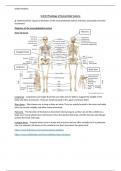
Diagrams of the musculoskeletal system
Flat bone
Bone structure
Irregular bone
Long bone
Short bone
Long bone – Long bones are longer than they are wide and are built to support the weight of the
body and allow movement. They are mostly located in the upper and lower limbs.
Short bone – Short bones are as long as they are wide. They are mainly located in the wrist and ankle
joints to provide stability and allow some movement.
Flat bone - The function of flat bones is to protect internal organs as they can act like a shield or a
large area muscle attachment. Flat bones in the skull protect the brain, and the sternum and ribcage
protect the heart and lungs.
Irregular bone - Irregular bones vary in shape and structure and are often complex to fit a particular
role. For example, the bones in the vertebrae are there to protect the spinal cord.
https://www.britannica.com/science/human-skeleton
https://www.visiblebody.com/learn/skeleton/types-of-bones
, Emilia Hawkins
Major joints
Pivot joint – A pivot joint is where the round end of a bone fits into a ring formed by the other bone;
this allows for a wide range of motion as the rounded bone moves on its own axes. An example of
this is the joint at the wrist.
Hinge joint – The rounded end of one bone fits into the hollowed out end of another. One end
moves while the other end stays stationary.
Saddle joint – The ends of each bone have concave and convex portions that fit together. For
example the saddle joint in the thumb allows for a wide range of movement.
Plane joint – They have flat or slightly curved surfaces to allow for a gliding movement, because of
this the range of motion is limited as there is no rotation.
Condyloid joint – An oval shaped end of a bone fits into the hollow oval shaped end of another, this
allows angled movement along two axes.
Ball and socket joint - The spherical end of one bone fits into the rounded socket of another to allow
movement in all possible directions, for the greatest range of motion. Examples of these are the
joints at the shoulder and hip.
https://courses.lumenlearning.com/wm-biology2/chapter/types-of-synovial-joints/
Unit 8: Physiology of Human Body Systems
A: Understand the impact of disorders of the musculoskeletal system and their associated corrective
treatments
Diagrams of the musculoskeletal system
Flat bone
Bone structure
Irregular bone
Long bone
Short bone
Long bone – Long bones are longer than they are wide and are built to support the weight of the
body and allow movement. They are mostly located in the upper and lower limbs.
Short bone – Short bones are as long as they are wide. They are mainly located in the wrist and ankle
joints to provide stability and allow some movement.
Flat bone - The function of flat bones is to protect internal organs as they can act like a shield or a
large area muscle attachment. Flat bones in the skull protect the brain, and the sternum and ribcage
protect the heart and lungs.
Irregular bone - Irregular bones vary in shape and structure and are often complex to fit a particular
role. For example, the bones in the vertebrae are there to protect the spinal cord.
https://www.britannica.com/science/human-skeleton
https://www.visiblebody.com/learn/skeleton/types-of-bones
, Emilia Hawkins
Major joints
Pivot joint – A pivot joint is where the round end of a bone fits into a ring formed by the other bone;
this allows for a wide range of motion as the rounded bone moves on its own axes. An example of
this is the joint at the wrist.
Hinge joint – The rounded end of one bone fits into the hollowed out end of another. One end
moves while the other end stays stationary.
Saddle joint – The ends of each bone have concave and convex portions that fit together. For
example the saddle joint in the thumb allows for a wide range of movement.
Plane joint – They have flat or slightly curved surfaces to allow for a gliding movement, because of
this the range of motion is limited as there is no rotation.
Condyloid joint – An oval shaped end of a bone fits into the hollow oval shaped end of another, this
allows angled movement along two axes.
Ball and socket joint - The spherical end of one bone fits into the rounded socket of another to allow
movement in all possible directions, for the greatest range of motion. Examples of these are the
joints at the shoulder and hip.
https://courses.lumenlearning.com/wm-biology2/chapter/types-of-synovial-joints/