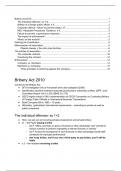
Bribery Act 2010.......................................................................................................................... 1
The individual offences: ss 1+2...............................................................................................1
Bribery of a foreign public official: s 6......................................................................................2
Corporate offence - failure to prevent bribery: s7....................................................................2
MOJ ‘Adequate Procedures’ Guidance: s 9.............................................................................3
Failure to prevent: a governance response.............................................................................4
The impact of enforcement?....................................................................................................4
What’s on the horizon?............................................................................................................5
Defining the Constitution..............................................................................................................5
Memorandum of association........................................................................................................6
Objects clauses + the ultra vires doctrine...........................................................................6
The articles of association...........................................................................................................9
The corporate contract.......................................................................................................... 10
Construing the contract......................................................................................................... 12
Enforcement.............................................................................................................................. 14
Company vs. members......................................................................................................... 14
Members vs. Company......................................................................................................... 15
Three principles in enforcing against the company:..........................................................16
Bribery Act 2010
Context to the Bribery Act:
● SFO investigation into al-Yamamah arms deal collapsed (2006)
● Identification doctrine rendered corporate prosecutions ‘extremely unlikely’ (DPP, Joint
Committee Report Vol II (n 29), BB48, Ev 273)
● OECD highly critical of UK’s implementation of OECD Convention on Combating Bribery
of Foreign Public Officials in International Business Transactions
● Draft Corruption Bill in 1995 – 15 years …
● Ultimately, ‘gold-plated’ international requirements – extending to private as well as
public companies
The individual offences: ss 1+2
● Here, we see our act covering private prosecutions and private bribery
● s1 – the Payer paying a bribe
○ (2) P “offers, promises or gives a financial or other advantage” and “intends to
induce a person to perform improperly a relevant function or activity”
○ (3) P “knows the acceptance of such financial or other advantage would itself
constitute the improper performance”
○ don’t pay bribes, and if you use a third party to pay bribes, you’ll still be
liable
● s 2 – the recipient receiving a bribe
, ○ R requests, agrees to receive or accepts a F/OA intending improper
performance
■ S 2(2): intending improper performance to follow (whether by R or
another)
■ S 2(3): where the request, agreement or acceptance itself amounts to
improper performance
■ S 2(4): as a reward for improperly performing the relevant function or
activity (by R or another)
■ S 2(5):
■ In anticipation of or in consequence of R requesting [etc] a relevant
function or activity is performed improperly by R or another person at R’s
request, assent or acquiescence”
○ S 2 (3)-(5): irrelevant that R knew performance was improper
Bribery of a foreign public official: s 6
● (1) It is an offence to bribe a foreign public official if P’s intention is to influence the FPO
in their capacity as a FPO
● (2) P must also intend to obtain or retain business or an advantage in the conduct of
business
● (3) Directly or through a third party
● UK plc at a disadvantage with these players
Corporate offence - failure to prevent bribery: s7
● Offence
○ Corporate liability if an associated person (s 8) bribes with the intention of
obtaining business for C (the Company)
■ s1 (making bribe); and
■ s6 (bribing FPO) only
■ no liability for failing to prevent the receipt of bribes (s2)
○ No need for AP to be prosecuted (s 7(3))
○ “associated person”: it can be an employee, subsidiary
● Defence
○ It is a defence if C had in place adequate procedures to prevent such
conduct
○ identification doctrine: removed the identification barrier, don’t need to ID a
directing mind and will. This is a strict liability defence. The mere act is sufficient,
and the burden of proof is on C to show they had adequate procedures in place.
■ Act trying to change corporate behaviour - to push proactive steps for
internal systems and controls. Internal analysis of where risk lay
, ■ The Act a radical departure at the time from how we recognize
corporations - it is a recognition of the bigger things we talk about; it’s not
enough to say that the company is liable if they act on their behalf
● Associated person (s 8)
○ A person who performs services for or on behalf of an organisation
○ Includes subsidiaries (s 8(3))
MOJ ‘Adequate Procedures’ Guidance: s 9
● Different drafts of this were received with mixed emotions.
○ Some argued “the section is deplorable and can be used to evade the act”
● But the Guidance sets out 6 principles to inform what constitutes adequate procedures
in any given instance.
○ Not commanding control, but “think about these principles yourself, apply them to
your own situation, recognising that it’s not a 1-size fits all approach”
● Guidance
○ Risk-based approach
○ Procedures to be informed by 6 principles – not prescriptive
○ Is it helpful?
○ Reflexive regulation
○ Use of hypothetical cases
● Principles
○ Proportionate procedures
■ Don’t need to adopt a “belt and braces” if it doesn’t apply to you
○ Top-level commitment
■ A cultural change: if the directors at the top aren’t committed, who is
reasonably expected to follow it?
○ Risk-assessment
■ “You undertake a risk assessment, you see what you need, are you in a
high risk industry, high risk jurisdictions etc.”?
■ Donovan: to respond to the fact that there was so much consternation to
the Act, really designed to lead w proportionality
○ Due diligence
■ If acquiring companies / entering new territory / engaging w 3rd parties
○ Communication (incl. training)
■ Must communicate Guidance to your team! No point if nobody knows
○ Monitoring and review
■ Not just periodically, but in response to any trigger event - acquisition,
new supplier
● Act a very new approach to corporate regulation: started to recognize that you
need to work out how to drive behavioural change in artificial people → drive
a governance response
The individual offences: ss 1+2...............................................................................................1
Bribery of a foreign public official: s 6......................................................................................2
Corporate offence - failure to prevent bribery: s7....................................................................2
MOJ ‘Adequate Procedures’ Guidance: s 9.............................................................................3
Failure to prevent: a governance response.............................................................................4
The impact of enforcement?....................................................................................................4
What’s on the horizon?............................................................................................................5
Defining the Constitution..............................................................................................................5
Memorandum of association........................................................................................................6
Objects clauses + the ultra vires doctrine...........................................................................6
The articles of association...........................................................................................................9
The corporate contract.......................................................................................................... 10
Construing the contract......................................................................................................... 12
Enforcement.............................................................................................................................. 14
Company vs. members......................................................................................................... 14
Members vs. Company......................................................................................................... 15
Three principles in enforcing against the company:..........................................................16
Bribery Act 2010
Context to the Bribery Act:
● SFO investigation into al-Yamamah arms deal collapsed (2006)
● Identification doctrine rendered corporate prosecutions ‘extremely unlikely’ (DPP, Joint
Committee Report Vol II (n 29), BB48, Ev 273)
● OECD highly critical of UK’s implementation of OECD Convention on Combating Bribery
of Foreign Public Officials in International Business Transactions
● Draft Corruption Bill in 1995 – 15 years …
● Ultimately, ‘gold-plated’ international requirements – extending to private as well as
public companies
The individual offences: ss 1+2
● Here, we see our act covering private prosecutions and private bribery
● s1 – the Payer paying a bribe
○ (2) P “offers, promises or gives a financial or other advantage” and “intends to
induce a person to perform improperly a relevant function or activity”
○ (3) P “knows the acceptance of such financial or other advantage would itself
constitute the improper performance”
○ don’t pay bribes, and if you use a third party to pay bribes, you’ll still be
liable
● s 2 – the recipient receiving a bribe
, ○ R requests, agrees to receive or accepts a F/OA intending improper
performance
■ S 2(2): intending improper performance to follow (whether by R or
another)
■ S 2(3): where the request, agreement or acceptance itself amounts to
improper performance
■ S 2(4): as a reward for improperly performing the relevant function or
activity (by R or another)
■ S 2(5):
■ In anticipation of or in consequence of R requesting [etc] a relevant
function or activity is performed improperly by R or another person at R’s
request, assent or acquiescence”
○ S 2 (3)-(5): irrelevant that R knew performance was improper
Bribery of a foreign public official: s 6
● (1) It is an offence to bribe a foreign public official if P’s intention is to influence the FPO
in their capacity as a FPO
● (2) P must also intend to obtain or retain business or an advantage in the conduct of
business
● (3) Directly or through a third party
● UK plc at a disadvantage with these players
Corporate offence - failure to prevent bribery: s7
● Offence
○ Corporate liability if an associated person (s 8) bribes with the intention of
obtaining business for C (the Company)
■ s1 (making bribe); and
■ s6 (bribing FPO) only
■ no liability for failing to prevent the receipt of bribes (s2)
○ No need for AP to be prosecuted (s 7(3))
○ “associated person”: it can be an employee, subsidiary
● Defence
○ It is a defence if C had in place adequate procedures to prevent such
conduct
○ identification doctrine: removed the identification barrier, don’t need to ID a
directing mind and will. This is a strict liability defence. The mere act is sufficient,
and the burden of proof is on C to show they had adequate procedures in place.
■ Act trying to change corporate behaviour - to push proactive steps for
internal systems and controls. Internal analysis of where risk lay
, ■ The Act a radical departure at the time from how we recognize
corporations - it is a recognition of the bigger things we talk about; it’s not
enough to say that the company is liable if they act on their behalf
● Associated person (s 8)
○ A person who performs services for or on behalf of an organisation
○ Includes subsidiaries (s 8(3))
MOJ ‘Adequate Procedures’ Guidance: s 9
● Different drafts of this were received with mixed emotions.
○ Some argued “the section is deplorable and can be used to evade the act”
● But the Guidance sets out 6 principles to inform what constitutes adequate procedures
in any given instance.
○ Not commanding control, but “think about these principles yourself, apply them to
your own situation, recognising that it’s not a 1-size fits all approach”
● Guidance
○ Risk-based approach
○ Procedures to be informed by 6 principles – not prescriptive
○ Is it helpful?
○ Reflexive regulation
○ Use of hypothetical cases
● Principles
○ Proportionate procedures
■ Don’t need to adopt a “belt and braces” if it doesn’t apply to you
○ Top-level commitment
■ A cultural change: if the directors at the top aren’t committed, who is
reasonably expected to follow it?
○ Risk-assessment
■ “You undertake a risk assessment, you see what you need, are you in a
high risk industry, high risk jurisdictions etc.”?
■ Donovan: to respond to the fact that there was so much consternation to
the Act, really designed to lead w proportionality
○ Due diligence
■ If acquiring companies / entering new territory / engaging w 3rd parties
○ Communication (incl. training)
■ Must communicate Guidance to your team! No point if nobody knows
○ Monitoring and review
■ Not just periodically, but in response to any trigger event - acquisition,
new supplier
● Act a very new approach to corporate regulation: started to recognize that you
need to work out how to drive behavioural change in artificial people → drive
a governance response