

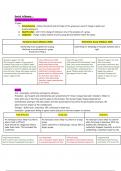
Social influence -
TYPES AND EXPLANATIONS:
3 types -
1) Internalisation - making the beliefs and attitudes of the group your own (LT change in public and
private behaviour).
2) Identification - short term change of behaviour only in the presence of a group.
3) Compliance - change in public beliefs around a group (private beliefs remain the same).
Normative Social Influence (NSI) Informative Social Influence (ISI)
Conforming to be accepted into a group. Conforming for knowledge or because someone else is
Conforms to social norms of a group. right.
Avoids not fitting in.
+Research support for ISI -Indv differences in NSI +Real life app of NSI +Research support for both
One strength is support from research People who are less concerned Link between NSI and bullying. Found Asch interviewed
evidence from Lucus et al (2006). Asked about being liked are less that a boy can be manipulated into participants conformity and
students mathematical problems and found affected by NSI than those who bullying by victimising another child found conformity was largely
conformity to incorrect answers was higher care more about being liked as it provides a common goal for a attributed to ISI and NSI.
with difficulty. Shows that people conform (nAffiliator). Afiliators have a group. Children would then bully to Supporting research
in situations when they don’t know the greater need for affiliation and gain approval from friends. therefore increases the
answer. Supports ISI are therefore more likely to validity of types of social
conform. Indv differences influences.
therefore impact generalisation
of the theory.
ASCH:
Aim - investigate conformity and majority influence
Procedure - participants and confederates were presented with 4 lines;3 comparisons and 1 standard. ASked to
state which one of the three was the same as the stimulus. The real participant always answered last.
Confederates would give the same answer and Asch would observe how often the participants would give the
same incorrect answer as the confederates.
Findings - 36.8% never conformed, 75% conformed at least once.
Conclusion - people were willing to ignore reality and give an incorrect answer to conform
Task difficulty Group size Unanimity
An individual is more likely to conform An individual is more likely to conform in a large An individual is more likely to conform
when a task is difficult. group. when the group is unanimous. With one
Asch altered the comparison lines to Lower conformity in small groups, rose by 30% in disaffected confederate, the
make them closer. This increased the larger groups conformity dropped. Unanimity is vital in
conformity. establishing a consistent majority view.
+High internal validity -Lab experiment. -Ethical issues +Supports NSI
Strict control over extraneous variables Lack of ecological validity. Based Deception as participants believed Participants reported they
such as timing of assessment and type of on a person’s perception of lines, the study was about perception not conformed to fit in with the
TYPES AND EXPLANATIONS:
3 types -
1) Internalisation - making the beliefs and attitudes of the group your own (LT change in public and
private behaviour).
2) Identification - short term change of behaviour only in the presence of a group.
3) Compliance - change in public beliefs around a group (private beliefs remain the same).
Normative Social Influence (NSI) Informative Social Influence (ISI)
Conforming to be accepted into a group. Conforming for knowledge or because someone else is
Conforms to social norms of a group. right.
Avoids not fitting in.
+Research support for ISI -Indv differences in NSI +Real life app of NSI +Research support for both
One strength is support from research People who are less concerned Link between NSI and bullying. Found Asch interviewed
evidence from Lucus et al (2006). Asked about being liked are less that a boy can be manipulated into participants conformity and
students mathematical problems and found affected by NSI than those who bullying by victimising another child found conformity was largely
conformity to incorrect answers was higher care more about being liked as it provides a common goal for a attributed to ISI and NSI.
with difficulty. Shows that people conform (nAffiliator). Afiliators have a group. Children would then bully to Supporting research
in situations when they don’t know the greater need for affiliation and gain approval from friends. therefore increases the
answer. Supports ISI are therefore more likely to validity of types of social
conform. Indv differences influences.
therefore impact generalisation
of the theory.
ASCH:
Aim - investigate conformity and majority influence
Procedure - participants and confederates were presented with 4 lines;3 comparisons and 1 standard. ASked to
state which one of the three was the same as the stimulus. The real participant always answered last.
Confederates would give the same answer and Asch would observe how often the participants would give the
same incorrect answer as the confederates.
Findings - 36.8% never conformed, 75% conformed at least once.
Conclusion - people were willing to ignore reality and give an incorrect answer to conform
Task difficulty Group size Unanimity
An individual is more likely to conform An individual is more likely to conform in a large An individual is more likely to conform
when a task is difficult. group. when the group is unanimous. With one
Asch altered the comparison lines to Lower conformity in small groups, rose by 30% in disaffected confederate, the
make them closer. This increased the larger groups conformity dropped. Unanimity is vital in
conformity. establishing a consistent majority view.
+High internal validity -Lab experiment. -Ethical issues +Supports NSI
Strict control over extraneous variables Lack of ecological validity. Based Deception as participants believed Participants reported they
such as timing of assessment and type of on a person’s perception of lines, the study was about perception not conformed to fit in with the


