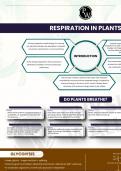
RESPIRATION IN PLANTS
All Iiving organisms need energy for carrying Cellular respir
out daily life activities, like absorption, transport, breakdown of food m
energy, and trapp
movement, reproduction or even breathing
process takes p
the
INTRODUCTION
All the energy required for ‘life’ processes is The compounds
obtained by oxidation of macromolecules, process are calle
called food like carbohydra
o
The process involves a series of slow step-wise reactions
controlled by enzymes and the released energy is trapped as
chemical energy in the form of ATP, which is broken down
whenever and wherever energy needs to be utilised
Y S I
DO PLANTS BREATHE?
H
P L
Plants have systems in place to ensure O2 Each plant part takes care of its own gas Roots, stems and leaves respire at rates
L
availability, i.e. stomata and lenticels for exchange needs. There is very little transport far lower than animals do
A
this purpose. of gases from one plant part to another
W
Complete combustion of glucose produces
CO2 and H2O as end products and yields But plants oxidise glucose in several small Facultative and obligate anaerobes, can
energy most of which is given as heat steps and energy released is coupled to respire in absence of O2
C6HI2O6 + 6O2 -> 6CO2 + 6H2O + Energy ATP synthesis
GLYCOIYSIS Glucose (6
ATP
H
ADP
• Greek-glycos - sugar and lysis = splitting
Glucose-6-phosp
• Scheme given by Embden, Meyerhof and Parnas. referred as EMP- pathway
• In anaerobic organisms, it is the only process in respiration
All Iiving organisms need energy for carrying Cellular respir
out daily life activities, like absorption, transport, breakdown of food m
energy, and trapp
movement, reproduction or even breathing
process takes p
the
INTRODUCTION
All the energy required for ‘life’ processes is The compounds
obtained by oxidation of macromolecules, process are calle
called food like carbohydra
o
The process involves a series of slow step-wise reactions
controlled by enzymes and the released energy is trapped as
chemical energy in the form of ATP, which is broken down
whenever and wherever energy needs to be utilised
Y S I
DO PLANTS BREATHE?
H
P L
Plants have systems in place to ensure O2 Each plant part takes care of its own gas Roots, stems and leaves respire at rates
L
availability, i.e. stomata and lenticels for exchange needs. There is very little transport far lower than animals do
A
this purpose. of gases from one plant part to another
W
Complete combustion of glucose produces
CO2 and H2O as end products and yields But plants oxidise glucose in several small Facultative and obligate anaerobes, can
energy most of which is given as heat steps and energy released is coupled to respire in absence of O2
C6HI2O6 + 6O2 -> 6CO2 + 6H2O + Energy ATP synthesis
GLYCOIYSIS Glucose (6
ATP
H
ADP
• Greek-glycos - sugar and lysis = splitting
Glucose-6-phosp
• Scheme given by Embden, Meyerhof and Parnas. referred as EMP- pathway
• In anaerobic organisms, it is the only process in respiration