Why should cells divide?
● Growth and Development (multicellular)
● Cell Size (Low Surface Area: Volume Ratio)
● Repair Injury/replace dead or damaged cells (multicellular)
● Reproduction
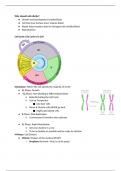
Cell Cycle: Life Cycle of a Cell
Interphase: Where the cell spends the majority of its life
● G1 Phase: Growth
● *G0 Phase: Non-Dividing & Differentiated State
○ Basically Exiting the Cell Cycle
○ Can be Temporary!
■ Like liver cells
○ Nerve & Muscle cells NEVER go back
■ Highly specialized cells
● S Phase: DNA Replication
○ Centrosomes/Centrioles also replicate
● G2 Phase: Rapid Metabolism
○ Get your duckies in a row
○ To be as healthy as possible and be ready for division
M Phase: Cell Division
● Mitosis: Division of the nucleus (PMAT)
○ Prophase (forward = first) or (p for prep)
, Cell Cycle Study Guide
1. DNA Condenses (no genes are exposed)
a. So chromosomes don’t get caught on each other
2. Nuclear membrane dissolves
3. Centrosomes migrate to opposite sides of the cell
a. Poles
4. Centrosomes will grow out spindle fibers
○ Metaphase (m for middle)
■ Chromosomes line up single file along the equator
■ Spindle fibers connect to each chromosome
● 1 from each side (to each chromatid) in the middle near the
centromere
○ Anaphase
■ Spindle fibers contract and pull sister chromatids apart
○ Telophase
■ Finish pulling chromatids at opposite ends of the cell
■ Fibers are broken down
■ Chromosomes are enclosed into 2 nuclei
■ DNA Relaxes
● Cytokinesis: Division of everything else
○ Replicate everything else
○ Overlap with telophase
○ Animal Cells
■ Cleavage
● Membrane squeezes and pinches off
○ Plant & Fungal Cells
■ Cell Plate
● Grow new cell wall in the middle
Coordination of Cell Dviision
● Critical for normal growth, development & maintenance
● Coordinate timing and rates across different tissues & organs
● Not all cells can have the same cell cycle
Checkpoint Control System
● Checkpoint: a movement in a cell’s life when if conditions are met, they activate a
mechanism (that can charge phases)
● G1/S: can DNA synthesis begin?
○ Most critical as it is the primary decision point
2
● Growth and Development (multicellular)
● Cell Size (Low Surface Area: Volume Ratio)
● Repair Injury/replace dead or damaged cells (multicellular)
● Reproduction
Cell Cycle: Life Cycle of a Cell
Interphase: Where the cell spends the majority of its life
● G1 Phase: Growth
● *G0 Phase: Non-Dividing & Differentiated State
○ Basically Exiting the Cell Cycle
○ Can be Temporary!
■ Like liver cells
○ Nerve & Muscle cells NEVER go back
■ Highly specialized cells
● S Phase: DNA Replication
○ Centrosomes/Centrioles also replicate
● G2 Phase: Rapid Metabolism
○ Get your duckies in a row
○ To be as healthy as possible and be ready for division
M Phase: Cell Division
● Mitosis: Division of the nucleus (PMAT)
○ Prophase (forward = first) or (p for prep)
, Cell Cycle Study Guide
1. DNA Condenses (no genes are exposed)
a. So chromosomes don’t get caught on each other
2. Nuclear membrane dissolves
3. Centrosomes migrate to opposite sides of the cell
a. Poles
4. Centrosomes will grow out spindle fibers
○ Metaphase (m for middle)
■ Chromosomes line up single file along the equator
■ Spindle fibers connect to each chromosome
● 1 from each side (to each chromatid) in the middle near the
centromere
○ Anaphase
■ Spindle fibers contract and pull sister chromatids apart
○ Telophase
■ Finish pulling chromatids at opposite ends of the cell
■ Fibers are broken down
■ Chromosomes are enclosed into 2 nuclei
■ DNA Relaxes
● Cytokinesis: Division of everything else
○ Replicate everything else
○ Overlap with telophase
○ Animal Cells
■ Cleavage
● Membrane squeezes and pinches off
○ Plant & Fungal Cells
■ Cell Plate
● Grow new cell wall in the middle
Coordination of Cell Dviision
● Critical for normal growth, development & maintenance
● Coordinate timing and rates across different tissues & organs
● Not all cells can have the same cell cycle
Checkpoint Control System
● Checkpoint: a movement in a cell’s life when if conditions are met, they activate a
mechanism (that can charge phases)
● G1/S: can DNA synthesis begin?
○ Most critical as it is the primary decision point
2