·
M
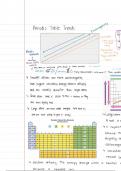
Periodic Table Trends tronegative
Ele same
g
7 ↳
Ionization
7
&now
easy loni
it
is to
take
away ↳
flowionization
Metallic 4
give
up easily
character
:
↑ ionization
high
↑ i
take
-
same trend 2
<
Atomic Radius
increasing
than protons ( +++
fewer
with
+
of
-
atom molecula
any or
&
z/anions and
2 +-
concernina
---- +
cations
any moleculelator
with more a than protons
a smaller atoms are more
electronegative,
have higher ionization energy election affinity
and less metallic character than larger atoms.
a small the
closer to
atoms have a nucleus so
they
are more
tightly held
↳
Large atoms are more stable charged, hold more
e
and are more willing to
give away.
a ↳
Larger atoms
& have a o
↳ e
negativiti
because the
thightly th
electronega
↳ ionization
remove an
a electron
affinity:the energy change when a neutral a
become a
negative ion.
, Electron Configuration
n its a list ofquantom numbers & numberofa in each
Electron
configuration ofcations &
justmore
↳ anions is back one b
(for cations) & for anions forward boxfo
missing you more one
from
removed instead o
Electron Configuration ofions
&
Exceptions:Cr. [ArJUs;3d"
Cu -
[Ar] 4s',3d's
binstead
#toms In
removes
tromere
Fe:[Ar] 4s3d" -Felt:[Ar]3d3 ↳s firstidentify the co
Fe: [Ar] 4s23d6'sFest. [Ar]3ds i then add or remove of
↳ this in row
4th but
is 3d instead of
ads
starts -1 =
& f
is
technically in the 6th row butis-2 nfl
=
instead ofEfM
Metals vs Non Metals metals are LO
a
a metals:larger atoms with loosely held electrons. Metals
They are lustrous, ductile, malleable, and excellentconductors of
in ionic bonds with non-metals.
is non-metals:smaller atoms with
tightly held electrons. Non-metals like
They have lower melting points than metals, and form bon
covalent
stuff involves non-metals.
[ levels
energy
↳
Energy the energies of
levels represent thee in an atom
is Quantized! Like stairs ramp-
not
↳ an
If a drops a
to lower energy level, energy is
released as
a photon (i.e. as electromagnetic radiation).
The released will be exactly equal to the
↳
energy
difference between the two energy levels.
The Work Function
, Radioactive Decay & halfl ife
↳ Radioactive
decay is the which unstable atoms
process by
time. The sometimes loses
over nucleus or
gainse,
neutrons called "alpha particles,"or even transforms
Alpha Decay loss of1 He nucleus, which has mass num
180 C
ex) -> loss of He, which is protons &
Beta
Decay
e
-
a neutron
2
t e
-
is
changed a
into proton t
with
ex)
8
↓ opposite
+ -> t
ejection of an e-
neutron proton
Electron Capture a
proton is
changed neutron
into
2
t e
-
e
-
via capture ofe-
ex)
8
+ -> +
proton neutron
Positron Emissions a
proton is
changed neutron
into
neutor
ro n
position
->
⑦ position
expulsion of position
with
ex)
o citslike a
-> e-
①
⑨
neutral
proton
Gamma Emmission:gamma rays are usually emmitted a
decays outlined above. Gamma
decay does not
change
3 Note:neutrons:a proton an electron
protons to
neutron
=
po
Half-Life
Problems
3 the half-life
of a substance (t) is the amount of time req
the mass ofthatsubstance disappear
to due to radioactiv
↳ three variables:half-life (t ), time elapsed (t), & theamountofsubs
↳ two, solve for third
M
Periodic Table Trends tronegative
Ele same
g
7 ↳
Ionization
7
&now
easy loni
it
is to
take
away ↳
flowionization
Metallic 4
give
up easily
character
:
↑ ionization
high
↑ i
take
-
same trend 2
<
Atomic Radius
increasing
than protons ( +++
fewer
with
+
of
-
atom molecula
any or
&
z/anions and
2 +-
concernina
---- +
cations
any moleculelator
with more a than protons
a smaller atoms are more
electronegative,
have higher ionization energy election affinity
and less metallic character than larger atoms.
a small the
closer to
atoms have a nucleus so
they
are more
tightly held
↳
Large atoms are more stable charged, hold more
e
and are more willing to
give away.
a ↳
Larger atoms
& have a o
↳ e
negativiti
because the
thightly th
electronega
↳ ionization
remove an
a electron
affinity:the energy change when a neutral a
become a
negative ion.
, Electron Configuration
n its a list ofquantom numbers & numberofa in each
Electron
configuration ofcations &
justmore
↳ anions is back one b
(for cations) & for anions forward boxfo
missing you more one
from
removed instead o
Electron Configuration ofions
&
Exceptions:Cr. [ArJUs;3d"
Cu -
[Ar] 4s',3d's
binstead
#toms In
removes
tromere
Fe:[Ar] 4s3d" -Felt:[Ar]3d3 ↳s firstidentify the co
Fe: [Ar] 4s23d6'sFest. [Ar]3ds i then add or remove of
↳ this in row
4th but
is 3d instead of
ads
starts -1 =
& f
is
technically in the 6th row butis-2 nfl
=
instead ofEfM
Metals vs Non Metals metals are LO
a
a metals:larger atoms with loosely held electrons. Metals
They are lustrous, ductile, malleable, and excellentconductors of
in ionic bonds with non-metals.
is non-metals:smaller atoms with
tightly held electrons. Non-metals like
They have lower melting points than metals, and form bon
covalent
stuff involves non-metals.
[ levels
energy
↳
Energy the energies of
levels represent thee in an atom
is Quantized! Like stairs ramp-
not
↳ an
If a drops a
to lower energy level, energy is
released as
a photon (i.e. as electromagnetic radiation).
The released will be exactly equal to the
↳
energy
difference between the two energy levels.
The Work Function
, Radioactive Decay & halfl ife
↳ Radioactive
decay is the which unstable atoms
process by
time. The sometimes loses
over nucleus or
gainse,
neutrons called "alpha particles,"or even transforms
Alpha Decay loss of1 He nucleus, which has mass num
180 C
ex) -> loss of He, which is protons &
Beta
Decay
e
-
a neutron
2
t e
-
is
changed a
into proton t
with
ex)
8
↓ opposite
+ -> t
ejection of an e-
neutron proton
Electron Capture a
proton is
changed neutron
into
2
t e
-
e
-
via capture ofe-
ex)
8
+ -> +
proton neutron
Positron Emissions a
proton is
changed neutron
into
neutor
ro n
position
->
⑦ position
expulsion of position
with
ex)
o citslike a
-> e-
①
⑨
neutral
proton
Gamma Emmission:gamma rays are usually emmitted a
decays outlined above. Gamma
decay does not
change
3 Note:neutrons:a proton an electron
protons to
neutron
=
po
Half-Life
Problems
3 the half-life
of a substance (t) is the amount of time req
the mass ofthatsubstance disappear
to due to radioactiv
↳ three variables:half-life (t ), time elapsed (t), & theamountofsubs
↳ two, solve for third