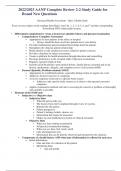
2022/2023 AANP Complete Review 2-2 Study Guide for
Brand New Questions
Advanced Health Assessment – Quiz 2 Study Guide
Focus on your studies on the readings from Bates’ text Chs. 1, 2, 3, 4, 5, 6, and 7 and the corresponding
PowerPoint (PPT) slides/audio lectures.
• Differentiate comprehensive versus a focused (or episodic) history and physical examination
• Comprehensive (Complete) Assessment
▪ Appropriate for new patients in the office or hospital
• Always should be done on all new patients never seen before
▪ Provides fundamental and personalized knowledge about the patient
▪ Strengthens the clinician-patient relationship
▪ Helps identify or rule out physical causes related to patient concerns
▪ Provides a baseline for future assessments
▪ Creates a platform for health promotion through education and counselling
▪ Develops proficiency in the essential skills of physical examination
▪ Requires a greater length of time
▪ Includes all of the patient’s past medical history, family history, personal and social
history, medications, allergies, and complete review of all systems (ROS)
• Focused (Episodic, Problem-oriented, SOAP)
▪ Appropriate for established patients, especially during routine or urgent care visits
▪ Addresses focused concerns or symptoms
▪ Assesses symptoms restricted to a specific body system
• Addresses only specific body systems as it relates to the reported concerns/
symptoms
▪ Applies examination methods relevant to assessing the concern or problem as thoroughly
and carefully as possible
• Elements of the SOAP note
• Subjective vs. Objective data
▪ Subjective Data
• What the person tells you
• The history from chief complaint through review of systems
• Reported by the patient
• Patient perspective
• Patient’s feelings, beliefs, desires, etc.
• Information that cannot be measured
• Makes up your health history portion of clinical encounter
▪ Objective Data
• What you detect during examination
• All physical examination findings
• What you see, hear, feel, touch, smell
• Labs and diagnostic tests
• Information that can be directly observed and measured by the clinician
• Components of a health history AND what type of information is collected in each area
▪ Initial Information
• Date and time of evaluation of the patient
• Identifying Data
• Age and gender
,2022/2023 AANP Complete Review 2-2 Study Guide for
Brand New Questions
• Source and Reliability
• Who is providing you the information?
• Patient? Family? Friend?
• Is the patient reliable?
▪ Chief complaint (C/C)
, 2022/2023 AANP Complete Review 2-2 Study Guide for
Brand New Questions
• Reason for the patient visit
• Should be documented in the patient’s own words (or that of the person reporting
if not the patient)
• Should be documented in one sentence
• Examples:
• “I have chest pain”
• “I am here for an annual wellness visit”
• “Mom was acting confused”
• In a case where someone other than patient is reporting
• A poor example is “I am here for a follow up”
• Better is “I’m here for a follow-up evaluation of my sprained
ankle”
▪ History of Present Illness (HPI)
• Expansion of the chief complaint, as if you are telling a story
• Sequential (chronological description) of the patient’s subjective report of
experiences/ symptoms related to the chief complaint or reason for clinical
encounter
• Should include a relative description of the patient’s complaints and issues,
baseline health, a narrative of events leading up to the visit
• Includes pertinent positives and pertinent negatives
• Pertinent positives – patient reports or affirms a finding (what the patient
has)
• Examples: weight loss within 3 weeks or cough with mucous
production
• Pertinent negatives – patient denies a finding (patient does not have)
• No nausea, vomiting, diarrhea, constipation, denies fever
• Should always include pertinent positives and negatives in your HPI and
ROS
• Attributes of each system reported should be fully described
• Organize questions about reported symptoms using OLD CARTS and Box 3-4 in
text
• OLD CARTS is used to pursue the attributes of patient’s symptoms and is
documented as part of the HPI
• With example: chest pain
• O – onset
• When did the chest pain start? (Document the actual
date if possible)
• Ask what the patient was doing (what caused it?)
• L – location
• Can you tell me exactly where the pain in?
• Ask the patient to point to it
• D – duration
• How long did/does the pain last?
• Ask if they have any more occurrences of the chest
pain and describe each instance
• C – character
• Describe what the pain feels like, exactly how they
Brand New Questions
Advanced Health Assessment – Quiz 2 Study Guide
Focus on your studies on the readings from Bates’ text Chs. 1, 2, 3, 4, 5, 6, and 7 and the corresponding
PowerPoint (PPT) slides/audio lectures.
• Differentiate comprehensive versus a focused (or episodic) history and physical examination
• Comprehensive (Complete) Assessment
▪ Appropriate for new patients in the office or hospital
• Always should be done on all new patients never seen before
▪ Provides fundamental and personalized knowledge about the patient
▪ Strengthens the clinician-patient relationship
▪ Helps identify or rule out physical causes related to patient concerns
▪ Provides a baseline for future assessments
▪ Creates a platform for health promotion through education and counselling
▪ Develops proficiency in the essential skills of physical examination
▪ Requires a greater length of time
▪ Includes all of the patient’s past medical history, family history, personal and social
history, medications, allergies, and complete review of all systems (ROS)
• Focused (Episodic, Problem-oriented, SOAP)
▪ Appropriate for established patients, especially during routine or urgent care visits
▪ Addresses focused concerns or symptoms
▪ Assesses symptoms restricted to a specific body system
• Addresses only specific body systems as it relates to the reported concerns/
symptoms
▪ Applies examination methods relevant to assessing the concern or problem as thoroughly
and carefully as possible
• Elements of the SOAP note
• Subjective vs. Objective data
▪ Subjective Data
• What the person tells you
• The history from chief complaint through review of systems
• Reported by the patient
• Patient perspective
• Patient’s feelings, beliefs, desires, etc.
• Information that cannot be measured
• Makes up your health history portion of clinical encounter
▪ Objective Data
• What you detect during examination
• All physical examination findings
• What you see, hear, feel, touch, smell
• Labs and diagnostic tests
• Information that can be directly observed and measured by the clinician
• Components of a health history AND what type of information is collected in each area
▪ Initial Information
• Date and time of evaluation of the patient
• Identifying Data
• Age and gender
,2022/2023 AANP Complete Review 2-2 Study Guide for
Brand New Questions
• Source and Reliability
• Who is providing you the information?
• Patient? Family? Friend?
• Is the patient reliable?
▪ Chief complaint (C/C)
, 2022/2023 AANP Complete Review 2-2 Study Guide for
Brand New Questions
• Reason for the patient visit
• Should be documented in the patient’s own words (or that of the person reporting
if not the patient)
• Should be documented in one sentence
• Examples:
• “I have chest pain”
• “I am here for an annual wellness visit”
• “Mom was acting confused”
• In a case where someone other than patient is reporting
• A poor example is “I am here for a follow up”
• Better is “I’m here for a follow-up evaluation of my sprained
ankle”
▪ History of Present Illness (HPI)
• Expansion of the chief complaint, as if you are telling a story
• Sequential (chronological description) of the patient’s subjective report of
experiences/ symptoms related to the chief complaint or reason for clinical
encounter
• Should include a relative description of the patient’s complaints and issues,
baseline health, a narrative of events leading up to the visit
• Includes pertinent positives and pertinent negatives
• Pertinent positives – patient reports or affirms a finding (what the patient
has)
• Examples: weight loss within 3 weeks or cough with mucous
production
• Pertinent negatives – patient denies a finding (patient does not have)
• No nausea, vomiting, diarrhea, constipation, denies fever
• Should always include pertinent positives and negatives in your HPI and
ROS
• Attributes of each system reported should be fully described
• Organize questions about reported symptoms using OLD CARTS and Box 3-4 in
text
• OLD CARTS is used to pursue the attributes of patient’s symptoms and is
documented as part of the HPI
• With example: chest pain
• O – onset
• When did the chest pain start? (Document the actual
date if possible)
• Ask what the patient was doing (what caused it?)
• L – location
• Can you tell me exactly where the pain in?
• Ask the patient to point to it
• D – duration
• How long did/does the pain last?
• Ask if they have any more occurrences of the chest
pain and describe each instance
• C – character
• Describe what the pain feels like, exactly how they