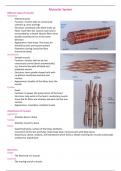
Muscular System
Different types of muscles
Voluntary
- Skeletal muscle
- Function: muscles that we consciously
control e.g. arms and legs
- Structure: cylindrical cells which make up
fibres. Each fibre has several nuclei and is
surrounded by a sheath. Muscle fibres form
bundles and they all run in the same
direction
- Appearance: look stripy. The strips are
formed by actin and myosin protein
filaments running across the fibre
transverse bands.
Involuntary
- Smooth muscle
- Function: muscles that we do not
consciously control (work automatically)
e.g. found in the walls of blood and
lymphatic vessels
- Structure: have spindle-shaped cells with
no distinct membrane and only one
nucleus.
- Appearance: bundles of the fibres form the
muscle
Cardiac
- Heart
- Function: to power the pump action of the heart
- Structure: only exists in the heart, involuntary muscle
tissue but its fibres are striated, and each cell has one
nucleus
- Appearance: resembles a skeletal muscle
Attachment of muscles
Ligaments
- Attaches bone to bone
Tendon
- Attaches muscle to bone
Fascia
- Superficial fascia: surface of the body, facilitates
movement of the skin and helps retain body heat. Connects skin with deep fascia
- Deep fascia: dense, inelastic, stiff membrane which forms a sheath covering for muscles and broads
surfaces for attachment.
Key terms
Origin
- The fixed end of a muscle
Insertion
- The moving end of a muscle
, Tone
- Slight degree of contraction by some fibres as others are relaxing
Tension
- Over-stimulation of muscle fibres
Fatigue
- When a stimulated muscle will need oxygen and fuel for its energy
Flexion
- Bend or flex a limb inward
Extension
- Bend or extend a limb outward
Abduction
- Move a limb away from the midline of the body
Adduction
- Move a limb towards the midline of the body
Rotation
- Rotate head and neck
Supination
- Turn a limb to face upwards
Pronation
- Turn a limb to face downwards
Dorsiflexion
- Flexing/bending foot up (toe up, heal down)
Plantarflexion
- Flexing/bending foot down (toe down, heal up)
Eversion
- Turning outwards away from centre e.g. sloe of foot
Inversion
- Turning towards centre e.g. sloe of foot
Circumduction
- Movement of in a circular pattern, combination of flexion, adduction, extension and abduction
Muscular contractions
How do muscles work
- When it contracts, the muscle fibres shorten
- Isometric: contractions in which there is no change on the length of the muscle
- Isotonic: contraction in which the muscle length changes, producing limb motion
How it provides movement
- Muscle attaches over a joint to create movement, pulls on a bone to cause movement
How muscle knows when to contract
- Motor nerves enter the muscles and break into many nerve endings, each one stimulating a single
muscle fibre
The source of energy to create a contraction
- Adequate blood supply to provide oxygen and nutrients and to remove carbon dioxide and wase
products from energy production.
- When the oxygen and nutrients are used up by the muscle, the waste product produced by the
venous blood stream is called lactic acid.
Different stages of contraction
Tone
- Slight degree of contraction by some fibres as others are relaxing
Different types of muscles
Voluntary
- Skeletal muscle
- Function: muscles that we consciously
control e.g. arms and legs
- Structure: cylindrical cells which make up
fibres. Each fibre has several nuclei and is
surrounded by a sheath. Muscle fibres form
bundles and they all run in the same
direction
- Appearance: look stripy. The strips are
formed by actin and myosin protein
filaments running across the fibre
transverse bands.
Involuntary
- Smooth muscle
- Function: muscles that we do not
consciously control (work automatically)
e.g. found in the walls of blood and
lymphatic vessels
- Structure: have spindle-shaped cells with
no distinct membrane and only one
nucleus.
- Appearance: bundles of the fibres form the
muscle
Cardiac
- Heart
- Function: to power the pump action of the heart
- Structure: only exists in the heart, involuntary muscle
tissue but its fibres are striated, and each cell has one
nucleus
- Appearance: resembles a skeletal muscle
Attachment of muscles
Ligaments
- Attaches bone to bone
Tendon
- Attaches muscle to bone
Fascia
- Superficial fascia: surface of the body, facilitates
movement of the skin and helps retain body heat. Connects skin with deep fascia
- Deep fascia: dense, inelastic, stiff membrane which forms a sheath covering for muscles and broads
surfaces for attachment.
Key terms
Origin
- The fixed end of a muscle
Insertion
- The moving end of a muscle
, Tone
- Slight degree of contraction by some fibres as others are relaxing
Tension
- Over-stimulation of muscle fibres
Fatigue
- When a stimulated muscle will need oxygen and fuel for its energy
Flexion
- Bend or flex a limb inward
Extension
- Bend or extend a limb outward
Abduction
- Move a limb away from the midline of the body
Adduction
- Move a limb towards the midline of the body
Rotation
- Rotate head and neck
Supination
- Turn a limb to face upwards
Pronation
- Turn a limb to face downwards
Dorsiflexion
- Flexing/bending foot up (toe up, heal down)
Plantarflexion
- Flexing/bending foot down (toe down, heal up)
Eversion
- Turning outwards away from centre e.g. sloe of foot
Inversion
- Turning towards centre e.g. sloe of foot
Circumduction
- Movement of in a circular pattern, combination of flexion, adduction, extension and abduction
Muscular contractions
How do muscles work
- When it contracts, the muscle fibres shorten
- Isometric: contractions in which there is no change on the length of the muscle
- Isotonic: contraction in which the muscle length changes, producing limb motion
How it provides movement
- Muscle attaches over a joint to create movement, pulls on a bone to cause movement
How muscle knows when to contract
- Motor nerves enter the muscles and break into many nerve endings, each one stimulating a single
muscle fibre
The source of energy to create a contraction
- Adequate blood supply to provide oxygen and nutrients and to remove carbon dioxide and wase
products from energy production.
- When the oxygen and nutrients are used up by the muscle, the waste product produced by the
venous blood stream is called lactic acid.
Different stages of contraction
Tone
- Slight degree of contraction by some fibres as others are relaxing