Week 8 - Chemoorganotrophy; Aerobic
Respiration and Fermentation
Friday, 24 March 2023 14:07
LO1: understand the basic pathways involved in aerobic respiration and
fermentation, and the different energy yields of the two processes.
LO2: understand the distinction between fermentation and anaerobic
respiration.
LOADS OF SOURCES ONLINE SAY THAT FERMENTATION IS A TYPE OF
ANAEROBIC RESPIRATION, THIS IS NOT TRUE!!!!!
- aerobic respiration and anaerobic respiration processes with the sulphate
reduction (gain of electrons) and denitrification are classified under
chemoorganotrophy because the electron donor is an organic molecule (NADH
and other stuff that is supplied to ETC).
- Nitrification and sulphate oxidation (loss of electrons) are forms of
chemolithotrophy because the nitrogen compounds and sulphur compounds
are the ones donating electrons to an ETC (instead of organic molecules) and
then allowing another molecule to accept them down the chain (anything
inorganic and low enough on the redox tower, often oxygen).
- In this case you can’t call these processes respiration because they don’t
require the oxidation of a sugar or organic molecule, don’t have a TCA cycle
prior to them etc.
- The end product of nitrification (we lose electrons and go from ammonia to
nitrite, nitrite to nitrate) is nitrate, while the end product of denitrification is
not a nitrate or nitrite (long chain of electron gaining processes that lead to N2
or something).
- Remember their names via thinking of Nitrate production vs. nitrate usage/loss
(nitrification vs. denitrification)
- Since denitrification requires the gaining of electrons, it’s at the end of its ETC
(electron acceptor).
- Nitrification requires the loss of electrons so it’s at the start of its ETC (it
donates electrons)
Introduction to Chemoorganotrophy; Fermentation
Modes of metabolism – a reminder of what we covered in Week 1
- All living things need:
- A source of raw materials
- A source of energy
, Introduction to Chemoorganotrophy; Fermentation
Modes of metabolism – a reminder of what we covered in Week 1
- All living things need:
- A source of raw materials
- A source of energy
- A source of reducing power
- Living things can be classified according to their metabolism, on the basis of
where they get these things from (in the case of “raw materials” classification is
usually on the basis of carbon source)
- Examples:
- chemoorganotrophs (= chemoheterotrophs)
- photolithotrophs (= photoautotrophs)
- chemolithotrophs (= chemoautotrophs) etc
Chemoorganotrophs
- Energy, electrons and carbon all obtained by breaking down organic
compounds, which are needed to do independent biosynthetic reactions
- Chemoorganotrophs are found wherever there is a supply of organic
compounds duh, how else will they survive - tend to predominate wherever:
a. there is a supply of organic compounds plus oxygen (or another
electron acceptor – see later lectures on anaerobic respiration)
- Chances are if there's oxygen or some other electron acceptor, the
organisms populating this area are likely to be chemoorganotrophs
b. there is a supply of organic compounds and no light (whether electron
acceptors present or not); anaerobic respiration or fermentation
- Notice how the theme is THERE MUST BE SUPPLY OF ORGANIC
COMPOUNDS
- Photoorganotroph/photoheterotrophy is another mode of metabolism that
uses organic compounds
Examples of chemoorganotrophic habitats:
- Soil (if light present tends to be aerobic near surface layers, if anaerobic (aka
anoxic; lack of oxygen) is usually also dark), because it also contains broken
down plant material
- Depending on the depth of the soil the organism lives in, it has a different
mode of metabolism, surface = photosynthesis, deep = no
photosynthesis
- Ocean sediments, chemoorganotrophs exploit any kind of sources of organic
compounds drifting down from the light layers of the ocean
- Our bodies:
- E.g. On the skin (plenty of organic compounds secreted by the host,
oxygen)
- In our guts (may be anaerobic, but also dark)
- All significant pathogens are chemoorganotrophs
- Should be obvious considering pathogens are trying to get a hold of
organic compounds from host bodies, can be parasitic but can also be
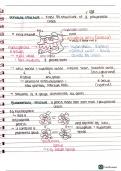
, - Net total of 2ATP in glycolysis because it uses up x2 ATP to oxidise
glucose into fructose 1,6-bisphosphate
- But then gain 4 when fructose 1,6-bisphosphate split into 2x
Glycaraldehyde-3-phosphate molecules
4-2 = 2 ATP molecules
Respiration and Fermentation
Friday, 24 March 2023 14:07
LO1: understand the basic pathways involved in aerobic respiration and
fermentation, and the different energy yields of the two processes.
LO2: understand the distinction between fermentation and anaerobic
respiration.
LOADS OF SOURCES ONLINE SAY THAT FERMENTATION IS A TYPE OF
ANAEROBIC RESPIRATION, THIS IS NOT TRUE!!!!!
- aerobic respiration and anaerobic respiration processes with the sulphate
reduction (gain of electrons) and denitrification are classified under
chemoorganotrophy because the electron donor is an organic molecule (NADH
and other stuff that is supplied to ETC).
- Nitrification and sulphate oxidation (loss of electrons) are forms of
chemolithotrophy because the nitrogen compounds and sulphur compounds
are the ones donating electrons to an ETC (instead of organic molecules) and
then allowing another molecule to accept them down the chain (anything
inorganic and low enough on the redox tower, often oxygen).
- In this case you can’t call these processes respiration because they don’t
require the oxidation of a sugar or organic molecule, don’t have a TCA cycle
prior to them etc.
- The end product of nitrification (we lose electrons and go from ammonia to
nitrite, nitrite to nitrate) is nitrate, while the end product of denitrification is
not a nitrate or nitrite (long chain of electron gaining processes that lead to N2
or something).
- Remember their names via thinking of Nitrate production vs. nitrate usage/loss
(nitrification vs. denitrification)
- Since denitrification requires the gaining of electrons, it’s at the end of its ETC
(electron acceptor).
- Nitrification requires the loss of electrons so it’s at the start of its ETC (it
donates electrons)
Introduction to Chemoorganotrophy; Fermentation
Modes of metabolism – a reminder of what we covered in Week 1
- All living things need:
- A source of raw materials
- A source of energy
, Introduction to Chemoorganotrophy; Fermentation
Modes of metabolism – a reminder of what we covered in Week 1
- All living things need:
- A source of raw materials
- A source of energy
- A source of reducing power
- Living things can be classified according to their metabolism, on the basis of
where they get these things from (in the case of “raw materials” classification is
usually on the basis of carbon source)
- Examples:
- chemoorganotrophs (= chemoheterotrophs)
- photolithotrophs (= photoautotrophs)
- chemolithotrophs (= chemoautotrophs) etc
Chemoorganotrophs
- Energy, electrons and carbon all obtained by breaking down organic
compounds, which are needed to do independent biosynthetic reactions
- Chemoorganotrophs are found wherever there is a supply of organic
compounds duh, how else will they survive - tend to predominate wherever:
a. there is a supply of organic compounds plus oxygen (or another
electron acceptor – see later lectures on anaerobic respiration)
- Chances are if there's oxygen or some other electron acceptor, the
organisms populating this area are likely to be chemoorganotrophs
b. there is a supply of organic compounds and no light (whether electron
acceptors present or not); anaerobic respiration or fermentation
- Notice how the theme is THERE MUST BE SUPPLY OF ORGANIC
COMPOUNDS
- Photoorganotroph/photoheterotrophy is another mode of metabolism that
uses organic compounds
Examples of chemoorganotrophic habitats:
- Soil (if light present tends to be aerobic near surface layers, if anaerobic (aka
anoxic; lack of oxygen) is usually also dark), because it also contains broken
down plant material
- Depending on the depth of the soil the organism lives in, it has a different
mode of metabolism, surface = photosynthesis, deep = no
photosynthesis
- Ocean sediments, chemoorganotrophs exploit any kind of sources of organic
compounds drifting down from the light layers of the ocean
- Our bodies:
- E.g. On the skin (plenty of organic compounds secreted by the host,
oxygen)
- In our guts (may be anaerobic, but also dark)
- All significant pathogens are chemoorganotrophs
- Should be obvious considering pathogens are trying to get a hold of
organic compounds from host bodies, can be parasitic but can also be
, - Net total of 2ATP in glycolysis because it uses up x2 ATP to oxidise
glucose into fructose 1,6-bisphosphate
- But then gain 4 when fructose 1,6-bisphosphate split into 2x
Glycaraldehyde-3-phosphate molecules
4-2 = 2 ATP molecules