LECTURE 1
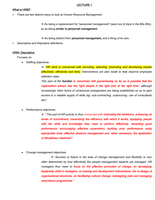
What is HRM?
There are two distinct ways to look at Human Resource Management
As being a replacement for “personnel management” (went out of style in the 80s-90s)
so as being similar to personnel management
As being distinct from personnel management, and a thing of its own.
Descriptive and Pejorative definitions
HRM- Descriptive
Focuses on:
Staffing objectives
“HR work is concerned with recruiting, selecting, promoting and developing people
effectively, efficiently and fairly. Interventions are also made to help improve employee
retention rates.
This part of the function is concerned with guaranteeing as far as is possible that the
organisation always has the 'right people in the right jobs at the right time', although
increasingly other forms of contractual arrangement are being established so as to gain
access to a reliable supply of skills (eg: sub-contracting, outsourcing, use of consultants
etc)”
Performance objectives
“ This part of HR activity is thus concerned with motivating the workforce, enhancing its
levels of commitment, maximising the efficiency with which it works, equipping people
with the skills and knowledge they need to perform effectively, rewarding good
performance, encouraging effective supervision, tackling poor performance using
appropriate tools, effective absence management and, when necessary, the application
of disciplinary measures”
Change management objectives
” Success or failure in the area of change management and flexibility is very
often determined by how effectively the people management aspects are managed. HR
managers thus need to focus on the effective promotion of change, on developing
leadership skills in managers, on training and development interventions, the re-design o
organisational structures, on facilitating cultural change, redesigning jobs and managing
redundancy programmes.”
What is HRM?
There are two distinct ways to look at Human Resource Management
As being a replacement for “personnel management” (went out of style in the 80s-90s)
so as being similar to personnel management
As being distinct from personnel management, and a thing of its own.
Descriptive and Pejorative definitions
HRM- Descriptive
Focuses on:
Staffing objectives
“HR work is concerned with recruiting, selecting, promoting and developing people
effectively, efficiently and fairly. Interventions are also made to help improve employee
retention rates.
This part of the function is concerned with guaranteeing as far as is possible that the
organisation always has the 'right people in the right jobs at the right time', although
increasingly other forms of contractual arrangement are being established so as to gain
access to a reliable supply of skills (eg: sub-contracting, outsourcing, use of consultants
etc)”
Performance objectives
“ This part of HR activity is thus concerned with motivating the workforce, enhancing its
levels of commitment, maximising the efficiency with which it works, equipping people
with the skills and knowledge they need to perform effectively, rewarding good
performance, encouraging effective supervision, tackling poor performance using
appropriate tools, effective absence management and, when necessary, the application
of disciplinary measures”
Change management objectives
” Success or failure in the area of change management and flexibility is very
often determined by how effectively the people management aspects are managed. HR
managers thus need to focus on the effective promotion of change, on developing
leadership skills in managers, on training and development interventions, the re-design o
organisational structures, on facilitating cultural change, redesigning jobs and managing
redundancy programmes.”