100% satisfaction guarantee Immediately available after payment Both online and in PDF No strings attached 4.6 TrustPilot
logo-home
Exam (elaborations)

Edexcel A-Level Mathematics - Core Pure Maths

Rating
-
Sold
-
Pages
59
Grade
A+
Uploaded on
12-05-2023
Written in
2022/2023

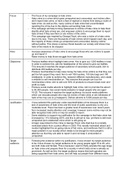
1. Order of a matrix Number of rows by number of columns 2. Square matrix Matrix of order NxN 3. Leading diagonal Diagonal of matrix from top left to bottom right 4. Conditions for two matrices to be equal - must have same order - each element in one matrix must be equal to the corresponding ele- ment in the other 5. Matrices which you can't add are... non-conformable for addition 6. Matrices which you can't multiply are... non-conformable for multiplication 7. Matrix multiplication properties Associative A(BC) = (AB)C NOT commutative AB=/=BA 8. What does it mean for matrix multi- plication A and B if each matrix only affects one of the unit vectors? 9. Geometrically what happens when multiply by I? 10. How do transformations explain asso- ciativity of matrix multiplication? AB=BA Returns object to original position In matrix (AB)C, AB represents transformation of B followed by A. (AB)C represents transformation of C followed by AB so (AB)C rep- resents C followed by B followed by A In matrix A(BC), BC represents transformation of C followed by B and A(BC) represents transforma- tion of (BC) followed by A so A(BC) represents C followed by B fol- lowed by A 11. Explain why can't you represent trans- lations with 2x2 matrix? 12. In 3D transformations how do you de- scribe rotations? 13. Things to mention when describing a sheer? 14. Matrices for a shear with x and y axis fixed respectively 15. How to find shear factor geometrical- ly? 16. How to find invariant line of shear fac- tor geometrically? The origin is invariant under all linear transformations (transforma- tions that can be represented by a 2x2) matrix. A translation would require the origin to not map onto itself You take anticlockwise and clock- wise about an axis by looking from the positive end of the axis towards the origin - which line is fixed e.g x axis - an example of a point and its im- age that's not on the fixed line Shear with x axis fixed ((1,k),(0,1)) Shear with y axis fixed ((1,0),(k,1)) Work out distance from a point P and its image using Pythagoras P' and call it d1. Work out distance from that point P to invariant line and call it d2. Do this by finding equation of invari- ant line and finding equation of line perpendicular to the invariant line that passes through P and finding where these lines cross and using Pythagoras'. The shear factor is d1/d2. Join point A and B and extend the line. Do same for the images A' and B' so that the two lines cross. Repeat this for another two points and join the points of intersection. This line is the invariant line. 17. What happens to points in a horizontal shear and a vertical shear? In horizontal shear, points above x axis move to the right and points below to the left. In vertical shear, points to the right of the y axis move up and points to the left move down 18. Matrix representing 2-way stretch ((a,0),(0,b)) represents a horizon- tal stretch SF a and a vertical stretch SF b 19. Matrix representing anticlockwise ro- tation about origin angle ¸ ((cos¸,-sin¸),(sin¸c, os¸)) 20. Proof for matrix representing rotation Rotate unit square with A(1,0) and B(0,1) mapped to A'(p,q) and B'(-q,p). Drop perpendicular from A' onto x axis. From right-triangle with OA' as hyp and perpendicular dropped as opposite cos¸=p/1 so p=cos¸ and sin¸=q/1 so q=sin¸ The matrix is then ((p,-q),(q,p)) = ((cos¸,-sin¸),(sin¸c, os¸)) 21. How to see if matrix ((a,b),(c,d)) repre- sents a rotation? 22. Matrix representing reflection in line y=xtan¸ If it represents a rotation a=d and b=-c ((cos2¸s, in2¸),(sin2¸,-cos2¸)) 23. Invariant points + how to find Points which maps onto themselve under a transformation. Find by multiplying transformation matrix M = ((a,b),(c,d)) by position vector x,y and setting equal to x,y since image has same position. You get ax+by=x and cx+dy=y. If both equations are equivalent then 24. How to find a line that a matrix maps all points onto? 25. How to denote points on line of invari- ant points + e.g for line y=2x? the line is a line of invariant points. If not then origin is only invariant point under that transformation Multiply the matrix by vector x,y and factor out common factors from the resulting entries to find equation As coordinates e.g (»,2»w)ould be for the line y=2x 26. Invariant line + how to find Where all points on line AB map onto same line, but not necessarily same point. Multiply matrix by (x,mx+c) and set equal to (x',mx'+c). Substitute x' into mx'+c. Gather all terms onto one side and factor c and x. For the expression to equal 0 set the two big terms equal to 0 and solve for m and c. The value of m obtained from e.g c(m-1) = 0 might not satisfy the oth- er term to equal 0 so check. If this value of m agrees then in the final equation you need the +c since c can equal anything. Now you have m and c (likely 0) so make equation y=mx+c 27. What invariant lines can't be found with normal method + why + how to find these? 28. Fact about invariant vertical lines + what matrices have them - vertical lines because they can't be written in form y=mx+c - multiply by vector (x, y) and set equal to (x, Y) and then solve If one vertical line not passing through the origin is an invariant line then all vertical lines are invari- 29. If a line is invariant it is also a line of ant - matrix has the form ((1, 0), (c, d)) False. If a line is a line of invariant invariant points. True or false? If false, points it is also an invariant line. how should it be? 30. Reflections and invariant lines and in- variant points 31. What happens if trying to find invari- ant line but can't solve for m because the equation has no real roots? 32. How can two different transformation matrices give same VISUAL image? All points on reflection line, l are invariant as they map onto them- selves so l is a line of invariant points. All lines perpendicular to l are in- variant lines as the points on these lines map onto some other point on the same line. If can't solve for m that means there is no invariant line in the form y=mx+c If the columns are the same e.g ((2,5),(0,1)) and ((5,2),(1,0)) both give transformations that look the same 33. Composition of transformations Carrying out multiple transforma- tions 34. How to verify if a line is an invariant line under transformation represented by matrix M? 35. Why irrational numbers not shown as separate set in diagrams? Take position vector of a general point on the line e.g »,2»for y=2x and pre-multiply by M. If The image also lies on the line then verified. The set of real numbers includes rational and irrational numbers. Numbers that are rational will fall into the rational set. Numbers that are irrational will still be in the real numbers, but not in the rational set, so no need for separate set of irra- tionals. 36. Conditions for two complex numbers - the real parts must be equal to be equal - the complex parts must be equal 37. Conditions for a complex number to - real part must be 0 be zero - complex part must be 0 38. Difference between imaginary and Pure imaginary number is just an complex number imaginary number with no real part e.g 2i Complex number is a number with an imaginary and a real part e.g. 5-2i 39. Result of adding z and z* or multiply- Always a real number ing them where z is a complex number 40. Is polynomial with roots ±, ², ³t.h..e only No. The same equation with each equation with these roots? term multiplied by k also has these roots. 41. Find quartic with roots ±, ², ³, ´ zt-(£z±³)+(£z±²²-)(£z±+²£³)±²³´=0 Where £± = ±+²s+u³m+´ o"f roots" £±² = ±²+±³s+u±m´+o²³f+p²r´o+d³´u"ct of pairs of roots" £±²³ = ±²s³u+m±²o´+f ±p³r´o+d²³u´c"t of triplets of roots" £±²³´pr=od±u²³c´t"of roots" 42. Relation between roots of polynomial For a quadratic £± =b/-a £±²c/=a and coefficients For a cubic you also have £±²³d/=a.- For a quartic you also have £±²e³/´a=. And so on... The signs always alternate from left to right starting with negative 43. Given a polynomial with roots ±, ²,d³e, - scribe 2 methods of finding polynomi- al with roots 2±+1, 2²+1, 2³+1 Substitution method is letting w = 2x+1 and rearranging to get x=(w-1)/2 and substituting this x into the original equation. Or use relationships between co- efficients and roots. For new equa- tion sum of roots is 2±+1+2²+1+2³+1 = 2(±+²+³)+H3e. re, ±+²i+s³just the sum of the roots of the original equation so sub this in. Similar applies for other coefficients. 44. How to find ±³+²³+f³o³r a cubic equation? - expand (£±)³ =b/-a - expand (£±)(£±²) - and do stuff 45. When can you NOT use method of relating roots of polynomial to coeffi- cients? 46. How to find square root of a complex number z = x+yi? When 1 or more coefficients of the equation are complex Take general complex number a+bi and square it to get a²-b²+2abi. Equate this with the square so x+yi = a²-b²+2abi. For these complex numbers to be equal, the real parts must be the same and the imag- inary parts must be the same so you get simultaneous equations x = a²-b² and y = 2ab 47. Principal argument Angle ¸a complex number makes with positive x axis where -À¸=À 48. How does modulus-argument form work? The modulus of a complex num- ber is r. It's argument is the angle it makes with the positive x axis. If you draw a right-triangle with r as hyp from basic trig you can see x=rcos¸and y=rsin¸.Substituting these into z=x+yi and factoring r out you get z=r(cos¸+isin¸) 49. Triangle inequality theorem |z1+z2| = |z1| + |z2| i.e. sum of lengths of two sides of a triangle is always greater than or equal to length of third side 50. Useful property related to squaring modulus of complex numbers and their complex conjugates? 51. Compound angle formulae for sin and cos 52. Explain what happens geometrically when multiplying complex numbers? 53. Useful property when adding and sub- tracting complex numbers and finding conjugates zz* = |z|² sin(A+B) = sinAcosB+sinBcosA sin(A-B) = sinAcosB-sinBcosA cos(A+B) = cosAcosB-sinAsinB cos(A-B) = cosAcosB+sinAsinB When multiplying z1*z2, z1 is en- larged by SF |z2| because |z1z2| = |z1||z2| z1 is rotated anticlockwise about (0,0) by angle arg(z2) because arg(z1z2) = arg(z1) + arg(z2) conj(z±w) = conj(z)±conj(w) 54. Circle locus on complex plane |z-a| = r is circle centre a, radius r 55. Halfline locus on complex plane arg(z-a) = ¸is a half-line starting at a, making an angle ¸with the posi- tive x axis 56. What happens at point z=a on half line? 57. Describe locus of z given arg((z-a)/(z-b))=± Leave hole because arg(0) is un- defined - partial circle with end points at a and b - this can be seen by writing it as arg(z-a)-arg(z-b)=± - let arg(z-a)=¸and arg(z-b)=Æso you have two separate half lines that intersect at a point P with angle of intersection ±which can be easily seen from geometry - as ¸and Ævary they do so in a way that keeps ¸-Æ=± - since angles subtended from an arc are equal P traces out part of the circumference 58. Equidistant line locus on complex |z-a| = |z-b| is line equidistant from plane points a and b. In other words it is their perpendicular bisector 59. How to find max/min values of arg(z) Draw circle for the locus of points given |z-a| = r? satisfying |z-a|=r. Draw two tan- gents from the circle that go through the origin. Form right-trian- gle with OC as hyp where C is cen- tre of circle and the opposite side is the radius. Work out angle between hyp and tangent using sin. If the circle does not touch an axis form another right-triangle with OC has hyp again but with the perpen- dicular dropped from a to an axis as the opposite and work out angle between the hyp and the axis using sin. From this angle subtract the previ- ous angle worked out arg of point on circle that's part of tangent to get min and add to get max but will likely depend a lot on situation 60. How to find max/min values of |z-b| given |z-a|=r? Draw circle for the locus of points satisfying |z-a|=r. Draw a line con- necting centre of circle to point b and extend it so that it cuts the circle at two points. Work out what these points are by working out equation of line and using simul- taneous equations. Work out dis- tances from b and each intersec- tion point. Furthest point from b is max, other is min. 61. |z-a|=|z-b|=|z-c| z is equidistant from a, b AND c so the locus is a single point. You get this point by drawing loci for two pairs separately and it's where they intersect. Note, you don't need to draw 3 lines since two lines will intersect at the point you need al- ready. 62. Why can't you represent complex numbers on a single number line? 63. When representing complex numbers in modulus argument form on Argand diagram what must you make sure to do? They have two components so need two axes - draw them as lines and label the line with the modulus - label in any angles 64. Sequence Ordered set of objects with an un- derlying rule 65. Series Sum of consecutive terms in se- quence starting from first term 66. Two ways of defining a sequence - deductive = work out term from it's position (position-to-term rule), defined by nth term - inductive = defined by first term, u™ and a term-to-term rule to generate the next term in the sequence such as u™Š•=2u™ 67. Main ways to describe a sequence - increasing = each term is greater than the previous - decreasing = each term is smaller than the previous - oscillating = the terms cycle above and below a middle value - periodic = repeats at regular inter- vals - converging = the terms get closer and closer to a limiting value but never actually reach it - diverging = terms don't approach a value 68. How to work out sum of a series in the most basic way (except actually literally adding each term)? 69. Standard result for sum of first n inte- gers 70. Standard result for sum of first n squares 71. Standard result for sum of first n cubes 72. "Trick" when working out sum of first n+1 terms 73. How to work out sum of first 2n terms given result for sum of first n terms? 74. How to work out sum of terms from n to m inclusive? Write the sum Sn and then Sn in reverse below it. Add them to get 2Sn and divide by 2. n(n+1)/2 n(n+1)(2n+1)/6 n²(n+1)²/4 If you have the result for the sum of the first n terms you can simply add on the (n+1)th term Simply substitute n for 2n in the result Work out sum of first m terms S˜ and take away sum of first n-1 terms to get S˜-S™‹• 75. Link between two of the first three standard summation results Sum of first n cubes is the re- sult of the sum of the first n in- tegers squared. i.e n²(n+1)²/4 = (n(n+1)/2)² 76. Method of differences Finding sum of first n terms of a sequence by splitting it into two parts, one subtracted from the oth- er. Write the first few terms and the last few terms. Find pattern for which terms cancel. The terms which cancel form a symmetrical pattern. For example the first and last terms may be left over or the 2nd and 2nd to last or any other combination 77. Telescoping sum Where a long sum cancels to only a few terms - in method of differ- ences 78. Given formula for S™ how to work outSimply substitute an+r into the for- formula for S•™Šc 79. Why is proof by exhaustion not good enough for most mathematical con- jectures? 80. Why, to prove a conjecture, provid- ing more and more evidence is not enough? 81. Steps for proof by induction for prov- ing the result of a series mula Because you can't be sure that the next case will be a counter-exam- ple that disproves the conjecture and it is often impossible to try every single possible case. Each bit of evidence supports the conjecture, but doesn't prove it. Need a proper mechanism for proof such as induction. - test for base case, usually n=1, and say LHS = RHS therefore true for n=1 - (optional) find target expression 82. Notation that means for integer values of x greater than or equal to 1 (useful in proof by induction) 83. Prove by induction that sum of first n integers equals n(n+1)/2 84. How is proof by induction slightly dif- ferent when proving a matrix raised to a power equals something? by substituting n=k+1 into the re- sult you are trying to prove so you know what you should get if the conjecture is true - assume the result is true for n=k and write the result for n=k. Then write the result for n=k+1 by writ- ing the assumed result for n=k and adding on the (k+1)th term and simplify. Tip: it is easier to factor out all fractions. Factor out k+1 in the end to show it is the next term - write sentence saying it is true for n=1 and if it is true for n=k then it is true for n=k+1 so by induction it must be true for 1+1=2, 2+1=3 etc for all positive integers greater than or equal to one x $z - for n=1, LHS = 1, RHS = 1(1+1)/2 = 1 so true for base case - target expression for n=k+1 is (1/2)(k+1)(k+2) - assume true for n=k, so on top: n=k, bottom: r=1 r=(1/2)k(k+1). for n=k+1, on top: n=k+1, bottom: r=1 r=(1/2)k(k+1)+(k+1) = (1/2)(k+1)(k+1+1) = (1/2)(k+1)(k+2) as expected - blah - test for base case n=1 as usual - target expression as usual by subbing n=k+1 - assume true for n=k as usual. 85. How is proof by induction slightly dif- ferent when proving result for induc- tive sequence? 86. Simple way of showing a conjecture is not true 87. What point do most proofs break down? 88. How to prove certain general terms of Then for n=k+1, it is the result for the matrix raised to the (n=k)th power multiplied by the original matrix because O5 z5O¹= - test for base case n=1 as usual - target expression as usual by subbing n=k+1 - assume true for n=k as usual so u– = [insert assumed result]. Then for n=k+1 use the original inductive definition and substitute in the re- sult for u– and simplify Substituting in numbers until you get counter-example Inductive step Set the general term equal to np a sequence are multiples of a number, where p is a positive integer. Work p? out what is would be for n=k+1 so (k+1)p and continue 89. Prove F™Š…=5F™Š•+3F™ where F is FF™iboŠn…ac=cFi ™Š„+F™Šƒ sequence 90. General effect of transforming unit square by matrix ((a,b),(c,d)) 91. Proof for general effect of transform- ing unit square by matrix ((a,b),(c,d)) = (F™Šƒ+F™Š‚)+F™Šƒ = 2F™Šƒ+F™Š‚ = 2(F™Š‚+F™Š•)+F™Š‚ = 3F™Š‚ + 2F™Š• = 3(F™Š•+F™) + 2F™Š• = 5F™Š• + 3F™ Image is a parallelogram with area ad-bc - (1,0) will be mapped to (a,c) - (0,1) will be mapped to (b,c) - (1,1) will be mapped to (a+b, d+c) - work out area of parallelogram by 92. Useful fact about determinant of in- verse of matrix 93. What does determinant of 2x2 matrix tell you geometrically? 94. What does determinant of 3x3 matrix tell you geometrically? 95. Geometric meaning if determinant 0 for 2x2 matrix 96. Geometric meaning if determinant 0 for 3x3 matrix 97. Explain geometrically useful property of determinants when multiplying ma- trices? 98. Geometric meaning if determinant of 2x2 matrix = 0? working out area of large rectangle (a+b)(d+c) = ab+ac+bc+bd - subtract areas of two triangles ac/2 and bd/2 - subtract areas of two trapezia bc+bd/2 and bc+ac/2 - end up with ad-bc as area of par- allelogram det(A{¹) = 1/det(A) Determinant tells you scale factor by which the area is enlarged The scale factor by which the vol- ume is englarged - orientation isn't preserved - vertices have reversed so that go- ing clockwise for the transformed unit square the points will be OJ'P'I' rather than the OIPJ of the object unit square - orientation isn't preserved - a triangle labelled ABC from point S is labelled A'B'C' anti-clockwise when seen from S' det(AB) = det(A) * det(B) Because an enlargement of SF det(A) followed by enlargement of SF det(B) result in enlargement SF det(AB) Enlargement SF 0 so image has 0 area effectively. The matrix maps all points onto a straight line with equation cx-ay=0 so there are an 99. Geometric meaning if determinant of 3x3 matrix = 0? infinite number of points that map to the same point. Can't do in- verse since an inverse would have to map each point to just anoth- er point, not an infinite number of them. Means image has no volume so all points are mapped to same plane 100. Proof that if 2x2 matrix is singular then Singular means determinant = 0 so it maps all points onto the line cx-ay=0 101. Pre-multiply A by B and post-multiply A by B meanings 102. What can you conclude about the el- ements in 2x2 matrix if determinant = 0? 103. Special case of determinant 0 for 2x2 matrix + geometric interpretation 104. Multiplying matrix by inverse (if it ex- ists) for the matrix ((a,b),(c,d)), ad-bc=0 Ô ad=bc Ô c/a=d/b Multiplying by position vector of the general point (x,y) to get ((a,b),(c,d))(x,y) = (ax+by,cx+dy) The line cx-ay=0 is y=cx/a so gra- dient is c/a with no y intercept Equating the x and y coordinates by factor k cx+dy=k(ax+by) you get k=c/a=d/b so the gradient is c/a Substituting into y=mx, y=cx/a Ô cx-ay=0 Pre = B before A so BA Post = B after A so AB ad-bc=0 4 ad=bc 4 a/b=c/d The zero matrix maps all points to the origin Gives identity matrix 105. Finding inverse of 2x2 matrix Switch positions of a and b. Multiply c and d each by -1. Multiply each element in matrix by 106. If inverse doesn't exist then matrix is else it is 1/determinant i.e inverse of A = ((a,b),(c,d)) is (1/ad-bc)((d,-b),(-c,a)) doesn't exist = singular does exist = non-singular 107. Prove algebraically (MN){¹ = N{¹M{¹ Let X = (MN){¹ (i.e X is the inverse of MN) 4 XMN = I (matrix by its inverse gives identity) XMNN{¹ = IN{¹ = N{¹ (post-multiplying by N{¹) XM = N{¹ XMM{¹ = N{¹M{¹ (post-multiplying by M{¹) X = N{¹M{¹ 4 at the beginning we said X is the inverse of MN and so (MN){¹ = N{¹M{¹ 108. Prove that if matrix A has an inverse then the inverse is unique Assume A has two different invers- es B and C BAC = (BA)C=IC=C because B is inverse of A BAC = B(AC)=BI=B because C is inverse of A therefore C=B and A has only one inverse 109. Geometrically why is (MN){¹ = N{¹M{¹ MN is doing transformation N fol- lowed by M so to undo it you undo M first and then N 110. Tip for raising a matrix to very high power e.g 100 111. Trick when given e.g A²=A{¹ Look at what transformation the matrix represents and see what doing the transformation that many times will do to an object such as unit square 112. Two lines y=f(x) and y=g(x) coin- cide. What will happen when you try to solve the equations using matrix method? 113. How to prove a matrix is an inverse of another? 114. What to do if determinant = 0 when using matrix to solve simultaneous equations? Look at the powers A²=A{¹ A²A=A{¹A A³ = I Determinant will be 0 as there are infinitely many solutions Multiply them and you should get identity matrix Equate the two equations by a fac- tor e.g 2x+6y=k(3x-5y). If k is not the same every time then the equa- tions are inconsistent and the lines don't cross meaning parallel. If k is the same then the equations are multiples of each other so they are the coincident and there are infi- nitely many solutions. 115. Dot product definition + alt name Product of magnitudes of two vec- tors multiplied by the angle be- tween them 5î.5ï =co|5sî(|¸|)5ï| Alt name = scalar product 116. Perpendicular and parallel vectors dot product 117. How to generally prove things using dot product? Âmeans 5î.5ï =sin0ce ¸=90°so cos(¸) = 0 || means 5î.5ï = ±s|i5nîc||e5ï¸|=0°or 180° so cos(¸) = 1 To prove things using dot prod- uct use vectors such as 5. =a5"+- b5a#nd 5/ =c5"d+5T#h. e dot product is ac+bd, but it is also |5.c||o5s/|¸ = sqrt((a²+b²)(c²+d²))cos¸so equate these two 118. Vector equation of a plane (2 slightly (5+-w5hî)e.5re' 5+ =x,y,z, 5î =x€,y€,z€ different forms) 119. How to convert from vector equation of plane to Cartesian? the position vector of a given point on the plane, 5' = a,b,c is a normal vector to the plane Could write this as 5+.5'=5î.5' Substitute general vector x,y,z for 5a+nd a normal vector a,b,c for 5to' get x,y,z.a,b,c = ax+by+cz. This equals 5î.5' x=€,y€,z€.a,b,c ax€+by€+cz€ which is a constant s label it -d ax+by+cz = ax€+by€+cz€ ax+by+cz+d = 0 120. 2 ways of working out d for equation of plane? 121. What parts of Cartesian equation de- termine what about the plane? - substitute in coordinates of known point and solve for d - or use d = -5î.5' Coefficients on x, y, z determine direction. d determines location 122. Useful property about dot product of 5 .5 sin=ce|5if 5|² x=,y,z then 5 .5 = vector by itself x²+y²+z² which is |5 |² 123. Angle between two planes Work out angle between normal vectors 124. Find normal vector to two known vec- tors As the dot product of each with the normal = 0, you can set up a system of 2 equations with 3 un- knowns. Since the vector can be of any size, set one of the variables to any value and solve for the others. The resulting vector will always be in the same direction just scaled differently depending on value of first variable you choose 125. Equation of plane given points A, B, C Work out vectors AB and AC. Find a vector that's normal to both of these. This will be the normal vec- tor and will give you the coefficients on x, y, z. To work out d you can substitute one of the points in and solve for d. 126. How to determine which of the 5 pos- sible plane arrangements you have? 127. Describe prismatic intersection of 3 planes 128. 128. - det =/= 0 then planes intersect at unique point Det = 0 then 4 possibilities - all 3 equations multiples of each other then all parallel (note if the constants are also multiples of each other then they're exactly the same plane) - 2 equations multiples of each oth- er but not the other then 2 parallel with 3rd intersecting (same things about constants applies here) Determine whether the equations are consistent by manipulating them and eliminating variables. - while trying to solve the equa- tions simultaneously end up with a contradiction so no solution then 3 planes don't intersect so prismatic intersection (triangular) - infinitely many solutions then equations are consistent so a sheaf (intersect at a single line) - each pair of planes intersects at a line - the 3 lines are parallel Given 3 points A, B, C on a plane and given that a line perpendicular to the plane passes through either A, B or C how can you work out through which point the line passes? 129. "If a vector a perpendicular to a plane then it's perpendicular to..." Is the converse true? If not, how should it be? Work out the three vectors on the plane AB, BC and AC. Let O be any point on the line. Work out AO, BO and CO. Work out the dot products AB.AO etc... If e.g AB.AO = 0 then that means the line AO is perpendicular to AB so the line must go through A. - if a vector a perpendicular to a plane then it's perpendicular to all vectors in the plane - converse is not true because a vector needs to be perpendicular to two non-parallel vectors in the plane for it to be perpendicular to the plane 130. What is a right-handed triple? 3 vectors that are mutually perpen- dicular 131. Area and arc length of sector when using radians 132. "Trick" to use to oscillate between 2 terms/sequences/whatever? 133. Graphically why do all cubics with real coefficients have at least 1 real root? A = r²¸/2 L = r¸ Use the fact that ((-1)•+1)/2 = 1 when n is even and = 0 when n is odd so multiply this expression by whatever you need. Make the power n±1 to shift the pattern by one. If the coefficient on x³ is positive then y is negative for large negative x and positive for large positive x so the graph crosses x axis at least once giving real root of f(x) = 0 If the coefficient on x³ is negative then y is positive for large negative x and negative for large positive x 134. If line l is a line of invariant points under transformation represented by M why, geometrically, is this line also a line of invariant points of transforma- tion represented by M•? 135. Trick for raising a singular matrix, M to a power n 136. Given that matrix T maps all points on a line y=ax+b onto a given point, how can you find T? 137. Use set notation to show the inequali- ty x is greater than 4 or less than 0 138. Use set notation to show the inequali- ty x is greater than 4 and less than 8 so crosses the axis axis at least once giving real root of f(x) = 0 M• represents represents the trans- formation repeated n times Each repeat leaves the points on the line l unchanged (a+d)•{¹M Find the coordinates of x and y intercepts of the given line and multiply their position vectors by the general matrix ((a,b),(c,d)), set equal to position vector of given point and solve for each matrix ele- ment. In each case either the x or y coordinate will be 0, making things easier {x: x0 * x4} {x: 4x8} 139. dy/dx x• implies what type of graph Polynomial graph of order n+1 E.g if dy/dx x then it's a quadratic graph 140. dy/dx y implies what type of graph Exponential 141. Indefinite integral Integral with no limits so has an arbitrary constant of integration 142. Definite integral Integral that is the difference be- tween values of integral at limits 143. Why is constant of integration needed in indefinite integration? 144. Why is constant of integration not needed in definite integration? The curve after integrating could have any y intercept but the gradi- ent function would still be the same It cancels out when subracting 145. Fundamental theorem of calculus - area under graph can be approx- imated by summing areas of rec- tangular strips under graph - taking the limit as the rectangles become narrower is the integral - fundamental theorem of calculus says this process is same as doing reverse of differentiation 146. How to find area between two curves? Subtract equation of bottom curve from equation of top and integrate 147. How to show 3 points A, B, C, are collinear? - find two vectors with a common point e.g AB and BC - write one vector as a multiple of the other to show they're parallel - both vectors have a common point as well so points are collinear 148. AÒB meaning - A implies B - B is necessary for A (because as soon as A happens B also hap- pens) - A is sufficient for B 149. AÔB meaning - A implies B and is implied by B - A is necessary and sufficient for B 150. Logical relationship between quadrat- ic and perfect squares 151. 151. Quadratic is a perfect squareÔdis- criminant=0 (there will be a repeated root) Given e.g x+y=3, maximise and min- imise x²y 152. Difference between line and line seg- ment - rearrange to get y=3-x - sub into expression to maximise and call it E to get E=x²(3-x)=3x²-x³ - find dE/dx and set equal to 0 to find turning points so dE/dx=6x-3x²=0 so x=2, x=0 - use d²E/dx² to determine if max/min points, at x=2, it's -6 so max point, at x=0 it's 6 so min point - max when x=2, y=1 - min when x=0, y=3 Line segment is line joining two points on a coordinate axis Line continues forever 153. 3 circle theorems you need to know - angle in semicircle is a right angle - perpendicular from centre of cir- cle to chord bisects the chord - radius to a given point on circum- ference is perpendicular to the tan- gent at that point 154. Is x²+2y²-3x+4y=11 equation of circle? No. For it to represent circle, coef- Explain 155. Why will set of circles passing through points P(a,b) and Q(x,y) all lie on straight line? 156. What does it mean graphically if dy/dx=0 and d²y/dx²=0? ficients on x² and y² must be equal Because for all the circles pass- ing through these points, PQ is a chord so diameter going through midpoint of PQ is a perpendicular bisector of P and Q and therefore all circles lie along this line Nothing. It could be a local max or min or an inflection point so must use gradient method 157. Concurrent lines Multiple lines that intersect at same point 158. How to find radius of cylinder cut out of sphere? 159. Given 2 turning points of cubic, how to work out equation of cubic? 160. What to remember when using sine rule? Create right-triangle with vertices centre of sphere, point where cylin- der touches sphere and midpoint of cylinder height, h/2 - sub coordinates of points into ax³+bx²+cx+d=y - sub x coordinate of one of the points into 3ax²+2bx+c=0 because gradient at turning point = 0 - solve simultaneous equation If finding an angle ¸,check whether 180-¸is also a solution 161. Graph of direct proportionality Straight line through origin 162. How to find equation of circle given 3 points - sub coordinates into x²+y²=r² to set up simultaneous equations OR - use fact that perpendicular bisec- tor of chord goes through centre and find the perpendicular bisector of two pairs of points, find where they intersect to get the centre, and find distance from centre to one of the points to get radius 163. CAST 1st quadrant All trig functions pos- itive 2nd quadrant Sine is positive 3rd quadrant Tan is positive 4th quadrant Cos is positive 164. Trig functions relation to unit circle + 2 identities 165. 165. - x=cos¸and y=sin¸from basic trig - y/x=tan¸=sin¸c/ os¸ - using Pythagoras' x²+y²=1² so cos²¸+sin²¸=1 Sin and cos curves relation to unit cir- cle 166. What to do in trig equation where an- gle not simply ¸and have to find ¸in range e.g solve cos(2¸+30)=1for 0- ¸360? 167. Number of turning points on polyno- mial of order n - sin curve generated by taking y values from unit circle as ¸varies - cos curve generated by taking x values from unit circle as ¸varies Must adjust range For e.g as 0¸360, 302¸+30750 At most n-1 168. Factor theorem (x-a) is a factor of f(x) Ô f(a)=0 169. Another term for "roots" of polynomi- al "Zeroes" of a polynomial 170. Discontinuous and continuous graph Branches never meet so impossi- ble to draw in one smooth go. Continuous = no breaks 171. Asymptote Lines approaching a value but nev- er reach it 172. Oblique asymptote Asymptote that's slanted relative to axes 173. y=f(x-t)+s Replacing x with x-t and y with y-s results in translation by column vector t, s 174. y=af(x/b) Replacing x with x/b and y with y/a results in stretch parallel to x axis SF b and parallel to y axis SF a 175. f(x)=x• stretch parallel to y axis SF a isStretch parallel to x axis SF 1/(nth equivalent to what? 176. Polar form of vector root of a) 177. Converting from polar form to compo- nent form of vector 178. Where is point R in relation to P and Q if |PR|=|QR|? 179. If PR is same direction as QR then where do points P, Q, R lie relative to each other (r,¸)is polar form where r is mag- nitude and ¸is angle it makes with positive x axis (r,¸) = rcos¸,rsin¸ R is on the perpendicular bisector of PQ In a straight line with either P or Q in the middle 180. â vector Unit vector in direction of a 181. A and B are points on plane with po- sition vectors 5and 5If e. very point on the plane can be written as p5q5w+ hat does it tell you about about positions of A and B? O A and B do not lie on straight line. i.e OA and OB aren't multiples of each other 182. Exponential growth Graph increases at ever-increas- ing rate 183. Logarithm and exponent forms equiv- alence log•b=x Ô b=aã 184. Prove log(xy)=log(x)+log(y) Exponential and logarithm are in- verses of each other so x=a^log•x and y=a^log•y So xy=a^(log•x+log•y) Taking log to base a of both sides log•(xy)=log(a^(log•x+log•y))=log•x+lo 185. Prove log(x/y)=log(x)-log(y) Exponential and logarithm are in- verses of each other so x=a^log•x and y=a^log•y So x/y=a^(log•x-log•y) Taking log to base a of both sides log•(x/y)=log(a^(log•x-log•y))=log•x-log 186. Prove log(x•)=nlog(x) log(x•)=log(xxx...x)=log(x)+log(x)+...+l 187. Prove log(1/x)=-log(x) Using logarithm divi- sion law derived before log(1/x)=log(1)-log(x)=-log(x) be- cause log(1)=0 188. What to make sure when solving in- equalities with logarithms? log•b is negative if EITHER 0a1 OR 0b1 so make sure to flip sign when dividing/multiplying 189. Logs of negative numbers? No real answers 190. Derive formula for e Take interest rate to bee 100% for one year which turns into 50% for every half year, 25% for every quarter year and so on Eventually, this becomes (1+1/n)• when interest is added at infini- tesimally small intervals as n ap- proaches infinity and the limit is e=2.... 191. How to model logarithmic relationship by straight line, 2 main versions Take logs of both sides and com- pare with y=mx+c Case 1: a=bx• log(a)=log(x)n+log(b) so m=n, c=log(b) Case 2: a=bnã log(a)=xlog(n)+log(b) so m=log(n), c=log(b) 192. Prove ln(x)=log(x)/log(e) - let y=ln(x) so x=e¸ - log(x)=log(e¸)=ylog(e) - so y=log(x)/log(e) 193. Increase of 10 decibels increases loudness by factor of 10. By what fac- tor does loudness increase if decibels increased by n? - subbing back y=ln(x) you get ln(x)=log(x)/log(e) 10^(n/10) - the base 10 is from the 10x loud- ness - the n/10 comes from increase in 10 decibels 194. Can you simplify e²zá•}²~? Yes e²zá•}²~=e²xeá•}²~=2e² 195. How to model curve if constant added e.g y=C+abã Bring C onto other side and plot log(y-C) instead of log(y) and carry on as usual, making sure to adjust for the C 196. ™Cc meaning + what it tells you? "n choose r" The number of ways of choosing r distinct objects from a set of n 197. Formal way of defining Pascal's trian- gle using combinations 198. Condition for special case of binomial expansion to work ™Š•CcŠ•=™Cc+™CcŠ• Power, n must be positive integer so that the last powers approach 0 and no more terms can be added 199. How to estimate 0.98w using binomial Use first few terms of expansion for expansion? (1+x)• where n=7 in this case and sub x=-0.2 200. Trick when finding ™Cc for large r ™Cc=™C™‹c due to symmetry 201. Trick to expand (a+b+c)• Let x=b+c so the expansion be- comes a binomial (a+x)• and sub x=b+c back in the end 202. ™Cc and ™Pc formulae ™Cc=n!/(r!(n-r)!) ™Pc=n!/(n-r)! 203. ™Cc and ™Pc difference P is permutations, order doesn't matter so there are more ways to select group of items C is combinations, order matters

Show more Read less

Content preview

Edexcel A-Level Mathematics - Core Pure Maths
Study online at https://quizlet.com/_8kjdlu

1. Order of a matrix Number of rows by
number of columns

2. Square matrix Matrix of order NxN

3. Leading diagonal Diagonal of matrix from top
left to bottom right

4. Conditions for two matrices to - must have same order
be equal - each element in one matrix
must be equal to the
corresponding ele- ment in
the other

5. Matrices which you can't add are... non-conformable for addition

6. Matrices which you can't non-conformable for
multiply are... multiplication

7. Matrix multiplication properties Associative A(BC) = (AB)C
NOT commutative AB=/=BA

8. What does it mean for matrix multi- AB=BA
plication A and B if each matrix
only affects one of the unit vectors?

9. Geometrically what happens Returns object to original
when multiply by I? position
10. How do transformations explain
asso- ciativity of matrix In matrix (AB)C, AB
multiplication?
represents transformation of
B followed by A. (AB)C
represents transformation of
C followed by AB so (AB)C
rep- resents C followed by B
followed by A
In matrix A(BC), BC
represents transformation of
1/

, Edexcel A-Level Mathematics - Core Pure Maths
Study online at https://quizlet.com/_8kjdlu
C followed by B and A(BC) represents
transforma- tion of (BC) followed by
A so A(BC) represents C followed by
B fol- lowed by A


2/

, Edexcel A-Level Mathematics - Core Pure Maths
Study online at https://quizlet.com/_8kjdlu


11. Explain why can't you represent The origin is invariant under
trans- lations with 2x2 matrix? all linear transformations
(transforma- tions that can be
represented by
a 2x2) matrix. A translation
would require the origin to
not map onto itself
12. In 3D transformations how do you
de- scribe rotations? You take anticlockwise and
clock- wise about an axis by
looking from the positive end
of the axis towards the origin
13. Things to mention when describing a
sheer? - which line is fixed e.g x axis
- an example of a point and
its im- age that's not on the
14. Matrices for a shear with x and y
axis fixed respectively fixed line

15. How to find shear factor geometrical- Shear with x axis fixed ((1,k),
ly? (0,1)) Shear with y axis fixed
((1,0),(k,1))

Work out distance from a
point P and its image using
Pythagoras P' and call it d1.
Work out distance from that
point P to invariant line and
call it d2. Do this by finding
equation of invari- ant line
and finding equation of line
perpendicular to the invariant
16. How to find invariant line of shear line that passes through P
fac- tor geometrically? and finding where these lines
cross and using Pythagoras'.
The shear factor is d1/d2.

Join point A and B and extend
the line.
3/

, Edexcel A-Level Mathematics - Core Pure Maths
Study online at https://quizlet.com/_8kjdlu
Do same for the images A' and B' so
that the two lines cross.
Repeat this for another two points
and join the points of intersection.
This line is the invariant line.


4/

Document information

Uploaded on
May 12, 2023
Number of pages
59
Written in
2022/2023
Type
Exam (elaborations)
Contains
Questions & answers

Subjects

Get to know the seller

Seller avatar
Reputation scores are based on the amount of documents a seller has sold for a fee and the reviews they have received for those documents. There are three levels: Bronze, Silver and Gold. The better the reputation, the more your can rely on the quality of the sellers work.
YOURVERIFIEDEXAMPLUG Havard School
View profile
Follow You need to be logged in order to follow users or courses
Sold
96
Member since
3 year
Number of followers
44
Documents
5699
Last sold
3 days ago
YOURVERIFIEDEXAMPLUG DEALING WITH TEST BANKS, STUDY GUIDES, PAST AND NEW EXAM PAPERS .

SOLUTION MANUALS | COMPLETE TEST BANKS AND QUIZ BANKS | STUDY SET EXAMS | STUDY GUIDES | 100% VERIFIED ANSWERS AND SOLUTIONS | ALL GRADED A+ On this page you will find well elaborated Test banks, Quiz banks, Solution manuals and many more documents, offered by seller YOURVERIFIEDEXAMPLUG. I wish you a great, easy and reliable learning through your course and exams. kindly message me for any inquiries or assistance in your studies and i will be of great help. THANKYOU!!!!!!!!!!!!!!!!!!!!!!!!!!!! for orders and pre-orders, email me :~

Read more Read less
4.1

15 reviews

5
9
4
1
3
3
2
1
1
1

Trending documents

Why students choose Stuvia

Created by fellow students, verified by reviews

Quality you can trust: written by students who passed their exams and reviewed by others who've used these revision notes.

Didn't get what you expected? Choose another document

No problem! You can straightaway pick a different document that better suits what you're after.

Pay as you like, start learning straight away

No subscription, no commitments. Pay the way you're used to via credit card and download your PDF document instantly.

Student with book image

“Bought, downloaded, and smashed it. It really can be that simple.”

Alisha Student

Frequently asked questions