TCCC Exam Questions with Complete Solutions
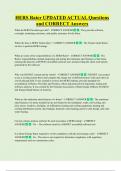
TCCC Exam Questions with Complete Solutions Which of the following is a principle of TCCC? a. Treat the casualty b. Prevent additional casualties c. Complete the mission d. All the above - ANSWER d. All the above Which of the following is NOT one of the three phases of care in TCCC? a. Care Under Fire b. Tactical Field Care c. Tactical Evacuation Care d. Combat Life Saving Care - ANSWER d. Combat Life Saving Care The preferred pain medication for someone who has wounds that are moderately painful but not life-threatening and that do not keep him from functioning effectively as a combatant: a. OTFC b. Ketamine IM c. Meloxicam and Tylenol ER d. Aspirin - ANSWER c. Meloxicam and Tylenol ER True or False: The most common cause of potentially preventable death on the battlefield is blood loss from non-compressible hemorrhage. - ANSWER True The best battlefield indicators of shock during Tactical Field Care are: a. Heart rate and face color b. State of consciousness and quality of the radial pulse c. Rapid heart rate d. None of the above - ANSWER b. State of consciousness and quality of the radial pulse True or False: All combat casualties should have an IV started as soon as possible. - ANSWER False True or False: A casualty has sustained a gunshot wound to the chest. She should be allowed to take fluids by mouth if she is conscious and able to swallow. - ANSWER True True or False: Administering large quantities of fluids to a casualty who has bleeding sites inside the chest or abdomen may worsen his or her hemorrhage by diluting clotting factors or by interfering with clot formation at the bleeding site. - ANSWER True True or False: Antibiotics are recommended for all combat casualties who sustain open wounds. - ANSWER True Which of the following is NOT appropriate to the Care Under Fire phase? a. Starting an IV b. Controlling life-threatening extremitybleeding with a limb tourniquet c. Returning fire as necessary d. All the above - ANSWER a. Starting an IV To be most effective at preventing infections, moxifloxacin should be given when after wounding: a. As soon as possible b. Whenever c. Within 4 hours d. None of the above - ANSWER a. As soon as possible What is the next step in airway management for a corpsman who has just used the chin-lift/jaw-thrust method to successfully open the airway of a casualty who is unconscious from a blast injury during the Tactical Field Care phase: a. Nasopharyngeal airway b. Surgical airway c. Tracheal intubation d. None of the above - ANSWER a. Nasopharyngeal airway As a corpsman, you are confronted with the following three casualties. Which one should be cared for first? a. Casualty A - shot in the head and unconscious b. Casualty B - shot in the abdomen - awake and alert c. Casualty C - heavy bleeding from a thigh wound - ANSWER c. Casualty C - heavy bleeding from a thigh wound
Written for
- Institution
- TCCC
- Module
- TCCC
Document information
- Uploaded on
- May 10, 2023
- Number of pages
- 25
- Written in
- 2022/2023
- Type
- Exam (elaborations)
- Contains
- Questions & answers
Subjects
-
tccc
-
tccc 2023 2024 exam
-
tccc 2023 2024 exam questions with complete solutions
-
which of the following is a principle of tccc
-
which of the following is not one of the three phases of care in tccc

Also available in package deal