CLC Section 4 & 5,. Latest Revision questions and answers. Rated A+
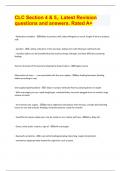
CLC Section 4 & 5,. Latest Revision questions and answers. Rated A+ Document Content and Description Below · Relactation variables: - ☑☑ability to produce milk, baby willingness to nurse, length of time to produce milk · Jaundice - ☑☑- yellow coloration of skin and eyes, babies born with fetal type red blood cells ·- Jaundice babies can be breastfed but they may be sleepy, lethargic, and have difficulty sustaining feeding Hand on the back of the head and shaping the breast lead to - ☑☑nipple trauma Observation of more ---- was associated with less sore nipples - ☑☑pre-feeding behaviors (feeding babies according to cue) Oversupply (hyperlactation) - ☑☑- baby is trying to hold back flow by clamping down on nipple - With oversupply you see: rapid weight gain, unsettled baby, recurrent plugged ducts or mastitis, large volume of stools · To minimize over supply: - ☑☑decrease additional stimulation/ milk removal, consider block feeding (nurse on one side only per feeding), Australian posture, watch for mastitis · Yeast/thrush causes nipple pain, may be visible or not, mother will have - ☑☑itchy, flaky skin · Green, shiny stools: may be a sign of - ☑☑milk oversupply · Raynaud's symptoms - ☑☑- pain while feeding/pumping, blanching, nipple discoloration - sometimes inappropriately treated for organisms such as yeast. Clogs, ducts, or cakes - ☑☑palpable lumps of milk within the lumen or duct system; local they move and disappear on their own w/in a day or 2, may come out as a string or blob · solution for clogs: - ☑☑find out cause (bra, clothing), massage (side of hand, not fingers), warmth, double nursing, see PCP if clog does not move 24-48 hrs · Common mastitis - ☑☑breast inflammation; sx: fever, ill feeling, redness, one inflamed breast; problem is generally not in milk but in the tissue of the breast - can nurse · Factors associated to common mastitis - ☑☑- blocked ducts from engorgement, hurried feedings, use of nipple shield, attachment difficulties, tight bra - Keep milk flowing and breasts soft and comfortable to avoid abscess development · Uncommon/ emergent mastitis - ☑☑the tissue of both breasts are inflamed, potentially fatal MRSA - ☑☑peeling skin, dimpling skin, feeling ill, can cause lesions and accesses · Abscess - ☑☑pus not milk; nursing on the other breast is possible · One concern about Methicillin-resistant Staphylococcus aureus (MRSA) is: - ☑☑it can look like mastitis · Goldsmith sign - ☑☑baby wont latch to one breast (persistent refusal) · Babies with low blood sugar (neonatal hypoglycemia); - ☑☑sx jitteriness, blue coloring, apnea (stop breathing), low body temp, poor body tone, poor feeding Gilbert's syndrome (GS) - ☑☑is a mild liver disorder in which the liver does not properly process bilirubin. · Babies who have difficulty sustaining a feed in the first few days may have one of many conditions, including: - ☑☑jaundice · Underfeeding is one reason for - ☑☑early onset jaundice. · Kangaroo mother care - ☑☑special kind of skin to skin holding for preemie and fragile babies that decrease mortality by 36% · The best position for a mother to be in when doing KMC with her premie is - ☑☑standing upright · Preemie types - ☑☑late preterm (34-36) and early term (37-38) Preemie LAT indicators - ☑☑state (deep sleep to crying), subtle feeding cues, no suck swallow, cannot sustain feed · Research discussed in this section showed that preterm infants do better on human milk and they have: - ☑☑Better brainstem maturation, greater nuclear gray matter volume and more rapid intestinal barrier function. ·------ are not associated with breastfeeding behaviors; initiation of breastfeeding for preterm infants should not be based on ---- - ☑☑·Birthweight and length of stay; age and weight **Dancer technique - ☑☑- breast held in the palm of the hand; thumb and forefinger support babys jaw, other hand holding back of neck- baby is upright (for babies with down syndrome or cleft) · Use of ___________ during gavage feedings enabled earlier transition to the breast. - ☑☑Odor of breastmilk · Gavage feeding- - ☑☑provide BM or formula directly to baby stomach through tube placed in babys nose Show Less Last updated: 5 months ago
Written for
- Institution
- CLC
- Module
- CLC
Document information
- Uploaded on
- May 9, 2023
- Number of pages
- 8
- Written in
- 2022/2023
- Type
- Exam (elaborations)
- Contains
- Questions & answers
Subjects
-
length o
-
clc section 4 amp 5
-
latest revision questions and answers rated a document content and description below · relactation variables ☑☑ability to produce milk
-
baby willingness to nurse

Also available in package deal