Financial Intermediation
Lecturer: O. De Jonghe
Exam date: 19-12-2016
Assigned Chapters/Readings (use http://people.stern.nyu.edu/lallen/ to find the end of chapter keys)
CH 1
CH 2 only what is covered in the slides
CH 7
CH 8
CH 9
CH 10
CH 11
CH 21
Forein Banks: Shock Transmission
Chapter 1: Why are Financial institutions Special?
Slides
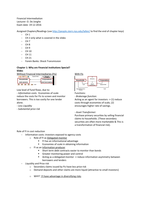
Without Financial Intermediaries (FIs) With FIs
Low level of fund flows, due to:
- Information costs. Economies of scale Functions:
reduce the costs for FIs to screen and monitor - Brokerage function:
borrowers. This is too costly for one lender Acting as an agent for investors -> (1) reduce
alone. costs through economies of scale, (2)
- Less Liquidity encourages higher rate of savings.
- Substantial price risk
- Asset Transformer:
Purchase primary securities by selling financial
claims to households. (These secondary
securities are often more marketable & This is
a transformation of financial risk).
Role of FI in cost reduction
Information costs: investors exposed to agency costs
o Role of FI as Delegated monitor
FI has an informational advantage
Economies of scale in obtaining information
o FI as an Information producer
Short term debt contracts easier to monitor than bonds
Greater monitoring power and control
Acting as a delegated monitor -> reduce information asymmetry between
borrowers and lenders
Liquidity and Price risk
o Secondary claims issued by FIs have less price risk
o Demand deposits and other claims are more liquid (attractive to small investors)
o WHY? FI have advantage in diversifying risks
Lecturer: O. De Jonghe
Exam date: 19-12-2016
Assigned Chapters/Readings (use http://people.stern.nyu.edu/lallen/ to find the end of chapter keys)
CH 1
CH 2 only what is covered in the slides
CH 7
CH 8
CH 9
CH 10
CH 11
CH 21
Forein Banks: Shock Transmission
Chapter 1: Why are Financial institutions Special?
Slides
Without Financial Intermediaries (FIs) With FIs
Low level of fund flows, due to:
- Information costs. Economies of scale Functions:
reduce the costs for FIs to screen and monitor - Brokerage function:
borrowers. This is too costly for one lender Acting as an agent for investors -> (1) reduce
alone. costs through economies of scale, (2)
- Less Liquidity encourages higher rate of savings.
- Substantial price risk
- Asset Transformer:
Purchase primary securities by selling financial
claims to households. (These secondary
securities are often more marketable & This is
a transformation of financial risk).
Role of FI in cost reduction
Information costs: investors exposed to agency costs
o Role of FI as Delegated monitor
FI has an informational advantage
Economies of scale in obtaining information
o FI as an Information producer
Short term debt contracts easier to monitor than bonds
Greater monitoring power and control
Acting as a delegated monitor -> reduce information asymmetry between
borrowers and lenders
Liquidity and Price risk
o Secondary claims issued by FIs have less price risk
o Demand deposits and other claims are more liquid (attractive to small investors)
o WHY? FI have advantage in diversifying risks