Endocrinology of Reproduction
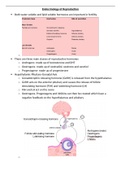
Both water soluble and lipid soluble hormones are important in fertility
o
There are three main classes of reproductive hormones
o Androgens- made up of testosterone and DHT
o Oestrogens- made up of oestradiol, oestrone and oestriol
o Progestagens- made up of progesterone
Hypothalamic-Pituitary-Gonadal Axis
o Gonadotrophin releasing hormone (GnRH) is released from the hypothalamus
o GnRH acts on the anterior pituitary and causes the release of follicle
stimulating hormone (FSH) and luteinising hormone (LH)
o FSH and LH act on the ovary
o Oestrogens, Progestagens and inhibins can then be created which have a
negative feedback on the hypothalamus and pituitary
o
, At some points in the HPG axis, feedback from the ovary switches to positive
feedback
o This means oestrogens tell the anterior pituitary to increase the amounts of
hormones it is releasing
o This only happens at one specific point in the cycle
The hypothalamus is a neuroendocrine organ
o It is a regulator that contains neurones and neurosecretory neurones
o Neurosecretory neurones (like paraventricular nuclei) make and release
hormones (such as oxytocin) that can then travel to the posterior pituitary
Oxytocin can induce labour, increase feelings of love, and is released in
breastfeeding
Oxytocin effects smooth muscle contraction
o Hormones released from the hypothalamus are secreted into the hypophysial
portal area
The hypophysial portal is where parvocellular neurons release GnRH in a
pulsatile fashion
The pulsatile release of GnRH prevents receptors being desensitised and
downregulated
Gonadotrophs make LH and FSH in the anterior pituitary
Kisspeptin regulates GnRH
o KiSS neurons feedback on GnRH neurons
o KiSS neurons receive feedback from the gonads, the pituitary, other parts of
the body and environmental cues
o
Hormones can be water soluble and transported freely in the blood
o Examples of these are GnRH, FSH and LH
o Hormone in the blood binds to receptor
Receptor activates G protein
Both water soluble and lipid soluble hormones are important in fertility
o
There are three main classes of reproductive hormones
o Androgens- made up of testosterone and DHT
o Oestrogens- made up of oestradiol, oestrone and oestriol
o Progestagens- made up of progesterone
Hypothalamic-Pituitary-Gonadal Axis
o Gonadotrophin releasing hormone (GnRH) is released from the hypothalamus
o GnRH acts on the anterior pituitary and causes the release of follicle
stimulating hormone (FSH) and luteinising hormone (LH)
o FSH and LH act on the ovary
o Oestrogens, Progestagens and inhibins can then be created which have a
negative feedback on the hypothalamus and pituitary
o
, At some points in the HPG axis, feedback from the ovary switches to positive
feedback
o This means oestrogens tell the anterior pituitary to increase the amounts of
hormones it is releasing
o This only happens at one specific point in the cycle
The hypothalamus is a neuroendocrine organ
o It is a regulator that contains neurones and neurosecretory neurones
o Neurosecretory neurones (like paraventricular nuclei) make and release
hormones (such as oxytocin) that can then travel to the posterior pituitary
Oxytocin can induce labour, increase feelings of love, and is released in
breastfeeding
Oxytocin effects smooth muscle contraction
o Hormones released from the hypothalamus are secreted into the hypophysial
portal area
The hypophysial portal is where parvocellular neurons release GnRH in a
pulsatile fashion
The pulsatile release of GnRH prevents receptors being desensitised and
downregulated
Gonadotrophs make LH and FSH in the anterior pituitary
Kisspeptin regulates GnRH
o KiSS neurons feedback on GnRH neurons
o KiSS neurons receive feedback from the gonads, the pituitary, other parts of
the body and environmental cues
o
Hormones can be water soluble and transported freely in the blood
o Examples of these are GnRH, FSH and LH
o Hormone in the blood binds to receptor
Receptor activates G protein