Sex Determination
Sex determination is a question of how mammals develop into males or females
Primordial germ cells start outside of “embryo proper” in the extraembryonic
material (yolk sac)
o Germ cells proliferate and migrate to eventually form one type of gonad
o Primordial germ cells can be identified by staining with alkaline phosphatase
Primordial germ cells are present in humans around three weeks post
fertilisation
Can be found at E6 in mice
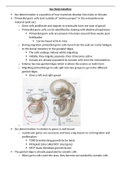
o During migration primordial germ cells move from the yolk sac to the hindgut,
to the dorsal mesentry to the gonadal ridges
The cells undergo mitosis whilst migrating
Initially, they migrate passively, then it becomes active
Gonads are already populated by somatic cells from the mesonephros
o Embryo has two genital ridges which is where the ovaries or testis form
o Migrating primordial germ cells split into two groups to go to the different
genital ridges
Gives a left and right gonad
o
Sex determination in relation to genes is well known
o 3 particular genes are necessary and have a big impact on cell migration and
proliferation:
TGFβ (transforming growth factor beta)
Kit ligand (also called SCF/ steel gene)
bFGF (basic fibroblast growth factor)
The genital ridge is already populated by somatic cells
o When germ cells reach the area, they become surrounded by somatic cells
, o Germ cells change from being called primordial germ cells to
prespermatogonia/prospermatogonia in males and oogonia in females
Use of mouse knockouts has given us a lot of knowledge about gene determination
of sex
o In EMX2 knockout, no gonads form
o In SF1 knockout, gonads start to form and then die
o In WT1 knockout, kidneys and gonads develop, then kidney development stops
(along with somatic cells that would move to the genital ridge), then gonad
development stops
From the time that germ cells first reach the genital ridge, until a proper genital is
formed, the area is known as an indifferent gonad
o The indifferent gonad has the ability to become either type of gonad
Known as bipotential
Either one organ or group of cells can develop in two ways
Happens in mammals
Or two organs or cell types develop, then one dies
Happens in some other species
The secondary sex characteristics you develop depend on whether you develop testis
or ovaries
o Alfred Jost, in the 1940s, removed the testis or ovaries from rabbits
All rabbits developed as female
Showed that female is the default state
Developing as a male is an active process
o Germ cells themselves are not required for the process
Blocking kit ligand (therefore stopping germ cells reaching the gonads)
doesn’t stop the development of secondary sex characteristics
Means that somatic cells are sufficient for this programming
In development, embryos have two sets of ducts
o
Sex determination is a question of how mammals develop into males or females
Primordial germ cells start outside of “embryo proper” in the extraembryonic
material (yolk sac)
o Germ cells proliferate and migrate to eventually form one type of gonad
o Primordial germ cells can be identified by staining with alkaline phosphatase
Primordial germ cells are present in humans around three weeks post
fertilisation
Can be found at E6 in mice
o During migration primordial germ cells move from the yolk sac to the hindgut,
to the dorsal mesentry to the gonadal ridges
The cells undergo mitosis whilst migrating
Initially, they migrate passively, then it becomes active
Gonads are already populated by somatic cells from the mesonephros
o Embryo has two genital ridges which is where the ovaries or testis form
o Migrating primordial germ cells split into two groups to go to the different
genital ridges
Gives a left and right gonad
o
Sex determination in relation to genes is well known
o 3 particular genes are necessary and have a big impact on cell migration and
proliferation:
TGFβ (transforming growth factor beta)
Kit ligand (also called SCF/ steel gene)
bFGF (basic fibroblast growth factor)
The genital ridge is already populated by somatic cells
o When germ cells reach the area, they become surrounded by somatic cells
, o Germ cells change from being called primordial germ cells to
prespermatogonia/prospermatogonia in males and oogonia in females
Use of mouse knockouts has given us a lot of knowledge about gene determination
of sex
o In EMX2 knockout, no gonads form
o In SF1 knockout, gonads start to form and then die
o In WT1 knockout, kidneys and gonads develop, then kidney development stops
(along with somatic cells that would move to the genital ridge), then gonad
development stops
From the time that germ cells first reach the genital ridge, until a proper genital is
formed, the area is known as an indifferent gonad
o The indifferent gonad has the ability to become either type of gonad
Known as bipotential
Either one organ or group of cells can develop in two ways
Happens in mammals
Or two organs or cell types develop, then one dies
Happens in some other species
The secondary sex characteristics you develop depend on whether you develop testis
or ovaries
o Alfred Jost, in the 1940s, removed the testis or ovaries from rabbits
All rabbits developed as female
Showed that female is the default state
Developing as a male is an active process
o Germ cells themselves are not required for the process
Blocking kit ligand (therefore stopping germ cells reaching the gonads)
doesn’t stop the development of secondary sex characteristics
Means that somatic cells are sufficient for this programming
In development, embryos have two sets of ducts
o