Unit 14C: Isomers
P4
Isomers are molecules (usually aliphatic) that have the same molecular formula but different
arrangement of the atoms. That does not include arrangements due to the molecule
rotating as a whole or rotating about particular bonds.
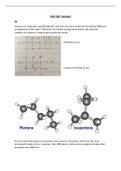
= Pentane (C5H12)
= Isomer of Pentane (C5H12)
The two molecules above are pentane and an isomer of pentane, both have the same
structural formula of C5H12. However, their difference in structural arrangement makes their
properties very different.
,There are two main types of isomers – structural isomerism and stereoisomerism.
Stereoisomers have the same molecular formula, but the atoms occupy different positions
in space.
Structural isomers:
Structural isomers have the same molecular formula but different structural formula. There
are three types of structural isomers – chain isomers, position isomers, and functional group
isomers.
Chain isomers:
Chain isomers arise because of the branching of broken carbon chains. They are molecules
with different carbon chains. In chain isomerism, carbon atoms can form branches. They
have the same molecular formula but different structural formula.
This molecule (C4H10) has more energy
between the bonds. Higher boiling point so it is
harder to break. There are only single bonds,
so it is saturated.
This molecule (C4H10) is an isomer of the one
above. They both have the same molecular
formula but different structures. There is less
energy between they bond so a lower boiling
point and it is easier to break apart. Chain
isomers always branch from the middle never
from the edges.
Position isomers:
Position isomers arise when their position of the functional group is changed. They are
molecules with the same functional group but different positions. They have the same
molecular formula but different structural formula.
Functional group isomerism:
Functional group isomers are molecules with different functional groups. They have the
same molecular formula but different structural formula. Functional group isomerism occurs
when there is a change of the functional group itself.
Stereoisomers:
There are two types of stereoisomerism – geometrical isomerism and optical isomerism.
Geometrical isomers occur due to the restricted rotation of C=C double bonds (single bonds
have free rotation, double bonds do not). They exist in two forms E and Z cis, and trans. Cis
isomers have the Z configuration, this means that they have two higher priority groups
, (groups with larger atomic numbers) on the same side of the double bond. Trans isomers
have the E configuration, this means that they have two higher priority groups of opposite
sides of the double bond.
1 = higher
2 = lower
This is a trans molecule with E configuration.
This is a cis molecule with Z configuration.
Optical isomers arise when molecules have a chiral centre (four different molecules
attached to one carbon). When mirror images are not superimposable, (if one is put on top
of the other, they do not look the same).
These molecules are not
superimposable – so they are
optical.
M3:
Diastereomers:
Diastereomers are non-superimposable geometric isomerism of stereoisomers, but they are
not mirror images. Diastereomers do not share the same physical properties or chemical
properties. This causes them to react differently. They are easy to separate and identify one
example of them is cis-but-2-ene and trans-but-2-ene.
P4
Isomers are molecules (usually aliphatic) that have the same molecular formula but different
arrangement of the atoms. That does not include arrangements due to the molecule
rotating as a whole or rotating about particular bonds.
= Pentane (C5H12)
= Isomer of Pentane (C5H12)
The two molecules above are pentane and an isomer of pentane, both have the same
structural formula of C5H12. However, their difference in structural arrangement makes their
properties very different.
,There are two main types of isomers – structural isomerism and stereoisomerism.
Stereoisomers have the same molecular formula, but the atoms occupy different positions
in space.
Structural isomers:
Structural isomers have the same molecular formula but different structural formula. There
are three types of structural isomers – chain isomers, position isomers, and functional group
isomers.
Chain isomers:
Chain isomers arise because of the branching of broken carbon chains. They are molecules
with different carbon chains. In chain isomerism, carbon atoms can form branches. They
have the same molecular formula but different structural formula.
This molecule (C4H10) has more energy
between the bonds. Higher boiling point so it is
harder to break. There are only single bonds,
so it is saturated.
This molecule (C4H10) is an isomer of the one
above. They both have the same molecular
formula but different structures. There is less
energy between they bond so a lower boiling
point and it is easier to break apart. Chain
isomers always branch from the middle never
from the edges.
Position isomers:
Position isomers arise when their position of the functional group is changed. They are
molecules with the same functional group but different positions. They have the same
molecular formula but different structural formula.
Functional group isomerism:
Functional group isomers are molecules with different functional groups. They have the
same molecular formula but different structural formula. Functional group isomerism occurs
when there is a change of the functional group itself.
Stereoisomers:
There are two types of stereoisomerism – geometrical isomerism and optical isomerism.
Geometrical isomers occur due to the restricted rotation of C=C double bonds (single bonds
have free rotation, double bonds do not). They exist in two forms E and Z cis, and trans. Cis
isomers have the Z configuration, this means that they have two higher priority groups
, (groups with larger atomic numbers) on the same side of the double bond. Trans isomers
have the E configuration, this means that they have two higher priority groups of opposite
sides of the double bond.
1 = higher
2 = lower
This is a trans molecule with E configuration.
This is a cis molecule with Z configuration.
Optical isomers arise when molecules have a chiral centre (four different molecules
attached to one carbon). When mirror images are not superimposable, (if one is put on top
of the other, they do not look the same).
These molecules are not
superimposable – so they are
optical.
M3:
Diastereomers:
Diastereomers are non-superimposable geometric isomerism of stereoisomers, but they are
not mirror images. Diastereomers do not share the same physical properties or chemical
properties. This causes them to react differently. They are easy to separate and identify one
example of them is cis-but-2-ene and trans-but-2-ene.