Chapter 1 The Law (1.1)
Saturday, 11 March 2023 16:08
1.1 Why law?
Main topics:
○ Different acceptance theories of law
○ Western and African Approach
Summary:
• Law presupposes a society
• More people = more claims to existing resources
Therefore- Need arises- Structure of authority or government that will make rules for the whole society
• Adhering to these rules = 'rule of law'
Justification of these rules are the idea of social contract
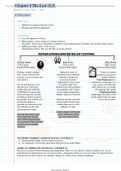
WESTERN JUSTIFICATIONS FOR THE LAW'S EXISTENCE.
Thomas hobbes John Locke John Rawls
17th Century 17th Century 20th Century
English Philosopher English Philosopher American Philosopher
Humans in their original Optimistic view of 'Theory of justice'
state living without rules humankind in its original hypothetical position of
become a slave to desire and condition. humans are people behind a
self-interest. governed from the 'Vail of ignorance' to
beginning by reason and explain the acceptance of a
Not in self-interest to live live good stable lives. just society, not knowing
this lifestyle. Therefore without fixed and genuinely their talents race or gender
people enter the SOCIAL ascertainable rules which all language they speak.
CONTRACT (agreement) can be implied impartially 'Original position'
Each person gives up their conflict cannot be resolved. people agree in terms of the
freedom in order to coexist social contract that are most
peacefully. fear of their own Therefore people enter the just to all in society
destruction makes it social contract where they
possible for them to accept submit themselves to the
Beyond veil of
the authority of the ruler authority of state.
ignorance
(government or state)
Helps us live
social contract is when the
out life's
the ruler lays down legal state is allowed to make
rules which the citizens laws and enforce them
must follow because they Accept because
have agreed to that authority of reason
and have given up their
freedom Life is savage, we will
destroy each other.
Fear of breaking law
allows us to accept it
WESTERN UNDERSTANIND OF SOCIAL CONTRACT: Individualistic way as to looking
1) Separated individuals (in the original position) why we subscribe to law
2) An imagined (or fictitious) agreement (between those individuals)
AFRICAN APPROACH OF SOCIAL CONTRACT:
Born into a world of ethical relations and obligations where we owe duties to others and they owe it to us.
Individuals are important but we are all born into a community which we can never truly be separated from.
instead all of us must respect one another's dignity by virtue of our common humanity.
UMBUNTU I am because you are.
New Section 1 Page 1
, Chapter 1 The Law (1.2)
Saturday, 11 March 2023 16:08
1.2 What is law?
Main topics:
○ Characteristics of law
○ SA law of sources
○ Ideology effects definition of what law is
Summary:
Characteristics of law:
→ Rules & principles facilitating and regulating human interaction
→ It orders society & gives some degree of certainty
→ Rules are applied or interpreted by institutions of state and is enforced by employees of the state (e.g. police)
→ democratic legal systems:
○ the legislative authority makes laws
○ Judicial authority (court) applies these laws and legal principles
○ executive authority enforces the law
→ Enforcement means a sanction will follow upon noncompliance with illegal rule
a sanction is a reaction of disapproval following such noncompliance and can be taken inform such
as punishment or compensation
→ The contains of the law depends on the history of the country
Characteristics of law manifest in specific laws
content of specific laws can be found in sources of law
South African rules and principles of law sources:
Constitution of the Republic of South Africa (1996)
• Written documents and force of law written by the democratically elected constitutional assembly
○ tells us states power
○ full of human rights
○ is the supreme law (Section 2)
supremacy clause- any law or conduct inconsistent with this is invalid
All other laws can be tested against the provisions of the constitution
Other binding sources of South African law which must be constant with the constitution:
• Legislation- lose written by democratically elected bodies (e.g. parliament) that's all given the force of law
• Customary law- laws of the First Nation peoples of Africa (African law)
• Common law- laws inherited from the South African colonial heritage (mixture of Roman Dutch &English
law) developed over time in court
• Custom- practices that develop as low due to continued usage over long periods of time
• International law- drafted by agreement between different states
In a democracy law should reflect the shared values of the majority of the population (society)
underlying any legal system is ideology
◊ economic values (e.g. free market capitalism )
◊ political values (e.g. democracy )
◊ social values (e.g. achievements of equality )
◊ moral values (e.g. conservative )
Legitimacy crisis
▪ Does not reflect the values of the population (does not reflect what people want or need)
▪ members lose their belief and confidence in their legal system
▪ e.g. in SA voting rights in 1983 did not reflect majority of the political values.
Most people were not allowed to vote which led to the legitimacy crisis in South African legal system.
Different ideological beliefs result in different definitions of what law is. our definitions of law depend on our
ideological positions and that is why it is not easy to answer 'what is law'
New Section 1 Page 2
Saturday, 11 March 2023 16:08
1.1 Why law?
Main topics:
○ Different acceptance theories of law
○ Western and African Approach
Summary:
• Law presupposes a society
• More people = more claims to existing resources
Therefore- Need arises- Structure of authority or government that will make rules for the whole society
• Adhering to these rules = 'rule of law'
Justification of these rules are the idea of social contract
WESTERN JUSTIFICATIONS FOR THE LAW'S EXISTENCE.
Thomas hobbes John Locke John Rawls
17th Century 17th Century 20th Century
English Philosopher English Philosopher American Philosopher
Humans in their original Optimistic view of 'Theory of justice'
state living without rules humankind in its original hypothetical position of
become a slave to desire and condition. humans are people behind a
self-interest. governed from the 'Vail of ignorance' to
beginning by reason and explain the acceptance of a
Not in self-interest to live live good stable lives. just society, not knowing
this lifestyle. Therefore without fixed and genuinely their talents race or gender
people enter the SOCIAL ascertainable rules which all language they speak.
CONTRACT (agreement) can be implied impartially 'Original position'
Each person gives up their conflict cannot be resolved. people agree in terms of the
freedom in order to coexist social contract that are most
peacefully. fear of their own Therefore people enter the just to all in society
destruction makes it social contract where they
possible for them to accept submit themselves to the
Beyond veil of
the authority of the ruler authority of state.
ignorance
(government or state)
Helps us live
social contract is when the
out life's
the ruler lays down legal state is allowed to make
rules which the citizens laws and enforce them
must follow because they Accept because
have agreed to that authority of reason
and have given up their
freedom Life is savage, we will
destroy each other.
Fear of breaking law
allows us to accept it
WESTERN UNDERSTANIND OF SOCIAL CONTRACT: Individualistic way as to looking
1) Separated individuals (in the original position) why we subscribe to law
2) An imagined (or fictitious) agreement (between those individuals)
AFRICAN APPROACH OF SOCIAL CONTRACT:
Born into a world of ethical relations and obligations where we owe duties to others and they owe it to us.
Individuals are important but we are all born into a community which we can never truly be separated from.
instead all of us must respect one another's dignity by virtue of our common humanity.
UMBUNTU I am because you are.
New Section 1 Page 1
, Chapter 1 The Law (1.2)
Saturday, 11 March 2023 16:08
1.2 What is law?
Main topics:
○ Characteristics of law
○ SA law of sources
○ Ideology effects definition of what law is
Summary:
Characteristics of law:
→ Rules & principles facilitating and regulating human interaction
→ It orders society & gives some degree of certainty
→ Rules are applied or interpreted by institutions of state and is enforced by employees of the state (e.g. police)
→ democratic legal systems:
○ the legislative authority makes laws
○ Judicial authority (court) applies these laws and legal principles
○ executive authority enforces the law
→ Enforcement means a sanction will follow upon noncompliance with illegal rule
a sanction is a reaction of disapproval following such noncompliance and can be taken inform such
as punishment or compensation
→ The contains of the law depends on the history of the country
Characteristics of law manifest in specific laws
content of specific laws can be found in sources of law
South African rules and principles of law sources:
Constitution of the Republic of South Africa (1996)
• Written documents and force of law written by the democratically elected constitutional assembly
○ tells us states power
○ full of human rights
○ is the supreme law (Section 2)
supremacy clause- any law or conduct inconsistent with this is invalid
All other laws can be tested against the provisions of the constitution
Other binding sources of South African law which must be constant with the constitution:
• Legislation- lose written by democratically elected bodies (e.g. parliament) that's all given the force of law
• Customary law- laws of the First Nation peoples of Africa (African law)
• Common law- laws inherited from the South African colonial heritage (mixture of Roman Dutch &English
law) developed over time in court
• Custom- practices that develop as low due to continued usage over long periods of time
• International law- drafted by agreement between different states
In a democracy law should reflect the shared values of the majority of the population (society)
underlying any legal system is ideology
◊ economic values (e.g. free market capitalism )
◊ political values (e.g. democracy )
◊ social values (e.g. achievements of equality )
◊ moral values (e.g. conservative )
Legitimacy crisis
▪ Does not reflect the values of the population (does not reflect what people want or need)
▪ members lose their belief and confidence in their legal system
▪ e.g. in SA voting rights in 1983 did not reflect majority of the political values.
Most people were not allowed to vote which led to the legitimacy crisis in South African legal system.
Different ideological beliefs result in different definitions of what law is. our definitions of law depend on our
ideological positions and that is why it is not easy to answer 'what is law'
New Section 1 Page 2