Lecture 13 – Enzymology, enzyme regulation and pathway control
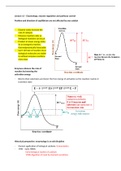
Position and direction of equilibrium are not affected by any catalyst
- Enzyme vastly increase the
rate of catalysis
- Enhance reaction rates so
biological reactions can occur
- Product at lower energy state,
its an exergonic reaction,
thermodynamically favourable
- Can’t tell rate of reaction most
biological molecules are stable
to without enzymes reactions
more slow
Enzymes enhance the rate of
reaction by lowering the
activation energy
- Bind to their substrates and lower the free energy of activation so the reaction reaches it
transition state
Historical perspective: enzymology is an old discipline
- Ancient application of biological catalysis: fermentation
- 1700 – early 1800s:
Early biological studies of catalysis
1700s digestion of meat by stomach secretions
, 1800s starch-to-sugar by saliva and plant extracts
- Victorian era: (1) origins of the term enzyme meaning “leavened” to modify or transform. (2)
specificity – “lock and key” hypothesis
- 1920s: Crystallisation of urease identifies protein as a source of enzyme activity
- 1960s: advent of x-ray crystallography facilitates structure-based studies of enzyme activity and
regulation
- 1980s: catalytic RNA molecules discovered
Key principle in enzymology
- In 1930 J.B.S. Haldane wrote the article
Enzymes. In this text he suggested that
multiple weak bonding interactions between
an enzyme and its substrate(s) might be used
to catalyse reactions
- Induced fit model (Daniel Koshland, 1959)
Some enzymes require no chemical groups other than
their amino acid residues, others do
- Some enzymes require a NON-PROTEIN component for their activity. Such components
are known as cofactors
- Organic cofactors are most generally known as co-enzymes
- Cofactors can be tightly or loosely associated with their enzymes. Tightly associated
cofactors are sometimes known as
prosthetic groups (e.g. Flavin group in
succinate dehydrogenase/mitochondrial respiratory
chain complex II)
- Co-enzymes that are loosely associated with their
enzymes (e.g. NAD/NADP) are often referred to
as co-substrates
- Co-enzymes can diffuse in and out of the
enzyme
- Another common group of cofactors are
metal cations (Na+, Mg2+). The multiple
oxidation states of some metal atoms (e.g.
Fe, Cu) is often important for their
cofactor function
- Metal cations cofactors help enzyme fold
correctly in polypeptide chain, or binding or catalytic pathway
- Multiple oxidation states of metal cations are important because they are excellent
acceptors for electrons
Co-enzymes participate in group transfer reactions
- i.e. they are transient carriers of function information
, - c.f. lecture 1 and use of the term ‘activated carrier’ by SKR
For enzymes with a tightly associated co-enzyme or cofactor (prosthetic group)
- in the absence of cofactor the protein is referred to as an apoprotein or apoenzyme
- in the presence of bound cofactor the protein is known as the holoprotein or
holoenzyme
- Transfer of a
chemical group,
transient carriers,
activated carriers
(coenzyme)
- Tightly associated
prosthetic group
absence apoprotein
- Presence
holoprotein
Many co-enzymes are derived from vitamins
, NAD+ and NADP function in 2e- transfer reactions
- Nicotinamide ring derived from niacin; these co-enzymes are sometimes referred to as
“pyridine nucleotides”
- NAD+ and NADP both undergo reversible reduction of their nicotinamide ring. Thus, for
a substrate undergoing enzyme-catalysed oxidation (dehydrogenation) the oxidised
form of co-enzyme accepts a hydride ion (:H. equivalent of 1 proton 2e-)
- Nature of R
group is the
only
difference,
NAD is
hydrogens
and NADP is
phosphate
group
- Purple is
nitrogenous
base, this is
the
nicotinamide
group
nucleotide,
attached to
another nucleotide – dinucleotide
- Involved in the transfer of 2 electrons derived from vitB3
- Reaction site where electrons removed or added
NAD+ functions primarily in the reversible oxidation of aldehydes and alcohols
- Oxidation of aldehydes or alcohols
- Accumulation of acetaldehyde by enzyme alcohol dehydrogenase, dependent of NAD+
reduced to NADH alcohol oxidised
- Acealdehyde more toxic than alcohol
- Aldehyde dehydrogenase breaks down acetaldehyde giving acetic acid
Position and direction of equilibrium are not affected by any catalyst
- Enzyme vastly increase the
rate of catalysis
- Enhance reaction rates so
biological reactions can occur
- Product at lower energy state,
its an exergonic reaction,
thermodynamically favourable
- Can’t tell rate of reaction most
biological molecules are stable
to without enzymes reactions
more slow
Enzymes enhance the rate of
reaction by lowering the
activation energy
- Bind to their substrates and lower the free energy of activation so the reaction reaches it
transition state
Historical perspective: enzymology is an old discipline
- Ancient application of biological catalysis: fermentation
- 1700 – early 1800s:
Early biological studies of catalysis
1700s digestion of meat by stomach secretions
, 1800s starch-to-sugar by saliva and plant extracts
- Victorian era: (1) origins of the term enzyme meaning “leavened” to modify or transform. (2)
specificity – “lock and key” hypothesis
- 1920s: Crystallisation of urease identifies protein as a source of enzyme activity
- 1960s: advent of x-ray crystallography facilitates structure-based studies of enzyme activity and
regulation
- 1980s: catalytic RNA molecules discovered
Key principle in enzymology
- In 1930 J.B.S. Haldane wrote the article
Enzymes. In this text he suggested that
multiple weak bonding interactions between
an enzyme and its substrate(s) might be used
to catalyse reactions
- Induced fit model (Daniel Koshland, 1959)
Some enzymes require no chemical groups other than
their amino acid residues, others do
- Some enzymes require a NON-PROTEIN component for their activity. Such components
are known as cofactors
- Organic cofactors are most generally known as co-enzymes
- Cofactors can be tightly or loosely associated with their enzymes. Tightly associated
cofactors are sometimes known as
prosthetic groups (e.g. Flavin group in
succinate dehydrogenase/mitochondrial respiratory
chain complex II)
- Co-enzymes that are loosely associated with their
enzymes (e.g. NAD/NADP) are often referred to
as co-substrates
- Co-enzymes can diffuse in and out of the
enzyme
- Another common group of cofactors are
metal cations (Na+, Mg2+). The multiple
oxidation states of some metal atoms (e.g.
Fe, Cu) is often important for their
cofactor function
- Metal cations cofactors help enzyme fold
correctly in polypeptide chain, or binding or catalytic pathway
- Multiple oxidation states of metal cations are important because they are excellent
acceptors for electrons
Co-enzymes participate in group transfer reactions
- i.e. they are transient carriers of function information
, - c.f. lecture 1 and use of the term ‘activated carrier’ by SKR
For enzymes with a tightly associated co-enzyme or cofactor (prosthetic group)
- in the absence of cofactor the protein is referred to as an apoprotein or apoenzyme
- in the presence of bound cofactor the protein is known as the holoprotein or
holoenzyme
- Transfer of a
chemical group,
transient carriers,
activated carriers
(coenzyme)
- Tightly associated
prosthetic group
absence apoprotein
- Presence
holoprotein
Many co-enzymes are derived from vitamins
, NAD+ and NADP function in 2e- transfer reactions
- Nicotinamide ring derived from niacin; these co-enzymes are sometimes referred to as
“pyridine nucleotides”
- NAD+ and NADP both undergo reversible reduction of their nicotinamide ring. Thus, for
a substrate undergoing enzyme-catalysed oxidation (dehydrogenation) the oxidised
form of co-enzyme accepts a hydride ion (:H. equivalent of 1 proton 2e-)
- Nature of R
group is the
only
difference,
NAD is
hydrogens
and NADP is
phosphate
group
- Purple is
nitrogenous
base, this is
the
nicotinamide
group
nucleotide,
attached to
another nucleotide – dinucleotide
- Involved in the transfer of 2 electrons derived from vitB3
- Reaction site where electrons removed or added
NAD+ functions primarily in the reversible oxidation of aldehydes and alcohols
- Oxidation of aldehydes or alcohols
- Accumulation of acetaldehyde by enzyme alcohol dehydrogenase, dependent of NAD+
reduced to NADH alcohol oxidised
- Acealdehyde more toxic than alcohol
- Aldehyde dehydrogenase breaks down acetaldehyde giving acetic acid