KHAN ACADEMY: JOURNEY INTO INFORMATION THEORY
Information allows one mind to influence another.
Bit: measurement of information
Pictogram: a drawing that resembles the physical object it represents
Ideogram: conception picture of an abstract idea
Protowriting: writing system using symbols instead of pictures.
Rebus principle: sound + sound new meaning.
Information is stored or transmitted using some medium (e.g. papyrus for Egyptians).
Language: arranging symbols in specific patterns
Word signs: represent a single, meaningful concept
Hieroglyphs
Sound signs: represent chunks of sound
In Egypt, scribes first wrote on stone. Later, papyrus was introduced as a medium that didn’t last as long as stone, but was easier
accessible, which resulted in a faster way of writing: hieratic script (simplified hieroglyphics).
In a later stage, demotic writing was introduced to make rapid writing easier. Shift towards sound signs/phonetic symbols
reducing the total amount of symbols (symbol space).
Phoenician alphabet: 1 sign represents 1 consonant further reduction of symbols.
Information is a selection of a collection of possible symbols.
The Rosetta stone contains the same message in ancient Greek, demotic (common language of the people) and hieroglyphs.
Rosetta stone hieroglyphs turn out to be phonetic.
Discrete source: selection of a finite number of symbols from the total amount of possible symbols.
Capacity of sending information: maximum amount of information that can be transmitted
You can use a fire signal if the space of possible messages is small, but when the message space is bigger, this is not efficient.
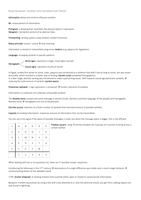
Polybius square: using 10 torches divided into 2 groups of 5 torches to bring across a
1 A B G D E
certain symbol
2 Z H Q I K
3 L M N X O
4 P R S T U
5 F C Y W
1 2 3 4 5
When dealing with yes or no questions (n), there are 2n possible answer sequences.
Introducing the telescope in the 17th century observation of a single difference was visible over a much longer distance
communicating letters of the alphabet easier.
1759: shutter telegraph. 6 rotating shutters that could be either open or closed to communicate information.
Benjamin Franklin discovered, by using a kite with a key attached to it, that the electrical shocks you get from rubbing objects are
also found in lightning.
Information allows one mind to influence another.
Bit: measurement of information
Pictogram: a drawing that resembles the physical object it represents
Ideogram: conception picture of an abstract idea
Protowriting: writing system using symbols instead of pictures.
Rebus principle: sound + sound new meaning.
Information is stored or transmitted using some medium (e.g. papyrus for Egyptians).
Language: arranging symbols in specific patterns
Word signs: represent a single, meaningful concept
Hieroglyphs
Sound signs: represent chunks of sound
In Egypt, scribes first wrote on stone. Later, papyrus was introduced as a medium that didn’t last as long as stone, but was easier
accessible, which resulted in a faster way of writing: hieratic script (simplified hieroglyphics).
In a later stage, demotic writing was introduced to make rapid writing easier. Shift towards sound signs/phonetic symbols
reducing the total amount of symbols (symbol space).
Phoenician alphabet: 1 sign represents 1 consonant further reduction of symbols.
Information is a selection of a collection of possible symbols.
The Rosetta stone contains the same message in ancient Greek, demotic (common language of the people) and hieroglyphs.
Rosetta stone hieroglyphs turn out to be phonetic.
Discrete source: selection of a finite number of symbols from the total amount of possible symbols.
Capacity of sending information: maximum amount of information that can be transmitted
You can use a fire signal if the space of possible messages is small, but when the message space is bigger, this is not efficient.
Polybius square: using 10 torches divided into 2 groups of 5 torches to bring across a
1 A B G D E
certain symbol
2 Z H Q I K
3 L M N X O
4 P R S T U
5 F C Y W
1 2 3 4 5
When dealing with yes or no questions (n), there are 2n possible answer sequences.
Introducing the telescope in the 17th century observation of a single difference was visible over a much longer distance
communicating letters of the alphabet easier.
1759: shutter telegraph. 6 rotating shutters that could be either open or closed to communicate information.
Benjamin Franklin discovered, by using a kite with a key attached to it, that the electrical shocks you get from rubbing objects are
also found in lightning.