Directors Duties Problem Question
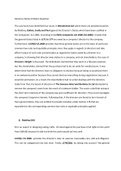
The case facts have identified four issues in Wondershot Ltd where there are possible breaches
by Matthey, Gallois, Scully and Paul against the Director’s Duties which have been codified in
the Companies’ Act 2006. According to S.170(1) Companies Act 2006 (CA 2006), it states that
the general duties listed in s171 to 177 are owed by a company’s director to the company.
Furthermore, S170(3) CA 2006 provides that these general duties are on the basis of particular
common law rules and equitable principles since they apply in regards to directors and take
effect in place of such rules and principles as regards the duties owed by a director to a
company. In showing that director owes duties to a company, and not shareholders, the case of
Percival v Wright is discussed. The defendants claimed that they were in a fiduciary position,
but the shareholders claimed that the purchase had to be set aside for nondisclosure. It was
determined that the directors have no obligation to disclose because doing so would put them
in an awkward position because they cannot disclose everything during negotiations because it
would be premature. As a result, the shareholders had no unfair dealings with the directors.
Aside from that, the board of directors of The Savoury Hotel and Berkeley Co Ltd attempted to
remove the company's asset from the reach of a takeover bidder. The courts ruled that acting in
the short term interests of the company law was insufficient for directors. They must investigate
the company's long-term interest. Following that, if the directors are found to be in breach of
their general duties, they are entitled to provide remedies under Section 178 that are
equivalent to the corresponding common law rules or equitable principles applied.
1) Matthey (M)
M is an expert in designing sailing crafts. M voted against the purchase of all rights to the yacht
from Edith(E) because he did not think the yacht would sail very well.
S174(1) CA 2006 provides the director’s duty to exercise reasonable care, skill and diligence.
This can be categorised into two tests. Firstly, s174(2)(a); by taking into account “the general
, knowledge, skill and experience that may reasonably be expected of a person carrying out a
director’s duties” (objective) or s174(2)(b); by considering “the general knowledge, skill and
experience that the particular director has” (subjective). Norman v Theodore Goddard has a
two stage test ; objective test and subjective test. Based on the facts, Scully acknowledged that
producing the yacht would probably be very profitable, thus, shouldn't M be aware of this?
Applying the subjective test, wouldn't a director of that relevant skill and experience in yachts
would vote in favour of the purchase of the yachts?
Thus, M has breached S174, along with S172 CA 2006; duty to promote the success of the
company. This is because The fact that M is an expert in yachts, and had failed to value the
yachts, thus M has failed to consider the success of Wondershot Ltd (W Ltd), good faith, long
term interest of W Ltd and even interest of employees. M is expected to have a higher degree
of reasoning when it comes to such matters, i.e. yachts.
2) Gallois (G)
G is the company’s solicitor, and is married to M. She often attends board meetings. This makes
G a de facto director.
S250 CA 2006 states that director includes any person occupying the position of director, by
whatever name is called. In SS for Trade and Industry v Hollier and Re Gemma Ltd, the essence
of occupying the position of a director seems to be attendance at board meetings, with the
same rights of decision-making as other directors. In Re Hydrodam Ltd, a de facto director is
one who claims to act and purports to act as a director, although not validly appointed as such.
G voted against the yacht purchase because she did not like Paul and because Matthey told her
to do so.
The case facts have identified four issues in Wondershot Ltd where there are possible breaches
by Matthey, Gallois, Scully and Paul against the Director’s Duties which have been codified in
the Companies’ Act 2006. According to S.170(1) Companies Act 2006 (CA 2006), it states that
the general duties listed in s171 to 177 are owed by a company’s director to the company.
Furthermore, S170(3) CA 2006 provides that these general duties are on the basis of particular
common law rules and equitable principles since they apply in regards to directors and take
effect in place of such rules and principles as regards the duties owed by a director to a
company. In showing that director owes duties to a company, and not shareholders, the case of
Percival v Wright is discussed. The defendants claimed that they were in a fiduciary position,
but the shareholders claimed that the purchase had to be set aside for nondisclosure. It was
determined that the directors have no obligation to disclose because doing so would put them
in an awkward position because they cannot disclose everything during negotiations because it
would be premature. As a result, the shareholders had no unfair dealings with the directors.
Aside from that, the board of directors of The Savoury Hotel and Berkeley Co Ltd attempted to
remove the company's asset from the reach of a takeover bidder. The courts ruled that acting in
the short term interests of the company law was insufficient for directors. They must investigate
the company's long-term interest. Following that, if the directors are found to be in breach of
their general duties, they are entitled to provide remedies under Section 178 that are
equivalent to the corresponding common law rules or equitable principles applied.
1) Matthey (M)
M is an expert in designing sailing crafts. M voted against the purchase of all rights to the yacht
from Edith(E) because he did not think the yacht would sail very well.
S174(1) CA 2006 provides the director’s duty to exercise reasonable care, skill and diligence.
This can be categorised into two tests. Firstly, s174(2)(a); by taking into account “the general
, knowledge, skill and experience that may reasonably be expected of a person carrying out a
director’s duties” (objective) or s174(2)(b); by considering “the general knowledge, skill and
experience that the particular director has” (subjective). Norman v Theodore Goddard has a
two stage test ; objective test and subjective test. Based on the facts, Scully acknowledged that
producing the yacht would probably be very profitable, thus, shouldn't M be aware of this?
Applying the subjective test, wouldn't a director of that relevant skill and experience in yachts
would vote in favour of the purchase of the yachts?
Thus, M has breached S174, along with S172 CA 2006; duty to promote the success of the
company. This is because The fact that M is an expert in yachts, and had failed to value the
yachts, thus M has failed to consider the success of Wondershot Ltd (W Ltd), good faith, long
term interest of W Ltd and even interest of employees. M is expected to have a higher degree
of reasoning when it comes to such matters, i.e. yachts.
2) Gallois (G)
G is the company’s solicitor, and is married to M. She often attends board meetings. This makes
G a de facto director.
S250 CA 2006 states that director includes any person occupying the position of director, by
whatever name is called. In SS for Trade and Industry v Hollier and Re Gemma Ltd, the essence
of occupying the position of a director seems to be attendance at board meetings, with the
same rights of decision-making as other directors. In Re Hydrodam Ltd, a de facto director is
one who claims to act and purports to act as a director, although not validly appointed as such.
G voted against the yacht purchase because she did not like Paul and because Matthey told her
to do so.