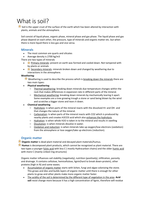
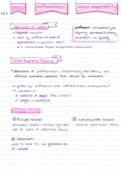
What is soil?
Soil is the upper crust of the surface of the earth which has been altered by interaction with
plants, animals and the atmosphere.
Soil consist of liquid phase, organic phase, mineral phase and gas phase. The liquid phase and gas
phase depend on each other, the pressure, type of minerals and organic matter etc. but when
there is more liquid there is less gas and vice versa.
Minerals
The most common are quarts and silicates
Average density is 2700 kg/m3
There are two types of minerals
Primary minerals: present on earth was formed and cooled down. Not tampered with
by plants or animals
Secondary minerals: minerals broken down and changed by weathering due to
interactions in the atmosphere.
Weathering:
Weathering is used to describe the process which is breaking down the minerals there are
two main types:
Physical weathering:
o Thermal weathering: breaking down minerals due temperature changes within the
rock that makes differences in expansion rate in different parts of the mineral.
o Mechanical weathering: breaking down minerals by mechanically tearing it apart.
Some examples are a tree growing trough a stone or sand being blown by the wind
and scratches a bigger stone and tears it down.
Chemical weathering
o Hydrolysis: is when parts of the mineral reacts with the dissolved H+ and OH- and
that changes the nature of the mineral.
o Carbonation: Is when parts of the mineral reacts with CO2 which is produced by
nearby plants and creates H2CO3 acid which also enhances the hydrolysis.
o Hydration: is when whole H2O is taken in to the mineral and results in swelling
o Dissolution: is when minerals dissolve in water.
o Oxidation and reduction: is when minerals take up oxygen/lose electrons (oxidation)
from the atmosphere or lose oxygen/take up electrons (reduction).
Organic matter
Organic matter is dead plant material and decayed plant materials/humus.
Humus is decomposed plant products, which cannot be recognized as plant material. There are
two types a younger fulvic acid with less C ( mostly Hydrocarbon chains) and the older humic acid
with more C (mainly Linked ring structures)
Organic matter influences soil stability (negatively), nutrition (positively), infiltration, porosity
and drainage. It contains cellulose, hemicellulose, lignin(hard to break down-protein), other
proteins (high in N) and some waxes.
Accumulation of organic matter starts with lichen, fungi and algae colonizing the stone.
This grows and dies and builds layers of organic matter until there is enough for other
plants to grow and other plants make more organic matter faster.
The acidity of the soil is determined by the different type of vegetation in the area. Acid
soil resist change more because it has a high concentration of lignin, therefore will residue
Soil is the upper crust of the surface of the earth which has been altered by interaction with
plants, animals and the atmosphere.
Soil consist of liquid phase, organic phase, mineral phase and gas phase. The liquid phase and gas
phase depend on each other, the pressure, type of minerals and organic matter etc. but when
there is more liquid there is less gas and vice versa.
Minerals
The most common are quarts and silicates
Average density is 2700 kg/m3
There are two types of minerals
Primary minerals: present on earth was formed and cooled down. Not tampered with
by plants or animals
Secondary minerals: minerals broken down and changed by weathering due to
interactions in the atmosphere.
Weathering:
Weathering is used to describe the process which is breaking down the minerals there are
two main types:
Physical weathering:
o Thermal weathering: breaking down minerals due temperature changes within the
rock that makes differences in expansion rate in different parts of the mineral.
o Mechanical weathering: breaking down minerals by mechanically tearing it apart.
Some examples are a tree growing trough a stone or sand being blown by the wind
and scratches a bigger stone and tears it down.
Chemical weathering
o Hydrolysis: is when parts of the mineral reacts with the dissolved H+ and OH- and
that changes the nature of the mineral.
o Carbonation: Is when parts of the mineral reacts with CO2 which is produced by
nearby plants and creates H2CO3 acid which also enhances the hydrolysis.
o Hydration: is when whole H2O is taken in to the mineral and results in swelling
o Dissolution: is when minerals dissolve in water.
o Oxidation and reduction: is when minerals take up oxygen/lose electrons (oxidation)
from the atmosphere or lose oxygen/take up electrons (reduction).
Organic matter
Organic matter is dead plant material and decayed plant materials/humus.
Humus is decomposed plant products, which cannot be recognized as plant material. There are
two types a younger fulvic acid with less C ( mostly Hydrocarbon chains) and the older humic acid
with more C (mainly Linked ring structures)
Organic matter influences soil stability (negatively), nutrition (positively), infiltration, porosity
and drainage. It contains cellulose, hemicellulose, lignin(hard to break down-protein), other
proteins (high in N) and some waxes.
Accumulation of organic matter starts with lichen, fungi and algae colonizing the stone.
This grows and dies and builds layers of organic matter until there is enough for other
plants to grow and other plants make more organic matter faster.
The acidity of the soil is determined by the different type of vegetation in the area. Acid
soil resist change more because it has a high concentration of lignin, therefore will residue