100% satisfaction guarantee Immediately available after payment Both online and in PDF No strings attached 4.2 TrustPilot
logo-home
Exam (elaborations)

Statistical Mechanics

Rating
-
Sold
-
Pages
5
Grade
A+
Uploaded on
29-03-2023
Written in
2022/2023

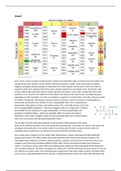
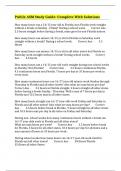
1. classical thermo- dynamics 2. 0th law of ther- modynamics describes macroscopic systems in equilibrium in terms of a few measurable variables If two systems are in thermodynamic equilibrium with a third system, then they are in thermal equilibrium with each other. 3. thermoscope a precursor to the thermometer - if the third body from the 0th law is heated and changes visibly, then it can be used as one of these to verify equality of temperature or to rank bodies according to temperature 4. thermometer a calibrated thermoscope - Any thermoscope can be used to define a numerical temperature scale over some range 5. what led to the ideal gas/ab- solute tempera- ture scale? 6. first law of ther- modynamics 7. adiabatic process thermoscopes based on the volumes of gases any change in internal energy E of a system is due to the amount of heat added to it and the work done on it A process in which no heat is transferred to or from the system by its surroundings. Q = 0 8. heat engine a device that converts thermal energy into mechanical energy - the net work done by the system is equal to the net heat transferred to the system (won't be a perfect system in all likelihood) 9. reversible process 10. quasistatic process a quasistatic process where friction can be ignored a process which proceeds very slowly such that the sys- tem is always in thermal equilibrium 11. 11. kelvin-planck statement 12. Clausius state- ment 13. fundamental thermodynamic relation It is impossible to construct an engine which, operating in a cycle, will produce no other effect than the extraction of heat from a reservoir and the performance of an equiva- lent amount of work. It is impossible to construct an refrigerator which, operat- ing in a cycle, will produce no other effect than the transfer of heat from a cooler body to a hotter one. dE = TdS - PdV 14. isentropic having equal/constant entropy 15. Gibbs free ener- gy 16. Helmholtz free energy 17. chemical poten- tial 18. How do we pre- dict properties of a macrostate for an isolated sys- tem? 19. intensive vari- ables 20. extensive vari- ables the energy of a system that is available to do work at a constant temperature and pressure G(T,P) = E - TS + PV The part of change in internal energy that we are free to use for work F(T,V) = E - TS the Gibbs free energy per molecule or mole. It is the key to to diffusive and chemical equilibrium. by averaging over the corresponding microstates are non-additive; their value is not proportional to the amount of substance are additive; their value is linearly proportional to the amount of substance. 21. what does phase coexistence (at fixed tempera- ture and pres- sure) require? Equal Gibbs free energy per molecule in the two phases. Otherwise the system would evolve to minimise its Gibbs free energy and one phase would convert into the other 22. partial pressure the contribution each gas in a mixture of gases makes to the total pressure Pi = (Ni/N)P 23. Ergodic Hypoth- esis 24. Microcanonical ensemble 25. Canonical En- semble 26. Grand Canonical Ensemble 27. postulate of equal a priori probabilities 28. pauli exclusion principle for fermions 29. pauli exclusion principle for bosons During its time evolution, a system visits all possible ac- cessible states in phase-space (specified by the positions and momenta of all particles) with equal probability. where the real system is isolated, that is at fixed energy and particle number, the copies in the ensemble are also isolated from one another If the real system is in contact with a heat bath, that is at fixed temperature, the copies are assumed to be in thermal contact, with all the rest of the copies acting as a heat bath of any individual copy If the real system can exchange both heat and particles with a reservoir, at fixed temperature and chemical poten- tial, the copies are also assumed to be in diffusive contact allows us to average over microstates - assumes that allowed microstates are equally likely the wave function should be antisymmetric under the ex- change of any pair of particles - at most one can be in anu fully-specified quantum state the wave function should be symmetric under the ex- change of any pair of particles - any number of them can be in the same quantum state

Show more Read less


Whoops! We can’t load your doc right now. Try again or contact support.

Document information

Uploaded on
March 29, 2023
Number of pages
5
Written in
2022/2023
Type
Exam (elaborations)
Contains
Questions & answers

Subjects

Content preview

Statistical Mechanics
Study online at
https://quizlet.com/_cptddw
1. classical
describes macroscopic systems in equilibrium in
thermo-
terms of a few measurable variables
dynamics
If two systems are in thermodynamic
2. 0th law of
equilibrium with a third system, then they are in
ther-
thermal equilibrium with each other.
modynamics

3. thermoscope a precursor to the thermometer - if the third body
from the 0th law is heated and changes visibly,
then it can be used as one of these to verify
equality of temperature or to rank bodies
according to temperature

4. thermometer a calibrated thermoscope - Any thermoscope can
be used to define a numerical temperature scale
over some range

5. what led to thermoscopes based on the volumes of gases
the ideal gas/ab-
solute tempera-
ture scale?

6. first law of any change in internal energy E of a system is
ther- due to the amount of heat added to it and the
modynamics work done on it
7. adiabatic A process in which no heat is transferred to or
process from the system by its surroundings.

Q=0

8. heat engine a device that converts thermal energy into
mechanical
energy - the net work done by the system is equal
to
the net heat transferred to the system (won't be
a perfect system in all likelihood)


1

, Statistical Mechanics
Study online at
9. https://quizlet.com/_cptddw
reversible a quasistatic process where friction can be
process ignored
10.quasistatic
process a process which proceeds very slowly such that
the sys- tem is always in thermal equilibrium

11. 11.


2

Get to know the seller

Seller avatar
Reputation scores are based on the amount of documents a seller has sold for a fee and the reviews they have received for those documents. There are three levels: Bronze, Silver and Gold. The better the reputation, the more your can rely on the quality of the sellers work.
YOURVERIFIEDEXAMPLUG Havard School
View profile
Follow You need to be logged in order to follow users or courses
Sold
92
Member since
3 year
Number of followers
44
Documents
5585
Last sold
3 weeks ago
YOURVERIFIEDEXAMPLUG DEALING WITH TEST BANKS, STUDY GUIDES, PAST AND NEW EXAM PAPERS .

SOLUTION MANUALS | COMPLETE TEST BANKS AND QUIZ BANKS | STUDY SET EXAMS | STUDY GUIDES | 100% VERIFIED ANSWERS AND SOLUTIONS | ALL GRADED A+ On this page you will find well elaborated Test banks, Quiz banks, Solution manuals and many more documents, offered by seller YOURVERIFIEDEXAMPLUG. I wish you a great, easy and reliable learning through your course and exams. kindly message me for any inquiries or assistance in your studies and i will be of great help. THANKYOU!!!!!!!!!!!!!!!!!!!!!!!!!!!! for orders and pre-orders, email me :~

Read more Read less
4.0

14 reviews

5
8
4
1
3
3
2
1
1
1

Recently viewed by you

Why students choose Stuvia

Created by fellow students, verified by reviews

Quality you can trust: written by students who passed their exams and reviewed by others who've used these revision notes.

Didn't get what you expected? Choose another document

No problem! You can straightaway pick a different document that better suits what you're after.

Pay as you like, start learning straight away

No subscription, no commitments. Pay the way you're used to via credit card and download your PDF document instantly.

Student with book image

“Bought, downloaded, and smashed it. It really can be that simple.”

Alisha Student

Frequently asked questions