Marketing chapter 14 retailing
14.1 The role of retailing
- Retailing: all activities involved in selling products and services directly to ultimate
consumers for their personal, family, household use.
- Retailers: the only channel intermediaries that are in direct contact with final customers.
They represent the distribution channel.
- Marketing-oriented retailers attract customers by adding value to the merchandise by:
1. Their location
2. The available product assortment
3. The store image
4. Customer service
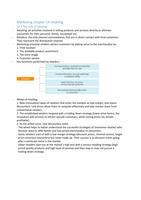
- Key functions performed by retailers:
- Wheel of retailing:
1. New (innovative) types of retailers that enter the markets as low-margin, low-status
discounters. Low prices allow them to compete effectively and take market share from
conventional retailers.
2. The established retailers respond with a trading down strategy (lower price items), the
innovators add services to attract upscale customers, while raising prices (to remain
profitable).
3. As the wheel turns, new discounters enter.
- The wheel helps to better understand the successful strategies of innovative retailers who
discover ways to offer better and low-priced merchandise to consumers.
- Some retailers start of with a low-margin strategy (discount prices, minimal service, target
price-conscious consumers) but never trade up. Their success is as discount stores going
after a particular niche in the market.
- Other retailers start out at the market’s high end with a service retailing strategy (high
priced quality products and high level of service) and then may or may not pursue a
trading-down strategy.
, 14.2 Types of retail operations
- Store-based retailers: operate from a fixed location and customers visit the store to select
products or services.
- Non-store-based retailers: use means, such as direct marketing, vending machines or the
internet to reach customers at home, at work or any place except the store.
- We will focus on:
1. The major types of retail stores
2. Non-store retailing
3. Shopping centres.
- Retail stores
Classification of stores based on:
1. Merchandise mix: total set of all product lines and products offered for sale by a retailer
depth, offerings available to the customer and breadth, the variety of products carried.
2. Relative prices: margins, discounts, sale events. Offer high-quality for premium prices and
regular merchandise for low prices.
3. Level of service: full-service (lots of assistance), limited-service (little assistance) or self-
service (no assistance).
- Most common types of retail stores:
1. Specialty stores: relatively small-scale stores offering a great deal of product depth within
a narrow range of product lines, often one type of product (shoes, clothing, fish,
jewellery). Specialisation.
2. Convenience stores: small shop, carries a limited assortment of food products and high-
turnover convenience goods (Shell, BP). Higher prices than supermarkets.
3. Supermarkets: large, departmentalised food stores that carry a limited range of non-food
products. Scrambled marketing, with non-food products (AH, Lidl).
4. Hypermarkets: huge retail outlet that offers both supermarket and discount store
shopping in one location (Carrefour).
, 5. Department stores: large, service-oriented retail institution that carries a wide product
mix of shopping and speciality goods, and offers a deep selection in product categories
and household products (Harrods, Bijenkorf). Shop in the shop. Anchor positions.
6. Discount stores: large retail store carrying various product lines at lower prices than
department stores, made possibly by offering limited customer service (Walmart). Variety
store. Warehouse club. Factory outlet store. Limited-line store.
7. Category killer: special type of limited-line store, that offers a huge selection of products
in a single product line at low prices (mediamarkt electronics).
- Scrambled merchandising: sale of items that are not usually associated with the retail store,
to generate more profit.
- Supercentre: a combination of a supermarket and discount department store that is not a
big as a hypermarket.
- Shop in the shop: customers make purchases in each department and pay there, no general
checkout area.
- Anchor positions: placement of large/well known retail store at attractive points of a
shopping centre, to draw consumers to the centre.
- Variety store: small version of a department store, but offering fewer services and targeting
mass market with an extensive range of low-priced products.
- Warehouse club: adaption of a discount store in which products are displayed in boxes or on
pallets.
- Non-store retailing: any method a company uses to create an exchange without requiring a
customer to visit a store, such as online sales.
- Major forms of non-store retailing:
1. Direct marketing
2. Direct selling
3. Network marketing
4. Street peddling
5. Automatic vending
14.1 The role of retailing
- Retailing: all activities involved in selling products and services directly to ultimate
consumers for their personal, family, household use.
- Retailers: the only channel intermediaries that are in direct contact with final customers.
They represent the distribution channel.
- Marketing-oriented retailers attract customers by adding value to the merchandise by:
1. Their location
2. The available product assortment
3. The store image
4. Customer service
- Key functions performed by retailers:
- Wheel of retailing:
1. New (innovative) types of retailers that enter the markets as low-margin, low-status
discounters. Low prices allow them to compete effectively and take market share from
conventional retailers.
2. The established retailers respond with a trading down strategy (lower price items), the
innovators add services to attract upscale customers, while raising prices (to remain
profitable).
3. As the wheel turns, new discounters enter.
- The wheel helps to better understand the successful strategies of innovative retailers who
discover ways to offer better and low-priced merchandise to consumers.
- Some retailers start of with a low-margin strategy (discount prices, minimal service, target
price-conscious consumers) but never trade up. Their success is as discount stores going
after a particular niche in the market.
- Other retailers start out at the market’s high end with a service retailing strategy (high
priced quality products and high level of service) and then may or may not pursue a
trading-down strategy.
, 14.2 Types of retail operations
- Store-based retailers: operate from a fixed location and customers visit the store to select
products or services.
- Non-store-based retailers: use means, such as direct marketing, vending machines or the
internet to reach customers at home, at work or any place except the store.
- We will focus on:
1. The major types of retail stores
2. Non-store retailing
3. Shopping centres.
- Retail stores
Classification of stores based on:
1. Merchandise mix: total set of all product lines and products offered for sale by a retailer
depth, offerings available to the customer and breadth, the variety of products carried.
2. Relative prices: margins, discounts, sale events. Offer high-quality for premium prices and
regular merchandise for low prices.
3. Level of service: full-service (lots of assistance), limited-service (little assistance) or self-
service (no assistance).
- Most common types of retail stores:
1. Specialty stores: relatively small-scale stores offering a great deal of product depth within
a narrow range of product lines, often one type of product (shoes, clothing, fish,
jewellery). Specialisation.
2. Convenience stores: small shop, carries a limited assortment of food products and high-
turnover convenience goods (Shell, BP). Higher prices than supermarkets.
3. Supermarkets: large, departmentalised food stores that carry a limited range of non-food
products. Scrambled marketing, with non-food products (AH, Lidl).
4. Hypermarkets: huge retail outlet that offers both supermarket and discount store
shopping in one location (Carrefour).
, 5. Department stores: large, service-oriented retail institution that carries a wide product
mix of shopping and speciality goods, and offers a deep selection in product categories
and household products (Harrods, Bijenkorf). Shop in the shop. Anchor positions.
6. Discount stores: large retail store carrying various product lines at lower prices than
department stores, made possibly by offering limited customer service (Walmart). Variety
store. Warehouse club. Factory outlet store. Limited-line store.
7. Category killer: special type of limited-line store, that offers a huge selection of products
in a single product line at low prices (mediamarkt electronics).
- Scrambled merchandising: sale of items that are not usually associated with the retail store,
to generate more profit.
- Supercentre: a combination of a supermarket and discount department store that is not a
big as a hypermarket.
- Shop in the shop: customers make purchases in each department and pay there, no general
checkout area.
- Anchor positions: placement of large/well known retail store at attractive points of a
shopping centre, to draw consumers to the centre.
- Variety store: small version of a department store, but offering fewer services and targeting
mass market with an extensive range of low-priced products.
- Warehouse club: adaption of a discount store in which products are displayed in boxes or on
pallets.
- Non-store retailing: any method a company uses to create an exchange without requiring a
customer to visit a store, such as online sales.
- Major forms of non-store retailing:
1. Direct marketing
2. Direct selling
3. Network marketing
4. Street peddling
5. Automatic vending