How do Owen and Heaney explore the power of nature in
'Exposure' and 'Storm on the Island'?
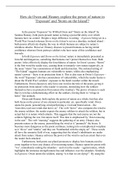
In the poems “Exposure” by Wilfred Owen and “Storm on the Island” by
Seamus Heaney, both poets present nature as being a powerful entity over which
humans have no control. Despite a large difference in setting – Exposure being set in a
World War I trench whereas Storm on the Island is set on a desolate, isolated island –
both poems effectively display the way in which humans are subject to nature’s
relentless attacks. However, Heaney chooses to present humans as having initial
confidence whereas Owen portrays soldiers who have none of this confidence and
bravado.
In both Exposure and Storm on the Island, nature is immediately presented as
forceful and dangerous, something that humans can’t protect themselves from. Both
poems’ titles effectively display the forcefulness of nature. In Owen’s poem, “Storm”
is the first word the reader sees, causing them to instantly view nature negatively, as
the noun “storm” has connotations of death and destruction. The isolated setting of
“The Island” suggests humans are vulnerable to nature, whilst also emphasising
nature’s power – there is no protection from it. This is also seen in Owen’s Exposure –
the word “Exposure” also has connotations of vulnerability, which the reader learns is
about the World War I soldiers’ exposure to the harsh weather within the trench.
Furthermore, Owen chooses to only have one word in the title of the poem, giving it
no protection from nature’s (the reader’s) scrutiny, mimicking how the soldiers
themselves have no protection from nature (the weather). The power of nature is such
that it even has a dehumanising effect on the soldiers, forcing them to “cringe in
holes” like animals.
Owen and Heaney both explore the power of nature as a whole, but they also
both focus on the power of one element in particular: air, specifically wind. Owen
opens his poem, personifying wind performing a vivid and brutal action – the
“merciless iced east winds that knive us”. The verb “knive” also compares the wind to
the enemy soldiers: the reader expects the enemy soldiers to attack the soldiers, but in
actual fact it is nature which attacks. This suggests that the real enemy are not the
soldiers fighting the war, but nature itself. This idea is emphasised by “dawn massing
in the east”. The verb “massing” suggests the gathering of an army. Heaney also
presents nature as the enemy, personifying the wind as it “pummels” the house. It
becomes more dangerous as the poem continues, turning into a metaphorical warplane
as it “dives” and “strafes” and they are “bombarded with the empty air”. These words
all have the semantic field of war, suggesting that the island’s inhabitants are under
attack from nature. Heaney enforces the power of the wind to such an extent that even
the reader feels attacked.
Furthermore, both poets use plural pronouns to display how humans need to
come together to have any chance of overcoming nature. Heaney opens his poem with
“we”, immediately uniting the islanders – and even the reader – against nature, which
highlights the immense strength nature has and influence over the islanders. Similarly,
in Exposure, Owen unites the soldiers, asking “is it that we are dying?”. By using the
'Exposure' and 'Storm on the Island'?
In the poems “Exposure” by Wilfred Owen and “Storm on the Island” by
Seamus Heaney, both poets present nature as being a powerful entity over which
humans have no control. Despite a large difference in setting – Exposure being set in a
World War I trench whereas Storm on the Island is set on a desolate, isolated island –
both poems effectively display the way in which humans are subject to nature’s
relentless attacks. However, Heaney chooses to present humans as having initial
confidence whereas Owen portrays soldiers who have none of this confidence and
bravado.
In both Exposure and Storm on the Island, nature is immediately presented as
forceful and dangerous, something that humans can’t protect themselves from. Both
poems’ titles effectively display the forcefulness of nature. In Owen’s poem, “Storm”
is the first word the reader sees, causing them to instantly view nature negatively, as
the noun “storm” has connotations of death and destruction. The isolated setting of
“The Island” suggests humans are vulnerable to nature, whilst also emphasising
nature’s power – there is no protection from it. This is also seen in Owen’s Exposure –
the word “Exposure” also has connotations of vulnerability, which the reader learns is
about the World War I soldiers’ exposure to the harsh weather within the trench.
Furthermore, Owen chooses to only have one word in the title of the poem, giving it
no protection from nature’s (the reader’s) scrutiny, mimicking how the soldiers
themselves have no protection from nature (the weather). The power of nature is such
that it even has a dehumanising effect on the soldiers, forcing them to “cringe in
holes” like animals.
Owen and Heaney both explore the power of nature as a whole, but they also
both focus on the power of one element in particular: air, specifically wind. Owen
opens his poem, personifying wind performing a vivid and brutal action – the
“merciless iced east winds that knive us”. The verb “knive” also compares the wind to
the enemy soldiers: the reader expects the enemy soldiers to attack the soldiers, but in
actual fact it is nature which attacks. This suggests that the real enemy are not the
soldiers fighting the war, but nature itself. This idea is emphasised by “dawn massing
in the east”. The verb “massing” suggests the gathering of an army. Heaney also
presents nature as the enemy, personifying the wind as it “pummels” the house. It
becomes more dangerous as the poem continues, turning into a metaphorical warplane
as it “dives” and “strafes” and they are “bombarded with the empty air”. These words
all have the semantic field of war, suggesting that the island’s inhabitants are under
attack from nature. Heaney enforces the power of the wind to such an extent that even
the reader feels attacked.
Furthermore, both poets use plural pronouns to display how humans need to
come together to have any chance of overcoming nature. Heaney opens his poem with
“we”, immediately uniting the islanders – and even the reader – against nature, which
highlights the immense strength nature has and influence over the islanders. Similarly,
in Exposure, Owen unites the soldiers, asking “is it that we are dying?”. By using the