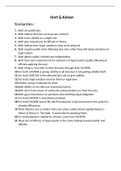
Hart & Kelsen
Similarities:-
1. Both are positivists.
2. Both believe that law can have any content.
3. Both trace validity to a single rule.
4. Both give importance to officials in theory.
5. Both believe that ‘legal’ sanctions have to be physical.
6. Both require public to be following law only, when they talk about existence of
legal system.
7. Both ignore public’s beliefs and subjectivities.
8. Both have two requirements for existence of legal system (public following &
officials applying the law).
9. Both bring in ‘morality’ in their theories through their GN/ROR.
10.For both, GN/ROR is giving validity to all laws but is not getting validity itself.
11.For both, ROR/GN is the ultimate/last rule to give validity.
12.For both, legal sanction must be there or legal laws.
13.Politics/ power irrelevant for both.
14.Both define LS via rules not in personal terms.
15.Both don’t have issues of continuity and persistence in their theories.
16.Both gave importance to sanctions when defining legal obligation.
17.For both GN/ROR is sometimes unstated.
18.For both GN/ROR seems like the first step but is discovered once the system is
already efficacious.
19.Their theories are so similar that even when Justice Munir applied Kelsen’s
theory in Dosso V. The Stale, it seems like he applying Harts.
20.For both objective validity for all laws come from GN/ROR.
21.Their test of efficacy of legal system is the same looking towards public and
officials.
Similarities:-
1. Both are positivists.
2. Both believe that law can have any content.
3. Both trace validity to a single rule.
4. Both give importance to officials in theory.
5. Both believe that ‘legal’ sanctions have to be physical.
6. Both require public to be following law only, when they talk about existence of
legal system.
7. Both ignore public’s beliefs and subjectivities.
8. Both have two requirements for existence of legal system (public following &
officials applying the law).
9. Both bring in ‘morality’ in their theories through their GN/ROR.
10.For both, GN/ROR is giving validity to all laws but is not getting validity itself.
11.For both, ROR/GN is the ultimate/last rule to give validity.
12.For both, legal sanction must be there or legal laws.
13.Politics/ power irrelevant for both.
14.Both define LS via rules not in personal terms.
15.Both don’t have issues of continuity and persistence in their theories.
16.Both gave importance to sanctions when defining legal obligation.
17.For both GN/ROR is sometimes unstated.
18.For both GN/ROR seems like the first step but is discovered once the system is
already efficacious.
19.Their theories are so similar that even when Justice Munir applied Kelsen’s
theory in Dosso V. The Stale, it seems like he applying Harts.
20.For both objective validity for all laws come from GN/ROR.
21.Their test of efficacy of legal system is the same looking towards public and
officials.