COTTERELL ON AUSTIN
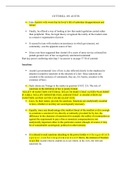
John Austin's wife wrote that he lived 'a life of unbroken disappointment and
failure'
Finally, he offered a way of looking at law that made legislation central rather
than peripheral. Thus, his legal theory recognised the reality of the modern state
as a massive organisation of power.
It seemed in tune with modern circumstances in which government, not
community, was the apparent source of law.
It has even been suggested that Austin's five years of army service coloured his
parade-ground view of law as negatively sanctioned command
Hart kay power conferring rules hap 3 ka answer is on page 57 58 of cotereal
Sanctions
Austin's governmental view of law is also reflected clearly in the emphasis he
attaches to punitive sanctions in the structure of a law. Since sanctions are
essential to the existence of commands, they are, for Austin, essential to the
existence of laws.
Such claims are 'foreign to the matter in question' (1832: 23). The role of
sanctions in the definition of law is purely formal.
NULITY IS SANCTION COTTERAL TELLS TO HART THAT AUSTIN WAS RIHJT
IF A BILL NULLIFY MINISTER FEEL ASHAM THAT A ASANCATION AS
SANCTION AS PER AUTIN CAN BE LEAST EVIL
Laws, by their nature, provide for sanctions. Sanctions are anafyticalfy essential
to laws, whether or not they are sociologically necessary.
Equally, since any disadvantage (the smallest threat of the smallest evil) is enough
to constitute a sanction if it is directly or indirectly provided for by law, the
difference in the character of sanctions (for example, the nullity of a transaction as
against the requirement to pay a fine or monetary compensation) is not
anafyticalfy important either in this particular context (though, of course, it may
be of considerable sociological, political or other interest).
It is absurd to seek sanctions attaching to the power holder w i t h r e g a r d t o t h
e p o w e r - c o n f e r r i n g e l e m e n t i t s e l f that is, the element of freedom
to act. But Austin's theory enables us to see where, in his view, the relevant
sanctions lie.
John Austin's wife wrote that he lived 'a life of unbroken disappointment and
failure'
Finally, he offered a way of looking at law that made legislation central rather
than peripheral. Thus, his legal theory recognised the reality of the modern state
as a massive organisation of power.
It seemed in tune with modern circumstances in which government, not
community, was the apparent source of law.
It has even been suggested that Austin's five years of army service coloured his
parade-ground view of law as negatively sanctioned command
Hart kay power conferring rules hap 3 ka answer is on page 57 58 of cotereal
Sanctions
Austin's governmental view of law is also reflected clearly in the emphasis he
attaches to punitive sanctions in the structure of a law. Since sanctions are
essential to the existence of commands, they are, for Austin, essential to the
existence of laws.
Such claims are 'foreign to the matter in question' (1832: 23). The role of
sanctions in the definition of law is purely formal.
NULITY IS SANCTION COTTERAL TELLS TO HART THAT AUSTIN WAS RIHJT
IF A BILL NULLIFY MINISTER FEEL ASHAM THAT A ASANCATION AS
SANCTION AS PER AUTIN CAN BE LEAST EVIL
Laws, by their nature, provide for sanctions. Sanctions are anafyticalfy essential
to laws, whether or not they are sociologically necessary.
Equally, since any disadvantage (the smallest threat of the smallest evil) is enough
to constitute a sanction if it is directly or indirectly provided for by law, the
difference in the character of sanctions (for example, the nullity of a transaction as
against the requirement to pay a fine or monetary compensation) is not
anafyticalfy important either in this particular context (though, of course, it may
be of considerable sociological, political or other interest).
It is absurd to seek sanctions attaching to the power holder w i t h r e g a r d t o t h
e p o w e r - c o n f e r r i n g e l e m e n t i t s e l f that is, the element of freedom
to act. But Austin's theory enables us to see where, in his view, the relevant
sanctions lie.