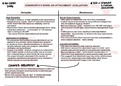
AINSWORTH’S WORK ON ATTACHMENT- EVALUATION
Strengths Weaknesses
High Reliability: Not all Types Covered:
• strength is evidence of high reliability in the observations • other types of attachment may have been overlooked
• Ainsworth et al.’s study - panel of experienced observers • original research did classify as many different subtypes but
which meant that inter-observer reliability could be they all related to Types A, B and C
calculated • Main and Solomon (1990) - analysed over 200 SSP videotapes
• Researchers found almost perfect agreement when rating and proposed a fourth type called insecure-disorganised (Type
exploratory behaviour - a correlation of +.94 between D)
rater’s coming on the SSP. • A fifth type has also been identified called disinhibited
- this means that the observations can be trusted attachment - characteristic of children who have experienced
severe privation
Application to Childcare • This means that the initial research may have oversimplified a
• the processes that facilitate secure attachment can be more complex situation - lacks validity
applied to any situation where children are cared for
• In situations where disordered patterns of attachment Low Internal Validity:
develop between baby and caregiver, intervention • SSP does not measure what it aims to measure
strategies can be developed • SSP aims to measure the attachment type of a child - but it
• Cooper et al (2005) - teaches caregivers to understand actually measures the quality of one particular relationship
their babies signals of distress better and to increase • Main and Weston (1981) - found that the classification of
their understanding of what it feels like to be anxious. attachment type depended on which parent a baby was with
• The project showed a decrease in the number of • This suggests that attachment type may not be valid because
caregivers classified as disordered and an increase in what we are measuring is one relationship rather than a
babies classed as securely attached personal characteristic lodged in the individual
• it could be argued that the relationship between a child and
their primary caregiver is the key factor in determining a
child’s attachment type
• Means that outcome may be valid - if relationship being
measured is with the primary attachment figure
Strengths Weaknesses
High Reliability: Not all Types Covered:
• strength is evidence of high reliability in the observations • other types of attachment may have been overlooked
• Ainsworth et al.’s study - panel of experienced observers • original research did classify as many different subtypes but
which meant that inter-observer reliability could be they all related to Types A, B and C
calculated • Main and Solomon (1990) - analysed over 200 SSP videotapes
• Researchers found almost perfect agreement when rating and proposed a fourth type called insecure-disorganised (Type
exploratory behaviour - a correlation of +.94 between D)
rater’s coming on the SSP. • A fifth type has also been identified called disinhibited
- this means that the observations can be trusted attachment - characteristic of children who have experienced
severe privation
Application to Childcare • This means that the initial research may have oversimplified a
• the processes that facilitate secure attachment can be more complex situation - lacks validity
applied to any situation where children are cared for
• In situations where disordered patterns of attachment Low Internal Validity:
develop between baby and caregiver, intervention • SSP does not measure what it aims to measure
strategies can be developed • SSP aims to measure the attachment type of a child - but it
• Cooper et al (2005) - teaches caregivers to understand actually measures the quality of one particular relationship
their babies signals of distress better and to increase • Main and Weston (1981) - found that the classification of
their understanding of what it feels like to be anxious. attachment type depended on which parent a baby was with
• The project showed a decrease in the number of • This suggests that attachment type may not be valid because
caregivers classified as disordered and an increase in what we are measuring is one relationship rather than a
babies classed as securely attached personal characteristic lodged in the individual
• it could be argued that the relationship between a child and
their primary caregiver is the key factor in determining a
child’s attachment type
• Means that outcome may be valid - if relationship being
measured is with the primary attachment figure