

IGCSE BIOLOGY – TOPIC 3
REPRODUCTION AND INHERITANCE
a) REPRODUCTION
FLOWERING PLANT REPRODUCTION:
• FLOWERS are the REPRODUCTIVE ORGAN of a plant, containing both
male and female reproductive parts
• Plants produce POLLEN which contains a nucleus inside that is a male
gamete – it is unable to move and therefore plants have a mechanism to
transfer pollen to the female parts of a flower
• This is known as POLLINATION – the two main types include INSECT
POLLINATION and WIND POLLINATION
• The structures of insect and wind pollinated flowers are different as they
are adapted for their functions
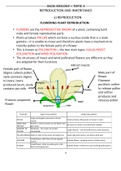
Attract insects
Female part of flower
Stigma collects pollen, Male part of
style connects stigma flower
to ovary, ovary Filament
produced ovum, ovule positions anther
contains sex cells to release pollen
and anther
produces and
Protects unopened releases pollen
flower
FEATURE INSECT-POLLINATED WIND-POLLINATED
Large and brightly coloured to attract
PETALS Small and dull, often green or brown in color
insects
SCENT AND Present – entices insects to visit flower and
No scent or nectar as no attraction needed
NECTAR get nectar
AMOUNT OF Moderate – for insects to transfer
Large amount – not all transferred so more produce
POLLEN successfully
POLLEN GRAINS Sticky to stick to the insect and larger too Small, light and small so carried by wind well
Inside flower, stiff, firm to brush against
ANTHERS Outside flower, swinging loose to release easily
insects
Inside flower, sticky so pollen grain stick
STIGMA Outside flower, feathery to catch drifting pollen grains
when insect goes past
44
, • FERTILISATION IN PLANTS –occurs when a pollen nucleus fuses with an
ovum nucleus in the ovule
• As the pollen cannot move a POLLEN TUBE is gown (only if the same
species of flower from where pollen is from)
• The nucleus inside the pollen grain slips down the tube as it grows down
the style towards the ovary
• The ovary contains one or more ovules each containing an ovum with a
female nucleus
• One the nuclei have joined together, the ovule has been fertilized and a
ZYGOTE is formed
• The Zygote begins to divide and eventually forms a seed
• As plants have different numbers of ovules, this explains different fruits
(developing from ovary) and seeds (develop from ovules)
• GERMINATION - the start of growth in the seed. Three factors are
required for successful germination:
o WATER – allows the seed to swell up and the enzymes in the
embryo to start working so that growth can occur
o OXYGEN – so that energy can be released for germination
o WARMTH – germination improves as temperature rises (up to a
maximum) as the reactions which take place are controlled by
enzymes
• A SEED has 3 main parts: the EMBRYO (the yound root and shoot
that become the adult plant), a FOOD STORE (starch for the
seedling to use until it is able to carry out photosynthesis, and a
SEED COAT – TESTA (a tough protective outer covering)
THE COTEYLEDON (main part of seed)
contains STARCH) which is used as a food
store in seeds
The enzyme AMYLASE will break down
STARCH into GLUCOSE
Glucose is used in aerobic respiration to
release for growth
45
REPRODUCTION AND INHERITANCE
a) REPRODUCTION
FLOWERING PLANT REPRODUCTION:
• FLOWERS are the REPRODUCTIVE ORGAN of a plant, containing both
male and female reproductive parts
• Plants produce POLLEN which contains a nucleus inside that is a male
gamete – it is unable to move and therefore plants have a mechanism to
transfer pollen to the female parts of a flower
• This is known as POLLINATION – the two main types include INSECT
POLLINATION and WIND POLLINATION
• The structures of insect and wind pollinated flowers are different as they
are adapted for their functions
Attract insects
Female part of flower
Stigma collects pollen, Male part of
style connects stigma flower
to ovary, ovary Filament
produced ovum, ovule positions anther
contains sex cells to release pollen
and anther
produces and
Protects unopened releases pollen
flower
FEATURE INSECT-POLLINATED WIND-POLLINATED
Large and brightly coloured to attract
PETALS Small and dull, often green or brown in color
insects
SCENT AND Present – entices insects to visit flower and
No scent or nectar as no attraction needed
NECTAR get nectar
AMOUNT OF Moderate – for insects to transfer
Large amount – not all transferred so more produce
POLLEN successfully
POLLEN GRAINS Sticky to stick to the insect and larger too Small, light and small so carried by wind well
Inside flower, stiff, firm to brush against
ANTHERS Outside flower, swinging loose to release easily
insects
Inside flower, sticky so pollen grain stick
STIGMA Outside flower, feathery to catch drifting pollen grains
when insect goes past
44
, • FERTILISATION IN PLANTS –occurs when a pollen nucleus fuses with an
ovum nucleus in the ovule
• As the pollen cannot move a POLLEN TUBE is gown (only if the same
species of flower from where pollen is from)
• The nucleus inside the pollen grain slips down the tube as it grows down
the style towards the ovary
• The ovary contains one or more ovules each containing an ovum with a
female nucleus
• One the nuclei have joined together, the ovule has been fertilized and a
ZYGOTE is formed
• The Zygote begins to divide and eventually forms a seed
• As plants have different numbers of ovules, this explains different fruits
(developing from ovary) and seeds (develop from ovules)
• GERMINATION - the start of growth in the seed. Three factors are
required for successful germination:
o WATER – allows the seed to swell up and the enzymes in the
embryo to start working so that growth can occur
o OXYGEN – so that energy can be released for germination
o WARMTH – germination improves as temperature rises (up to a
maximum) as the reactions which take place are controlled by
enzymes
• A SEED has 3 main parts: the EMBRYO (the yound root and shoot
that become the adult plant), a FOOD STORE (starch for the
seedling to use until it is able to carry out photosynthesis, and a
SEED COAT – TESTA (a tough protective outer covering)
THE COTEYLEDON (main part of seed)
contains STARCH) which is used as a food
store in seeds
The enzyme AMYLASE will break down
STARCH into GLUCOSE
Glucose is used in aerobic respiration to
release for growth
45


