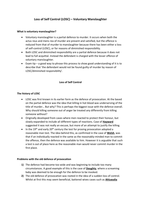
Loss of Self Control (LOSC) – Voluntary Manslaughter
What is voluntary manslaughter?
Voluntary manslaughter is a partial defence to murder. It occurs when both the
actus reus and mens rea of murder are present and satisfied, but the offence is
reduced from that of murder to manslaughter because there has been either a loss
of self-control (LOSC), or for reasons of diminished responsibility.
Both LOSC and diminished responsibility are a partial defence because it does not
lead to full acquittal. Instead the defendant is charged with the lesser offence of
voluntary manslaughter.
Exam tip – a good way to phrase this process to show good understanding of it is to
describe that ‘the defendant would not be found guilty of murder by reason of
LOSC/diminished responsibility’.
Loss of Self Control
The history of LOSC
LOSC was first known in its earlier form as the defence of provocation. At the based
on the partial defence was the idea that killing in hot blood was underserving of the
title of murder… But why? This is perhaps the biggest issue with the defence overall.
Why should killing someone out of anger be treated any differently from killing
someone without?
Originally developed from cases where men reacted to protect their honour, but
slowly expanded to include all different types of reactions. Case of Hayward
suggested it was not really an excuse, but more of an attempt to justify the killing.
In the 19th and early 20th century the test for proving provocation adopted a
reasonable man test. The idea behind this, as confirmed in the case of Welsh, was
that if an individually reacted in the same as the reasonably-minded man to commit
the offence, then the defence was available to him. However it is arguable that such
a test is out of place here as the reasonable man would never commit murder in the
first place.
Problems with the old defence of provocation
1) The defence had become too wide and was beginning to include too many
circumstances. A good example of this is the case of Doughty, where a screaming
baby was deemed to be enough for the defence to be invoked.
2) The old defence of provocation was rooted in the idea of a sudden loss of control.
Whilst at first this may seem beneficial, battered wives cases such as Ahluwalia
What is voluntary manslaughter?
Voluntary manslaughter is a partial defence to murder. It occurs when both the
actus reus and mens rea of murder are present and satisfied, but the offence is
reduced from that of murder to manslaughter because there has been either a loss
of self-control (LOSC), or for reasons of diminished responsibility.
Both LOSC and diminished responsibility are a partial defence because it does not
lead to full acquittal. Instead the defendant is charged with the lesser offence of
voluntary manslaughter.
Exam tip – a good way to phrase this process to show good understanding of it is to
describe that ‘the defendant would not be found guilty of murder by reason of
LOSC/diminished responsibility’.
Loss of Self Control
The history of LOSC
LOSC was first known in its earlier form as the defence of provocation. At the based
on the partial defence was the idea that killing in hot blood was underserving of the
title of murder… But why? This is perhaps the biggest issue with the defence overall.
Why should killing someone out of anger be treated any differently from killing
someone without?
Originally developed from cases where men reacted to protect their honour, but
slowly expanded to include all different types of reactions. Case of Hayward
suggested it was not really an excuse, but more of an attempt to justify the killing.
In the 19th and early 20th century the test for proving provocation adopted a
reasonable man test. The idea behind this, as confirmed in the case of Welsh, was
that if an individually reacted in the same as the reasonably-minded man to commit
the offence, then the defence was available to him. However it is arguable that such
a test is out of place here as the reasonable man would never commit murder in the
first place.
Problems with the old defence of provocation
1) The defence had become too wide and was beginning to include too many
circumstances. A good example of this is the case of Doughty, where a screaming
baby was deemed to be enough for the defence to be invoked.
2) The old defence of provocation was rooted in the idea of a sudden loss of control.
Whilst at first this may seem beneficial, battered wives cases such as Ahluwalia