Statutory Interpretation – Aids to Interpretation
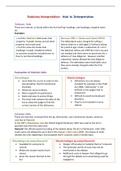
Intrinsic Aids
These are internal, so found within the Act itself eg. headings, sub-headings, marginal notes
etc.
Examples:
-s 4 of the Theft Act 1968 states that Harrow LBC v Shah and Shah (1999)
‘property’ includes money and all other The defendants were charged for selling a
property real or personal. lottery ticket to a child aged 13 without asking
-s 9 of the same Act states that for proof of age. Under a subsection of s 13 in
‘buildings’ include ‘inhabited vehicle’ the National Lottery Act 1993 the mens rea was
so caravans would be included even so not needed and there were no provisions for a
they’re not literal buildings. defence of ‘due diligence’. However another
subsection clearly allowed the due diligence
defence. The defendant were held liable since
they were actually charged under the first
section.
Evaluation of Intrinsic Aids:
Advantages: Disadvantages:
• more likely for courts to come to the • Definitions are not always
interpretation that the Parliament included for example in the Theft
intended. Act 1968, “dishonesty” is not
• Allows for more certainty. defined so the judges had to
• More respectful to parliament. interpret it.
• Quick and easy to access things. • Difficult to avoid harsh/absurd
• The short title contains the date of the decisions.
Act to allow the judge to find the • They’re not included in every
correct version of the dictionary. statute.
Extrinsic Aids
These are external, so beyond the Act eg. dictionaries, Law Commission reports, previous
case law or Hansard.
In the DPP v Cheeseman case the Oxford English Dictionary 1847 was used as the Act in
question was from the same year.
Hansard- the official report/recording of the debate about the Act in Parliament. Until 1992
courts were not allowed to use it but in the Pepper v Hart case (1993) , the House of Lords
relaxed the rules regarding it and accepted that it could be used in limited ways.
Advantages of using Hansard: Disadvantages of using Hansard:
• Available for everyone to • Danger of focusing on material that isn’t relevant.
consult. • The particular words at issue may not be
• Makes the statute words much mentioned in the debate.
clearer. • Additional costs as lawyers feel obliged to go
• Gives the reason that led to the through the debate as to avoid being sued for
Act negligence.
Intrinsic Aids
These are internal, so found within the Act itself eg. headings, sub-headings, marginal notes
etc.
Examples:
-s 4 of the Theft Act 1968 states that Harrow LBC v Shah and Shah (1999)
‘property’ includes money and all other The defendants were charged for selling a
property real or personal. lottery ticket to a child aged 13 without asking
-s 9 of the same Act states that for proof of age. Under a subsection of s 13 in
‘buildings’ include ‘inhabited vehicle’ the National Lottery Act 1993 the mens rea was
so caravans would be included even so not needed and there were no provisions for a
they’re not literal buildings. defence of ‘due diligence’. However another
subsection clearly allowed the due diligence
defence. The defendant were held liable since
they were actually charged under the first
section.
Evaluation of Intrinsic Aids:
Advantages: Disadvantages:
• more likely for courts to come to the • Definitions are not always
interpretation that the Parliament included for example in the Theft
intended. Act 1968, “dishonesty” is not
• Allows for more certainty. defined so the judges had to
• More respectful to parliament. interpret it.
• Quick and easy to access things. • Difficult to avoid harsh/absurd
• The short title contains the date of the decisions.
Act to allow the judge to find the • They’re not included in every
correct version of the dictionary. statute.
Extrinsic Aids
These are external, so beyond the Act eg. dictionaries, Law Commission reports, previous
case law or Hansard.
In the DPP v Cheeseman case the Oxford English Dictionary 1847 was used as the Act in
question was from the same year.
Hansard- the official report/recording of the debate about the Act in Parliament. Until 1992
courts were not allowed to use it but in the Pepper v Hart case (1993) , the House of Lords
relaxed the rules regarding it and accepted that it could be used in limited ways.
Advantages of using Hansard: Disadvantages of using Hansard:
• Available for everyone to • Danger of focusing on material that isn’t relevant.
consult. • The particular words at issue may not be
• Makes the statute words much mentioned in the debate.
clearer. • Additional costs as lawyers feel obliged to go
• Gives the reason that led to the through the debate as to avoid being sued for
Act negligence.