The Multi-Store Model of Memory- AO1
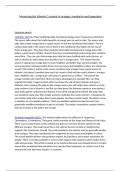
Atkinson and Shiffrin (1968) proposed one of the earliest models of memory.
They suggested that memory is made up of three compounds, that memories are
formed sequentially and that information is passed from one component to the next
in a linear fashion. Rehearsal
Information Transfer
via senses Sensory Attention Short-term Long-term
Register memory memory
(STM) Retrieval (LTM)
Decay Decay Decay
Sensory Register:
Capacity-potentially unlimited.
Encoding- ionic memory (visual Short-term memory:
information is coded visually) and Capacity-7+/-
echoic memory (auditory information also known as 5-9
information is coded acoustically). chunks.
Duration- -2 seconds). Encoding- acoustically
Forgetting- if attention is not paid Duration- around 18 seconds.
the information is forgotten. Forgetting- displacement (more
likely to remember some stuff to
others). Decay, where memory
Long-term memory: fades with time.
Capacity-unlimited capacity. Retrieval- information can be
Encoding- semantically retrieved by maintenance
Duration- lifetime duration. rehearsal.
Forgetting- interference(something
else interferes with the original
memory). Decay, where memory
fades with time.
Retrieval- using retrieval cues.
How do memories decay?
Interference:
Proactive interference- when something learnt earlier interferes with the current
learning.
Retrospective interference- when something learnt later gets in the way of
something learnt previously.
Atkinson and Shiffrin (1968) proposed one of the earliest models of memory.
They suggested that memory is made up of three compounds, that memories are
formed sequentially and that information is passed from one component to the next
in a linear fashion. Rehearsal
Information Transfer
via senses Sensory Attention Short-term Long-term
Register memory memory
(STM) Retrieval (LTM)
Decay Decay Decay
Sensory Register:
Capacity-potentially unlimited.
Encoding- ionic memory (visual Short-term memory:
information is coded visually) and Capacity-7+/-
echoic memory (auditory information also known as 5-9
information is coded acoustically). chunks.
Duration- -2 seconds). Encoding- acoustically
Forgetting- if attention is not paid Duration- around 18 seconds.
the information is forgotten. Forgetting- displacement (more
likely to remember some stuff to
others). Decay, where memory
Long-term memory: fades with time.
Capacity-unlimited capacity. Retrieval- information can be
Encoding- semantically retrieved by maintenance
Duration- lifetime duration. rehearsal.
Forgetting- interference(something
else interferes with the original
memory). Decay, where memory
fades with time.
Retrieval- using retrieval cues.
How do memories decay?
Interference:
Proactive interference- when something learnt earlier interferes with the current
learning.
Retrospective interference- when something learnt later gets in the way of
something learnt previously.