CARDIAC CYCLE
1. Ventricular filling from IVC and SVC.
2. Atrial systole – atria contract when pressure in atria is greater than ventricles (P-R
waves).
3. Isovolumetric contraction – AV valves shut, S1 heart sound, QRS complex.
4. Ejection phase – ST segment, semi-lunar valves open, as pressure in ventricles is
greater than atria.
5. Isovolumetric relaxation – just after T phase, ventricles relax and atria start filling S2
heart sound as semi-lunar valves shut.
Normal Blood Pressure – 120/80mmHg.
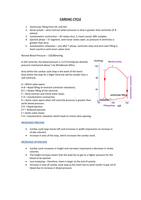
In left ventricle, the blood pressure is 117/1mmHg but diastolic
pressure maintained above 1 by Windkessel effect.
Area within the cardiac cycle loop is the work of the heart.
Area within the loop for a Right Ventricle will be smaller than a
Left Ventricle.
A = Mitral valve opens.
A-B = Rapid filling of ventricle (ventricle relaxation).
B-C = Slower filling of the ventricle.
C = Atria contract and mitral valve closes.
C-D = Isovolumetric contraction.
D = Aortic valve opens when left ventricle pressure is greater than
aortic blood pressure.
D-E = Rapid ejection.
E-F = Reduced ejection.
F = Aortic valve closes.
F-A = Isovolumetric relaxation which leads to mitral valve opening.
INCREASED PRELOAD
Cardiac cycle loop moves left and increases in width (represents an increase in
stroke volume).
Increase in area of the loop, which increases the cardiac work.
INCREASED AFTERLOAD
Cardiac cycle increases in height and narrower (represents a decrease in stroke
volume).
The height increase means that the load has to get to a higher pressure for the
blood to be ejected.
Less emptying – therefore, heart is larger at the end of systole.
Increase in area of cardiac cycle loop as the heart has to work harder to get rid of
blood due to increase in blood pressure.
1. Ventricular filling from IVC and SVC.
2. Atrial systole – atria contract when pressure in atria is greater than ventricles (P-R
waves).
3. Isovolumetric contraction – AV valves shut, S1 heart sound, QRS complex.
4. Ejection phase – ST segment, semi-lunar valves open, as pressure in ventricles is
greater than atria.
5. Isovolumetric relaxation – just after T phase, ventricles relax and atria start filling S2
heart sound as semi-lunar valves shut.
Normal Blood Pressure – 120/80mmHg.
In left ventricle, the blood pressure is 117/1mmHg but diastolic
pressure maintained above 1 by Windkessel effect.
Area within the cardiac cycle loop is the work of the heart.
Area within the loop for a Right Ventricle will be smaller than a
Left Ventricle.
A = Mitral valve opens.
A-B = Rapid filling of ventricle (ventricle relaxation).
B-C = Slower filling of the ventricle.
C = Atria contract and mitral valve closes.
C-D = Isovolumetric contraction.
D = Aortic valve opens when left ventricle pressure is greater than
aortic blood pressure.
D-E = Rapid ejection.
E-F = Reduced ejection.
F = Aortic valve closes.
F-A = Isovolumetric relaxation which leads to mitral valve opening.
INCREASED PRELOAD
Cardiac cycle loop moves left and increases in width (represents an increase in
stroke volume).
Increase in area of the loop, which increases the cardiac work.
INCREASED AFTERLOAD
Cardiac cycle increases in height and narrower (represents a decrease in stroke
volume).
The height increase means that the load has to get to a higher pressure for the
blood to be ejected.
Less emptying – therefore, heart is larger at the end of systole.
Increase in area of cardiac cycle loop as the heart has to work harder to get rid of
blood due to increase in blood pressure.