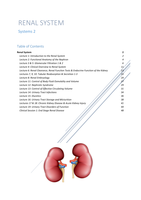
RENAL SYSTEM
Systems 2
Table of Contents
Renal System 2
Lecture 1: Introduction to the Renal System 2
Lecture 2: Functional Anatomy of the Nephron 4
Lecture 3 & 5: Glomerular Filtration 1 & 2 6
Lecture 4: Clinical Overview to Renal System 11
Lecture 6: Renal Clearance, Renal Funciton Tests & Endocrine Function of the Kidney 13
Lectures 7, 9, 10: Tubular Reabsorption & Secretion 1-3 15
Lecture 8: Renal Embryology 24
Lecture 11: Control of Body Fluid Osmolality and Volume 27
Lecture 12: Nephrotic Syndrome 29
Lecture 13: Control of Effective Circulating Volume 31
Lecture 14: Urinary Tract Infections 34
Lecture 15: Diuretics 36
Lecture 16: Urinary Tract Storage and Micturition 38
Lectures 17 & 18: Chronic Kidney Disease & Acute Kidney Injury 41
Lecture 19: Urinary Tract Disorders of Function 44
Clinical Session 1: End Stage Renal Disease 48
, Renal System
Lecture 1: Introduction to the Renal System
• Describe the distribution of water between the fluid compartments of the body.
• Describe the ionic composition of extracellular fluid to include sodium, chloride, bicarbonate and
other. The total concentration of cations and the concentration of
anions must of course be the same but the constituent ions include:
o Na+ = 140mmol/L
o Other cation (e.g. K+, Ca2+, Mg2+) = 10mmol/L
o Cl- = 102mmol/L
o HCO3- = 25mmol/L
o Other anion (e.g. HPO4-, SO42-, proteins) = 15mmol/L
• What are the major functions of the kidney?
1. Salt and water homeostasis (also controlled by thirst)
2. Contribution to pH regulation (by rate of H+ and HCO3- excretion)
3. Excretion of nitrogenous waste
4. Conservation and regulation of essential substances such as:
o Glucose
o Potassium
o Amino acids
o Magnesium
o Phosphate
o Calcium
5. Hormone secretion:
o Active form of vitamin D (important for calcium and phosphate absorption from gut)
o Renin (for RAAS and control of blood pressure)
o Erythropoietin (synthesis of RBCs, hence why anaemia is often kidney related)
o Various prostaglandins
• What other system also regulates pH? Respiratory system, by regulating levels of CO2 in the blood,
which is an acid
• What are the extracellular concentrations of the following ions, and how closely are they
controlled (%)?
Ion Concentration and control range (%)
Sodium, Na+ 140mmol/l (+/- 4%)
Chloride, Cl- 102mmol/l (+/- 5%)
Marc Huttman 2
, Bicarbonate, HCO3- 25mmol/l (+/- 10%)
Potassium, K+ 4.2mmol/l (+/- 18%)
Calcium, Ca2+ 1.2mmol/l (+/- 7%)
Phosphate, PO4- 1.1mmol/l (+/- 20%)
• What are the different ways that concentration can be measured?
Measurement Description Units
Concentration (weight/volume) The mass of solute per volume of g/L
solvent. So if 10g of glucose is
dissolved in 100ml of blood, the
concentration could be written as
10g/100ml
Concentration (molarity) The amount of moles dissolved in mol/L
an amount of solvent. This
describes the number of molecules
in the solvent, and doesn’t not take
into account the weight of each
molecule
Concentration (equivalents) This is useful for charged solutes. It Eq/l
is effectively measuring how much
charge is dissolved in a solvent,
because it takes into account the
number of ions (in moles) and the
charge on each ion (valence). For
example, 152mmol/l of Na+ could
be written as 152mEq/l. But
152mmol/l of Ca2+ would be written
as 304mEq/l, because it has a
charge of 2.
Osmolarity This looks at the pressure the Osm/l
solute in the solution. This depends
on how many particles are in that
solution. The concentration in
Osmoles/l = concentration in
moles/l x number of particles into
which each molecule dissociates.
For example 150mmol/l NaCl,
because it almost completely
dissociates into Na+ and Cl- in
water, has an osmolarity of almost
300mOsm/l. Osmolarity is the
number of osmoles per litre of
solution
Osmolality The same as osmolarity, except it’s Osm/kg
the number of osmoles per kg of
solvent, not per litre of solution. In
water of course, since 1kg = 1l,
osmolarity = osmolality
Marc Huttman 3
, • What is the normal blood osmolarity? 285 mOsm/l
• What is your urine output (in ml/min) and concentration (in mOsm/l) in extreme dehydration and
overhydration?
Severe dehydration Severe overhydration
Urine output 0.3 ml/min 15 ml/min
Urine concentration 1200 mOsm/l, 4 times more 85 mOsm/l, 3 times more dilute
concentrated than the blood than the blood
Lecture 2: Functional Anatomy of the Nephron
• How many nephrons does each kidney have? 1 million
• How long is each nephron? 5cm
• Summarise the kidney extremely briefly in terms of filtering plasma.
o Kidney filters blood plasma
o Protein-free filtrate is passed through the nephron
o 95-99% of the filtrate is reabsorbed
o The rest is excreted as urine
• Know the labels for the longitudinal section of a kidney:
• How does the cortex look compared to the medulla? Paler and more granular in appearance
• What is the structure of a nephron? Know epithelium types and which regions have many
mitochondria.
Marc Huttman 4
Systems 2
Table of Contents
Renal System 2
Lecture 1: Introduction to the Renal System 2
Lecture 2: Functional Anatomy of the Nephron 4
Lecture 3 & 5: Glomerular Filtration 1 & 2 6
Lecture 4: Clinical Overview to Renal System 11
Lecture 6: Renal Clearance, Renal Funciton Tests & Endocrine Function of the Kidney 13
Lectures 7, 9, 10: Tubular Reabsorption & Secretion 1-3 15
Lecture 8: Renal Embryology 24
Lecture 11: Control of Body Fluid Osmolality and Volume 27
Lecture 12: Nephrotic Syndrome 29
Lecture 13: Control of Effective Circulating Volume 31
Lecture 14: Urinary Tract Infections 34
Lecture 15: Diuretics 36
Lecture 16: Urinary Tract Storage and Micturition 38
Lectures 17 & 18: Chronic Kidney Disease & Acute Kidney Injury 41
Lecture 19: Urinary Tract Disorders of Function 44
Clinical Session 1: End Stage Renal Disease 48
, Renal System
Lecture 1: Introduction to the Renal System
• Describe the distribution of water between the fluid compartments of the body.
• Describe the ionic composition of extracellular fluid to include sodium, chloride, bicarbonate and
other. The total concentration of cations and the concentration of
anions must of course be the same but the constituent ions include:
o Na+ = 140mmol/L
o Other cation (e.g. K+, Ca2+, Mg2+) = 10mmol/L
o Cl- = 102mmol/L
o HCO3- = 25mmol/L
o Other anion (e.g. HPO4-, SO42-, proteins) = 15mmol/L
• What are the major functions of the kidney?
1. Salt and water homeostasis (also controlled by thirst)
2. Contribution to pH regulation (by rate of H+ and HCO3- excretion)
3. Excretion of nitrogenous waste
4. Conservation and regulation of essential substances such as:
o Glucose
o Potassium
o Amino acids
o Magnesium
o Phosphate
o Calcium
5. Hormone secretion:
o Active form of vitamin D (important for calcium and phosphate absorption from gut)
o Renin (for RAAS and control of blood pressure)
o Erythropoietin (synthesis of RBCs, hence why anaemia is often kidney related)
o Various prostaglandins
• What other system also regulates pH? Respiratory system, by regulating levels of CO2 in the blood,
which is an acid
• What are the extracellular concentrations of the following ions, and how closely are they
controlled (%)?
Ion Concentration and control range (%)
Sodium, Na+ 140mmol/l (+/- 4%)
Chloride, Cl- 102mmol/l (+/- 5%)
Marc Huttman 2
, Bicarbonate, HCO3- 25mmol/l (+/- 10%)
Potassium, K+ 4.2mmol/l (+/- 18%)
Calcium, Ca2+ 1.2mmol/l (+/- 7%)
Phosphate, PO4- 1.1mmol/l (+/- 20%)
• What are the different ways that concentration can be measured?
Measurement Description Units
Concentration (weight/volume) The mass of solute per volume of g/L
solvent. So if 10g of glucose is
dissolved in 100ml of blood, the
concentration could be written as
10g/100ml
Concentration (molarity) The amount of moles dissolved in mol/L
an amount of solvent. This
describes the number of molecules
in the solvent, and doesn’t not take
into account the weight of each
molecule
Concentration (equivalents) This is useful for charged solutes. It Eq/l
is effectively measuring how much
charge is dissolved in a solvent,
because it takes into account the
number of ions (in moles) and the
charge on each ion (valence). For
example, 152mmol/l of Na+ could
be written as 152mEq/l. But
152mmol/l of Ca2+ would be written
as 304mEq/l, because it has a
charge of 2.
Osmolarity This looks at the pressure the Osm/l
solute in the solution. This depends
on how many particles are in that
solution. The concentration in
Osmoles/l = concentration in
moles/l x number of particles into
which each molecule dissociates.
For example 150mmol/l NaCl,
because it almost completely
dissociates into Na+ and Cl- in
water, has an osmolarity of almost
300mOsm/l. Osmolarity is the
number of osmoles per litre of
solution
Osmolality The same as osmolarity, except it’s Osm/kg
the number of osmoles per kg of
solvent, not per litre of solution. In
water of course, since 1kg = 1l,
osmolarity = osmolality
Marc Huttman 3
, • What is the normal blood osmolarity? 285 mOsm/l
• What is your urine output (in ml/min) and concentration (in mOsm/l) in extreme dehydration and
overhydration?
Severe dehydration Severe overhydration
Urine output 0.3 ml/min 15 ml/min
Urine concentration 1200 mOsm/l, 4 times more 85 mOsm/l, 3 times more dilute
concentrated than the blood than the blood
Lecture 2: Functional Anatomy of the Nephron
• How many nephrons does each kidney have? 1 million
• How long is each nephron? 5cm
• Summarise the kidney extremely briefly in terms of filtering plasma.
o Kidney filters blood plasma
o Protein-free filtrate is passed through the nephron
o 95-99% of the filtrate is reabsorbed
o The rest is excreted as urine
• Know the labels for the longitudinal section of a kidney:
• How does the cortex look compared to the medulla? Paler and more granular in appearance
• What is the structure of a nephron? Know epithelium types and which regions have many
mitochondria.
Marc Huttman 4