UNIT 15: Assignment A &B
Introduction
This report is for a company that I have been work at as a trainee technician that highlights my
knowledge of electrical concepts and demonstrates my ability to connect and function various
electrical circuits.
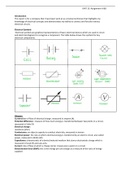
Electrical Symbols
Electrical symbols are graphical representations of basic electrical devices which are used in circuit
and electrical diagrams to recognise a component. The table below shows the symbols for key
electrical components.
Glossary
Current:Rate of flow of electrical charge, measured in ampere (A).
Potential difference: measure of how much energy is transferred between two points in a circuit,
measured in Volts (V)
Electrical charge:
resistance (ohm)
Conductance: an objects capacity to conduct electricity, measured in siemen
Electrical power: the rate at which electrical energy is transferred by an electric circuit, also called
power, measured in Watts (W).
Capacitance: characteristic of a device/material medium that stores electrostatic charge which is
measured in farad (F) and sub-units.
Current: rate of flow at which a charge carrier crosses pass a point on a circuit
Electromotive force (EMF): this is the energy per unit charge as a measure of the ratio of energy
supplied.
, UNIT 15: Assignment A &B
Conductance and resistance in relation to density of mobile charge carriers: Conductance is the
inverse of resistance: it measures how easily electric current flows through something. Conductance
is denoted by the letter "G" and is measured in mhos or Siemens. Conductance is equal to the
reciprocal of resistance in mathematics: G = 1/R.
Electrical Formulas and relationships
1. Energy supplied: W = VIt
Energy (E/W) = energy in joules, J
V =potential difference in volts, V
I = Current in Amperes, A
t = Time in seconds, s
Energy and power are related through an equation, this means that if the power of an device is
known, this also means that work done changed at any given time is able to be calculated through
the equation above.
1) Calculate the work done dissipated by a resistor if pd 7.5V is applied for 1.5 minutes through a
current of 0.17A.
Power: P=IV & P= I2R
The diagram of the circuit constructed on the left
shows the battery giving the charges potential energy.
Electrical energy in the bulb is transferred and radiated
through thermal energy. The battery supplied 7J of
energy every second meaning the power will also be
7W. The bulb takes energy at the same rate concluding
the power to also be 7Watts.
In more detail, Power = rate energy transferred. SI =
Watt.
Power = energy transferred / time taken
The power required for a component in a circuit can be
calculated by the potential difference across the circuit
and the current flowing through. The equation for this
is
P (Watts, W) = V (PD, V) X I (current- A)
As the current flows through a resistor, heat is given
out which causes electrons to lose potential energy
therefore it is known as thermal energy. This shows
that energy is lost in the resistor. To calculate the
energy lost we use the equation:
Power = current ^2 x resistance
Introduction
This report is for a company that I have been work at as a trainee technician that highlights my
knowledge of electrical concepts and demonstrates my ability to connect and function various
electrical circuits.
Electrical Symbols
Electrical symbols are graphical representations of basic electrical devices which are used in circuit
and electrical diagrams to recognise a component. The table below shows the symbols for key
electrical components.
Glossary
Current:Rate of flow of electrical charge, measured in ampere (A).
Potential difference: measure of how much energy is transferred between two points in a circuit,
measured in Volts (V)
Electrical charge:
resistance (ohm)
Conductance: an objects capacity to conduct electricity, measured in siemen
Electrical power: the rate at which electrical energy is transferred by an electric circuit, also called
power, measured in Watts (W).
Capacitance: characteristic of a device/material medium that stores electrostatic charge which is
measured in farad (F) and sub-units.
Current: rate of flow at which a charge carrier crosses pass a point on a circuit
Electromotive force (EMF): this is the energy per unit charge as a measure of the ratio of energy
supplied.
, UNIT 15: Assignment A &B
Conductance and resistance in relation to density of mobile charge carriers: Conductance is the
inverse of resistance: it measures how easily electric current flows through something. Conductance
is denoted by the letter "G" and is measured in mhos or Siemens. Conductance is equal to the
reciprocal of resistance in mathematics: G = 1/R.
Electrical Formulas and relationships
1. Energy supplied: W = VIt
Energy (E/W) = energy in joules, J
V =potential difference in volts, V
I = Current in Amperes, A
t = Time in seconds, s
Energy and power are related through an equation, this means that if the power of an device is
known, this also means that work done changed at any given time is able to be calculated through
the equation above.
1) Calculate the work done dissipated by a resistor if pd 7.5V is applied for 1.5 minutes through a
current of 0.17A.
Power: P=IV & P= I2R
The diagram of the circuit constructed on the left
shows the battery giving the charges potential energy.
Electrical energy in the bulb is transferred and radiated
through thermal energy. The battery supplied 7J of
energy every second meaning the power will also be
7W. The bulb takes energy at the same rate concluding
the power to also be 7Watts.
In more detail, Power = rate energy transferred. SI =
Watt.
Power = energy transferred / time taken
The power required for a component in a circuit can be
calculated by the potential difference across the circuit
and the current flowing through. The equation for this
is
P (Watts, W) = V (PD, V) X I (current- A)
As the current flows through a resistor, heat is given
out which causes electrons to lose potential energy
therefore it is known as thermal energy. This shows
that energy is lost in the resistor. To calculate the
energy lost we use the equation:
Power = current ^2 x resistance