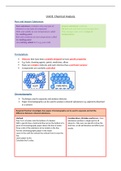
Unit 8: Chemical Analysis
Pure and Impure Substances
Pure substance: contains only one type of Impure substance: mixtures.
element or one type of compound. Do not melt and boil at one temperature
Melt and solidify at one temperature called They change state over a range of
the melting point temperatures
Boil and condense at one temperature called
the boiling point
Has nothing added to it e.g. pure milk
Formulations
Mixtures that have been carefully designed to have specific properties
E.g. fuels, cleaning agents, paints, medicines, alloys
Many are complex mixtures and each chemical has a particular purpose
Components are carefully controlled
ALLOY PURE METAL
Chromatography
Technique used to separate and analyse mixtures
Paper chromatography can be used to analyse coloured substances e.g. pigments dissolved
in a solvent
Required Practical: Investigate how paper chromatography can be used to separate and tell the
difference between coloured substances.
Method: Considerations, Mistakes and Errors:- Pure
Pour 1cm3 of water into the bottom of a beaker. substances produce a single spot in all
With a pencil draw a horizontal line across the bottom of a solvents.- Only ever use pencil to draw the
piece of chromatography paper above the line of water. start line, as ink will dissolve and affect your
Draw a dot of the substance to be tested on the line. results.
Put the chromatography paper in the water.
Leave in the until the solvent the solvent front is near the
top.
Leave paper to dry.
Calculate the Rf value.
, How does it work?
By separating out substances according to:
how soluble they are in a solvent
how attracted they are to the paper
Chromatography involves:
Mobile Phase:
When the dye is dissolved in the water on the surface of the paper (does move)
Stationery Phase:
When the dye molecules cling to the paper (doesn’t move)
A substance very soluble in the solvent and not very attracted to the paper, will spend a lot
of time in the mobile phase and move further up the paper.
A substance less soluble in the solvent and more attracted to the paper, will spend a lot less
time in the mobile phase and not move so far up the paper.
The Rf Value
Compares how far the pigment has travelled with how far the solvent has travelled.
Different components have different Rf values
Providing the same temperature and solvents are used, the R f value for a particular
component is constant and can be used to identify the component.
distance moved by substance
Rf=
distance moved by solvent
Maximum Rf value = 1 (substance travels as far as the solvent)
Minimum Rf value = 0 (substance doesn’t travel in the solvent at all)
Gas Tests
GAS PROPERTIES TEST FOR GAS
Hydrogen, H2 Colourless gas. Combines When mixed with air, burns with a
violently with oxygen when squeaky pop.
ignited.
Chlorine, Cl2 Green poisonous gas that Turns damp litmus paper white
bleaches dyes. (bleaches).
Oxygen, O2 Colourless gas that helps fuels Relights a glowing splint.
burn more readily than in air.
Carbon dioxide, CO2 Colourless gas. When bubbled through limewater it
turns the limewater cloudy.
Instrumental Methods
Standard laboratory equipment can be used to detect and identify elements and
compounds.
However, methods that involve using highly accurate instruments to analyse and identify
substances have been developed to perform this function more effectively.
Pure and Impure Substances
Pure substance: contains only one type of Impure substance: mixtures.
element or one type of compound. Do not melt and boil at one temperature
Melt and solidify at one temperature called They change state over a range of
the melting point temperatures
Boil and condense at one temperature called
the boiling point
Has nothing added to it e.g. pure milk
Formulations
Mixtures that have been carefully designed to have specific properties
E.g. fuels, cleaning agents, paints, medicines, alloys
Many are complex mixtures and each chemical has a particular purpose
Components are carefully controlled
ALLOY PURE METAL
Chromatography
Technique used to separate and analyse mixtures
Paper chromatography can be used to analyse coloured substances e.g. pigments dissolved
in a solvent
Required Practical: Investigate how paper chromatography can be used to separate and tell the
difference between coloured substances.
Method: Considerations, Mistakes and Errors:- Pure
Pour 1cm3 of water into the bottom of a beaker. substances produce a single spot in all
With a pencil draw a horizontal line across the bottom of a solvents.- Only ever use pencil to draw the
piece of chromatography paper above the line of water. start line, as ink will dissolve and affect your
Draw a dot of the substance to be tested on the line. results.
Put the chromatography paper in the water.
Leave in the until the solvent the solvent front is near the
top.
Leave paper to dry.
Calculate the Rf value.
, How does it work?
By separating out substances according to:
how soluble they are in a solvent
how attracted they are to the paper
Chromatography involves:
Mobile Phase:
When the dye is dissolved in the water on the surface of the paper (does move)
Stationery Phase:
When the dye molecules cling to the paper (doesn’t move)
A substance very soluble in the solvent and not very attracted to the paper, will spend a lot
of time in the mobile phase and move further up the paper.
A substance less soluble in the solvent and more attracted to the paper, will spend a lot less
time in the mobile phase and not move so far up the paper.
The Rf Value
Compares how far the pigment has travelled with how far the solvent has travelled.
Different components have different Rf values
Providing the same temperature and solvents are used, the R f value for a particular
component is constant and can be used to identify the component.
distance moved by substance
Rf=
distance moved by solvent
Maximum Rf value = 1 (substance travels as far as the solvent)
Minimum Rf value = 0 (substance doesn’t travel in the solvent at all)
Gas Tests
GAS PROPERTIES TEST FOR GAS
Hydrogen, H2 Colourless gas. Combines When mixed with air, burns with a
violently with oxygen when squeaky pop.
ignited.
Chlorine, Cl2 Green poisonous gas that Turns damp litmus paper white
bleaches dyes. (bleaches).
Oxygen, O2 Colourless gas that helps fuels Relights a glowing splint.
burn more readily than in air.
Carbon dioxide, CO2 Colourless gas. When bubbled through limewater it
turns the limewater cloudy.
Instrumental Methods
Standard laboratory equipment can be used to detect and identify elements and
compounds.
However, methods that involve using highly accurate instruments to analyse and identify
substances have been developed to perform this function more effectively.