Unit 4: Chemical Changes
Redox Reactions
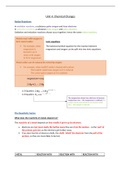
In oxidation reactions, a substance gains oxygen and loses electrons
In reduction reactions, a substance loses oxygen and gains electrons
Oxidation and reduction reactions always occur together, hence the name redox reactions.
Metals react with oxygen to
form metal oxides. Ionic equations
For example, when The balanced symbol equation for the reaction between
magnesium is magnesium and oxygen can be split into two ionic equations:
burned in air it
reacts with oxygen
to form magnesium
oxide.
Metal oxides can be reduced by removing oxygen.
The magnesium
gains
For oxygen in
example, whenthe lead(IV) oxide is heated with carbon:
reaction,
- The so it is
lead(IV) oxide loses oxygen so it is reduced
oxidised:
- The carbon gains oxygen so it is oxidised
-
magnesium+oxygen → magnesium oxide
-
2 Mg+O2 →2 MgO
−¿ ¿
- 1/2 Equation: 2 Mg →2 M g 2+¿+4 e ¿
2−¿¿
- 1/2 Equation: O 2 +4 e−¿→2 O ¿
The magnesium atoms lose electrons to become
magnesium ions – the magnesium is oxidised.The
oxygen atoms gain electrons to become oxide
ions – the oxygen is reduced.
The Reactivity Series
What does the reactivity of metals depend on?
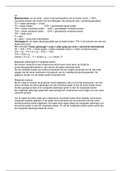
The reactivity of a metal depends on how readily it gives up its electrons.
Electrons are lost more easily the further away they are from the nucleus – as the ‘pull’ of
the protons gets less as the electrons get further away.
If an atom has lots of electron shells, the shells ‘shield’ the electrons from the pull of the
protons, so they are more likely to be lost.
METAL REACTION WITH REACTION WITH REACTION WITH
, Most
reactive
OXYGEN WATER ACIDS
potassium K
Reacts violently and gives
Sodium Na Reacts to produce a metal off H2(g)
Lithium Li hydroxide solution and
Burns to form an oxide gives off H2(g)
Calcium Ca
Magnesium Mg Reacts and gives off H2(g)
Aluminium Al
Carbon C
Zinc Zn
Iron Fe Forms oxide when heated Reacts slowly and gives off
No reaction
Tin Sn (metal powder burns) H2(g)
Lead Pb
Hydrogen H
Copper Cu Forms oxide when heated
Silver Ag
No reaction
Gold Au No reaction
Least Platinum Pt
reactive
Displacement Reactions
A more reactive metal displaces a less reactive metal from a solution of its salt.
Example:
Mg is more reactive than Cu, so Mg will displace Cu from a solution of CuSO 4:
magnesium+copper sulfate→ copper +magnesium sulfate
2−¿ ( aq) ¿
2+ ¿ SO ¿
4
2+¿ S O42−¿→Cu (s )+ M g ¿
¿
Mg ( s ) +C u
2+ ¿+Cu ¿
Ionic equation: Mg+ C u2+¿ → M g ¿
−¿ ¿
1/2 equation: Mg → M g2 +¿+2 e ¿
(lost two electrons and becomes positively charged)
−¿→Cu¿
2 +¿+2 e ¿
1/2 equation: C u (gained two electrons and has no overall charge)
- The sulphate ion is called a spectator ion, because it does not take part in the
reaction.
Extraction of Metals
This method depends on the reactivity of the metal.
- Unreactive metals (gold, platinum etc.) exist as elements at the Earth’s surface.
- Most metals are found as metal oxides, or as compounds that can be easily changed to
metal oxides.
- Metals more reactive than carbon (potassium, aluminium etc.) are extracted from molten
compounds by electrolysis.
- Metals less reactive than carbon (iron, lead etc.) can be extracted from their oxides by
heating with carbon:
iron oxide+carbon → iron+carbon dioxide
The iron oxide loses oxygen and is reduced. The carbon gains oxygen and is oxidised.
Redox Reactions
In oxidation reactions, a substance gains oxygen and loses electrons
In reduction reactions, a substance loses oxygen and gains electrons
Oxidation and reduction reactions always occur together, hence the name redox reactions.
Metals react with oxygen to
form metal oxides. Ionic equations
For example, when The balanced symbol equation for the reaction between
magnesium is magnesium and oxygen can be split into two ionic equations:
burned in air it
reacts with oxygen
to form magnesium
oxide.
Metal oxides can be reduced by removing oxygen.
The magnesium
gains
For oxygen in
example, whenthe lead(IV) oxide is heated with carbon:
reaction,
- The so it is
lead(IV) oxide loses oxygen so it is reduced
oxidised:
- The carbon gains oxygen so it is oxidised
-
magnesium+oxygen → magnesium oxide
-
2 Mg+O2 →2 MgO
−¿ ¿
- 1/2 Equation: 2 Mg →2 M g 2+¿+4 e ¿
2−¿¿
- 1/2 Equation: O 2 +4 e−¿→2 O ¿
The magnesium atoms lose electrons to become
magnesium ions – the magnesium is oxidised.The
oxygen atoms gain electrons to become oxide
ions – the oxygen is reduced.
The Reactivity Series
What does the reactivity of metals depend on?
The reactivity of a metal depends on how readily it gives up its electrons.
Electrons are lost more easily the further away they are from the nucleus – as the ‘pull’ of
the protons gets less as the electrons get further away.
If an atom has lots of electron shells, the shells ‘shield’ the electrons from the pull of the
protons, so they are more likely to be lost.
METAL REACTION WITH REACTION WITH REACTION WITH
, Most
reactive
OXYGEN WATER ACIDS
potassium K
Reacts violently and gives
Sodium Na Reacts to produce a metal off H2(g)
Lithium Li hydroxide solution and
Burns to form an oxide gives off H2(g)
Calcium Ca
Magnesium Mg Reacts and gives off H2(g)
Aluminium Al
Carbon C
Zinc Zn
Iron Fe Forms oxide when heated Reacts slowly and gives off
No reaction
Tin Sn (metal powder burns) H2(g)
Lead Pb
Hydrogen H
Copper Cu Forms oxide when heated
Silver Ag
No reaction
Gold Au No reaction
Least Platinum Pt
reactive
Displacement Reactions
A more reactive metal displaces a less reactive metal from a solution of its salt.
Example:
Mg is more reactive than Cu, so Mg will displace Cu from a solution of CuSO 4:
magnesium+copper sulfate→ copper +magnesium sulfate
2−¿ ( aq) ¿
2+ ¿ SO ¿
4
2+¿ S O42−¿→Cu (s )+ M g ¿
¿
Mg ( s ) +C u
2+ ¿+Cu ¿
Ionic equation: Mg+ C u2+¿ → M g ¿
−¿ ¿
1/2 equation: Mg → M g2 +¿+2 e ¿
(lost two electrons and becomes positively charged)
−¿→Cu¿
2 +¿+2 e ¿
1/2 equation: C u (gained two electrons and has no overall charge)
- The sulphate ion is called a spectator ion, because it does not take part in the
reaction.
Extraction of Metals
This method depends on the reactivity of the metal.
- Unreactive metals (gold, platinum etc.) exist as elements at the Earth’s surface.
- Most metals are found as metal oxides, or as compounds that can be easily changed to
metal oxides.
- Metals more reactive than carbon (potassium, aluminium etc.) are extracted from molten
compounds by electrolysis.
- Metals less reactive than carbon (iron, lead etc.) can be extracted from their oxides by
heating with carbon:
iron oxide+carbon → iron+carbon dioxide
The iron oxide loses oxygen and is reduced. The carbon gains oxygen and is oxidised.