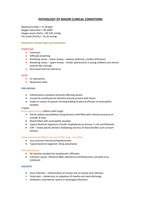
PATHOLOGY OF MAJOR CLINICAL CONDITIONS
Respiratory Rate = 12-20 bpm
Oxygen Saturation = 96-100%
Oxygen levels (PaO2) = 80-105 mmHg
CO2 levels (PaCO2) = 35-45 mmHg
Respiratory Disease Signs and Symptoms
SYMPTOMS
Confusion
Difficulty breathing
Breathing noises – lower airway – wheeze (asthma), crackles (infection).
Breathing noises – upper airway – stridor (particularly in young children) and stertor
(sounds like snoring).
Decreased exercise tolerance.
SIGNS
O2 Saturations
Respiratory Rate
PNEUMONIA
Inflammatory condition primarily affecting alveoli.
Caused by viral/bacterial infection (should present with fever).
Leads to culture of sputum forming leading to pleural effusion of neutrophilic
exudate.
3 types:
Bronchopneumonia (affects both lungs)
Patchy yellow consolidation (lung become solid filled with infective process) on
outside of lung.
Alveoli filled with neutrophilic exudate.
Typical bacterial organisms include: Staphylococcus Aureus, E.coli and Klebsiella.
CXR – shows patchy (whiter) shadowing and loss of sharp borders such as heart
borders.
Lobar pneumonia (affects one part of the lung – one lobe)
Less common than bronchopneumonia.
Typical bacterial organism: Strep pneumonia
Viral pneumonia
No alveolar exudate but lymphocytic infiltrates.
Common causes: influenza A&B, adenovirus and Respiratory syncytial virus
(children).
SINUSITIS
Sinus infection – inflammation of sinuses due to mainly viral infection.
Facial pain – tenderness on palpation of maxilla and nasal discharge.
Antibiotics reserved for severe or prolonged infections.
Respiratory Rate = 12-20 bpm
Oxygen Saturation = 96-100%
Oxygen levels (PaO2) = 80-105 mmHg
CO2 levels (PaCO2) = 35-45 mmHg
Respiratory Disease Signs and Symptoms
SYMPTOMS
Confusion
Difficulty breathing
Breathing noises – lower airway – wheeze (asthma), crackles (infection).
Breathing noises – upper airway – stridor (particularly in young children) and stertor
(sounds like snoring).
Decreased exercise tolerance.
SIGNS
O2 Saturations
Respiratory Rate
PNEUMONIA
Inflammatory condition primarily affecting alveoli.
Caused by viral/bacterial infection (should present with fever).
Leads to culture of sputum forming leading to pleural effusion of neutrophilic
exudate.
3 types:
Bronchopneumonia (affects both lungs)
Patchy yellow consolidation (lung become solid filled with infective process) on
outside of lung.
Alveoli filled with neutrophilic exudate.
Typical bacterial organisms include: Staphylococcus Aureus, E.coli and Klebsiella.
CXR – shows patchy (whiter) shadowing and loss of sharp borders such as heart
borders.
Lobar pneumonia (affects one part of the lung – one lobe)
Less common than bronchopneumonia.
Typical bacterial organism: Strep pneumonia
Viral pneumonia
No alveolar exudate but lymphocytic infiltrates.
Common causes: influenza A&B, adenovirus and Respiratory syncytial virus
(children).
SINUSITIS
Sinus infection – inflammation of sinuses due to mainly viral infection.
Facial pain – tenderness on palpation of maxilla and nasal discharge.
Antibiotics reserved for severe or prolonged infections.